








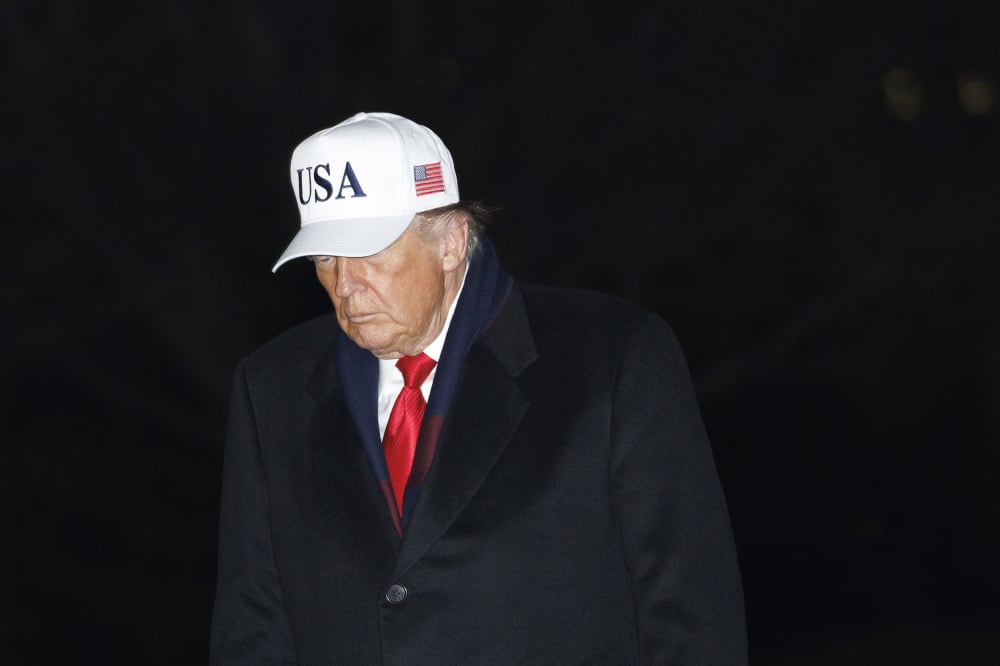
President Donald Trump arrived back at the White House in January full of promises: He would end wars and make peace, curtail diversity, equity and inclusion efforts and to make the economy “great again.”
Nearly a year into his first term, some of his pledges remain unfulfilled, while others have advanced — though not always as advertised.
Here are key promises that Trump campaigned on, accompanied by assessments of how far he has (or has not) come in accomplishing them.
End Russia’s war in Ukraine within 24 hours
Trump pledged dozens of times that he could end Russia’s war on Ukraine “within 24 hours” of taking office. But 11 months into his second term, that war rages on.
When a reporter confronted him in June about that timeline, Trump claimed he was being “sarcastic” and conceded, “it’s more difficult than people would have any idea.”
Last month, the president proposed a peace plan that would require Ukraine to cede territory and forgo joining NATO.
On Dec. 28, Trump met with Ukrainian President Volodymyr Zelenskyy at his Mar-a-Lago resort to attempt to iron out a deal, but it remains elusive, with some details yet to be finalized.
“I do think we’re getting a lot closer, maybe very close,” Trump said afterward.
End the weaponization of the Justice Department
“Never again will the immense power of the state be weaponized to persecute political opponents — something I know something about,” Trump said in January during his inaugural address. “We will not allow that to happen.”
Yet his administration has done exactly that. The Trump Justice Department has sought to prosecute high-profile critics of the president, including former FBI Director James Comey and New York Attorney General Letitia James — the latter of which White House chief of staff Susie Wiles conceded to Vanity Fair “might be retribution.”
Trump also issued blanket pardons to more than 1,000 people who stormed the Capitol on Jan. 6, 2021 — including some who violently assaulted police officers — in an effort to overthrow the results of the 2020 election, which Trump lost.
Generate wealth for average Americans through tariffs
Trump has called “tariff” his favorite word in the English language and repeatedly predicted the levies would enrich Americans.
“Instead of taxing our citizens to enrich other countries, we will tariff and tax foreign countries to enrich our citizens,” he said in his Inauguration speech.
Since Trump announced sweeping tariffs in April, the reality has been more complicated. While the Trump administration has estimated that the new tariffs have brought in an additional $200 billion in revenue this year, they are ultimately paid by U.S. importers and consumers. A Yale Budget Lab analysis estimated that tariffs will cost the average U.S. household $1,700 a year. They’ve also contributed to the stubbornly high inflation rate, which has gone up since the tariffs were unveiled in April. And consumer confidence has declined for five consecutive months, with tariffs cited as a leading reason for that pessimism.
End federal recognition of transgender Americans
“As of today, it will henceforth be the official policy of the United States government that there are only two genders: male and female,” Trump said in his inauguration speech.
Trump moved swiftly to reshape federal policy on gender identity, effectively erasing transgender and nonbinary people from existence. On his first day in office, he signed an executive order stating the government would only recognize biological sex rather than gender identity. In subsequent orders, he sought to ban transgender troops from the military, block gender-affirming care for minors and pledged to revoke federal funding for schools that support what the administration calls “gender ideology” or the social transitioning of transgender kids. And in December, top federal health officials announced a slate of actions aimed at eradicating gender-affirming care for trans youth.
Each of those actions has attracted legal challenges from advocates for transgender Americans.
“Trans, nonbinary and intersex people are living proudly all across the country, and there is nothing that Donald Trump can do to change that,” Rodrigo Heng-Lehtinen, executive director of Advocates for Trans Equality, said in a statement after Trump’s first day in office.
Trump has targeted diversity, equity and inclusion initiatives, framing such programs as discriminatory against white people and men. Within 48 hours of taking office, the president issued a pair of executive orders decreeing that DEI initiatives violate federal civil rights law, demanding all federal agencies eliminate DEI programs and encouraging the private sector to do the same. Trump’s crusade against DEI seems to be effective. One in five companies surveyed by Resume.org, a CV-development platform, reported eliminating their DEI programs between Trump’s November 2024 re-election and July 2025. And a variety of tech companies whose CEOs have ingratiated themselves to Trump — including Amazon, Google, and Meta — have reportedly eliminated their DEI programs since Trump resumed office. Trump pledged during the 2024 campaign to make in vitro fertilization free. “We are going to be, under the Trump administration, we are going to be paying for that treatment,” Trump told NBC News on the campaign trail last year. “We’re going to be mandating that the insurance company pay.” What he has delivered is significantly more modest. About a month into his second term, Trump signed an executive order demanding a list of recommendations on how to protect IVF access and reduce the cost of treatments, which can cost $15,000 – $20,000, federal data has shown. In October, Trump announced both a cost-cutting deal on a critical IVF drug and a voluntary fertility benefit that employers could provide. More recently, Trump also signed the defense bill into law — without a provision mandating insurance coverage for IVF for active duty service members and their dependents, after House Speaker Mike Johnson, R-La., stripped it from the legislation, as MS NOW first reported. True to Project 2025’s proposal, Trump in March signed an executive order that called for facilitating the closure of the Department of Education. (Actually doing so would, like many of Trump’s unilateral actions, require an act of Congress.) “We’re going to be returning education, very simply, back to the states where it belongs,” Trump said when he signed the order. “Instead of filtering resources through layers of federal red tape, we will empower states to take charge and advocate for and implement what is best for students, families, and educators in their communities,” Secretary of Education Linda McMahon said in a statement at the time. Nine months later, the Education Department still exists, though significantly reduced. Nearly half of its 4,100-person workforce was eliminated in March. In October, hundreds more department employees who worked on special education and civil rights compliance were laid off. Last month, the agency announced that it was passing some of its biggest grant programs off to six other federal agencies. On the campaign trail last year, Trump pledged to “begin the largest deportation operation” in U.S. history on his first day in office, and said his administration would focus on deporting “the worst of the worst.” So far, the Trump administration has lived up to the first part of that promise. In a December news release, the Department of Homeland Security said the Trump administration enacted more than 622,000 deportations and that an estimated 1.9 million people chose to self-deport. That is far more than both former presidents Barack Obama and Joe Biden deported in their first years in office.
Julianne McShane is a breaking news reporter for MS NOW. Recommended


Eliminate diversity, equity and inclusion initiatives
Expand IVF access
Abolish the Department of Education
Enact the largest deportation operation in U.S. history
But the administration’s deportation dragnet has not been limited to “the worst of the worst,” contrary to Trump’s claims. Nonpublic ICE data obtained by the Cato Institute, a libertarian think tank, in June showed that the majority of people detained by Immigration and Customs Enforcement had no criminal convictions.
