
It’s been about a week since Donald Trump downplayed the importance of American troops with traumatic brain injuries — the latest in a series of slights toward members of the armed services — which generated a fair amount of attention. What received less coverage, however, is what the former president said in the next sentence.
“So, just so you understand, there was nobody ever tougher on Iraq,” the Republican said, referring to Iran. “They had no money with me, they would have made any deal with me. I would have had a deal made within — literally, I would have had a deal made within one week after the election.”
He’s been saying this quite a bit lately. A few weeks ago, during a rambling press conference, Trump said that he was prepared to reach an agreement with Iran “within one week after the election” if he’d won in 2020. And during his latest interview with conservative host Hugh Hewitt, the GOP candidate said it again.
“I would have had a deal a long time ago,” the former president claimed, adding, in reference to Iranian officials, “They were totally busted. They were ready to make a deal. They would have made a deal.”
Trump: I would have made a nuclear deal with Iran
— Kamala HQ (@KamalaHQ) October 7, 2024
(Trump pulled out of the Iran nuclear deal) pic.twitter.com/NGK09lJHtG
Trump might not remember his presidency as well as he should.
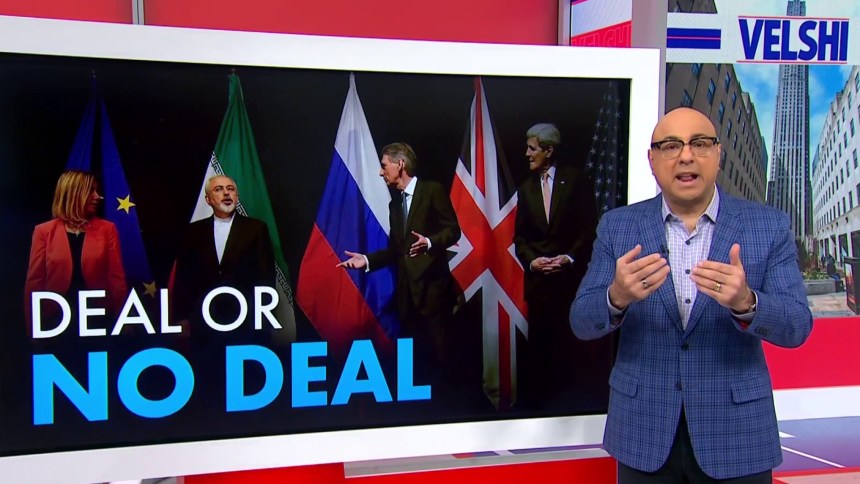
Iran had already made a deal with the United States — in Barack Obama’s second term. It was the Joint Comprehensive Plan of Action (JCPOA), and it came to be known as the Iran nuclear deal.
As regular readers know, the international agreement with Iran did exactly what it set out to do: The policy dramatically curtailed Tehran’s nuclear ambitions and established a rigorous system of monitoring and verification. Once the policy took effect, each of the parties agreed that the participants were holding up their end of the bargain, and Iran’s nuclear program was, at the time, on indefinite hold.
And then Trump took office and abandoned the policy for reasons he was never able to explain.
In broad strokes, Obama set out to use economic sanctions to get Iran to the international negotiating table. That worked and a breakthrough agreement eventually followed. Trump came to believe he could duplicate the strategy by abandoning the policy, restoring the old sanctions and adding new ones.
This was known as the Republican’s “maximum pressure” campaign, and it was pursued with the assumption that Tehran would inevitably return to the negotiating table. If Obama’s sanctions led to a landmark deal, the argument went, then maybe Trump’s sanctions could produce an even better deal.
That didn’t happen. Trump’s approach failed.
In fact, once the U.S. was no longer a part of the agreement, the West lost verification access to Tehran’s program; and Iran, rather than begging the White House for attention, almost immediately became more dangerous by starting up advanced centrifuges and ending its commitment to limit enrichment of uranium.
A couple of years ago, Robert Malley, the then-special envoy for Iran, told the Senate Foreign Relations Committee that after Trump’s decision, Iranian attacks on U.S. personnel in the region got worse, Iranian support for regional proxies got worse, and the pace of the Iranians’ nuclear research program got “much worse.” A year later, Colin Kahl, the then-under secretary of Defense, explained to the House Armed Services Committee that Iran’s nuclear progress since Trump abandoned the international nuclear agreement has been “remarkable.” Around the same time, the Pentagon told Congress that Iran could make enough fissile for one nuclear bomb in “about 12 days” — a number that is now smaller — as opposed to the year it would’ve taken while the 2015 Iran nuclear deal was in effect. How Trump arrived at his decision adds insult to injury. One of my favorite stories about the Iran deal came a few months into Trump’s term in the White House, when the then-president held a lengthy meeting with top members of his team: Secretary of State Rex Tillerson, Defense Secretary James Mattis, White House National Security Adviser H. R. McMaster, and Chairman of the Joint Chiefs of Staff Gen. Joseph Dunford. Each of the officials told Trump the same thing: It was in the U.S.’ interest to preserve the JCPOA policy that existed at the time. The Republican expected his team to tell him how to get out of the international agreement, not how to stick with it. When his own foreign policy and national security advisers told him the policy was working, Trump “had a bit of a meltdown.” Soon after, he abandoned the JCPOA anyway, not because it was failing, but because Trump was indifferent to its success. All Trump had to do was nothing. He could’ve simply left the policy alone and allowed it to keep working. He instead did the opposite. The Republican was convinced his strategy would work — he even boasted at one point during his term that he was prepared to be Iran’s “best friend” — but the entire gambit backfired and left the world less safe. The GOP candidate now expects people to believe he was this close to succeeding. It’s a fantasy, intended to obscure his costly failure. This post updates our related earlier coverage.
Steve Benen is a producer for "The Rachel Maddow Show," the editor of MaddowBlog and an MS NOW political contributor. He's also the bestselling author of "Ministry of Truth: Democracy, Reality, and the Republicans' War on the Recent Past."
Latest Post
Recommended