









Amid the flurry of names being tapped to join President-elect Donald Trump’s incoming administration, I’ve been dreading one in particular: Russell Vought. He is the president-elect’s choice to again become the director of the White House Office of Management and Budget. Normally obscured from the limelight, it’s a crucial role in coordinating how the executive branch functions on a day-to-day basis.
Vought served as deputy OMB director for most of Trump’s term and as director in its final year. The Government Accountability Office determined while Vought was there that OMB violated federal law by following Trump’s orders to withhold money Congress had appropriated. I would be shocked if Vought’s return to the Eisenhower Executive Office Building doesn’t coincide with a renewed string of similar accusations of lawbreaking to the detriment of Americans.
All signs point to Vought urging Trump to act unilaterally in pursuing the devastating budget cuts that Congress has long refused to implement.
Since he left the White House in 2021, Vought has been a radical voice in the ear of MAGA Republicans in Congress, urging their most destructive tendencies. The Washington Post reported in February 2023 that the think tank Vought runs, the Center for Renewing America, encouraged the GOP to take a chainsaw to the budget by advocating for “$2 trillion in cuts to Medicaid, the health program for the poor; more than $600 billion in cuts to the Affordable Care Act; more than $400 billion in cuts to food stamps; hundreds of billions of dollars in cuts to educational subsidies; and a halving of the State Department and the Labor Department, among other federal agencies.” Combined with his role in helping prepare to transform the Heritage Foundation’s Project 2025 into a reality, his likely return to OMB is deeply troubling.
All signs point to Vought urging Trump to act unilaterally in pursuing the devastating budget cuts that Congress has long refused to implement. He recently told former Fox News host Tucker Carson that he’d use a renewed role at OMB to “tame the administrative state.” Vought’s position reflects the Project 2025 chapter he wrote, wherein he outlined how OMB could be used to centralize unchecked executive power in the White House.
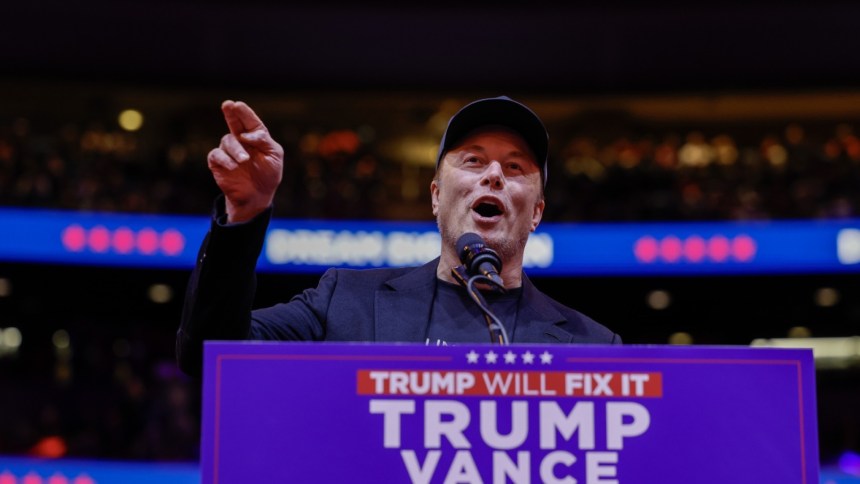
Vought also told Carson that he’d work with the blue-ribbon commission, known as the “Department” of Government Efficiency, that business bros Elon Musk and Vivek Ramaswamy are poised to lead. Only Congress has the power of the purse under the Constitution; lawmakers decide how much money to raise via taxes and to spend on federal programs. But with Vought at OMB, he’d likely try to enact Musk and Ramaswamy’s recommendations whether lawmakers agree or not. After all, in a Wednesday op-ed in The Wall Street Journal, the billionaires lay out their intent to “focus particularly on driving change through executive action based on existing legislation rather than by passing new laws.”
Trump could theoretically order Vought to simply not spend the money appropriated to whatever agencies or programs he wanted choked off.
Their stated goals include slashing scores of government regulations, cutting a commensurate number of federal jobs and refusing to spend billions of dollars that Congress has decided to spend. And by using a process known as “impoundment,” Trump could theoretically order Vought to simply not spend the money appropriated to whatever agencies or programs he wanted choked off.
It was a favorite trick of President Richard Nixon, who refused to spend funds on domestic programs that the Democratic-controlled Congress had passed. After his resignation, Congress passed the Impoundment Control Act to formally limit the White House’s ability to determine which appropriations to use. In 2019, Vought and his then-boss, OMB Director and acting chief of staff Mick Mulvaney, violated that law by following Trump’s orders to withhold millions of dollars in military aid for Ukraine. (Trump wanted to pressure Ukraine to give him dirt on Joe Biden ahead of the 2020 election; he was impeached for those efforts but was acquitted in his Senate trial.)
The Supreme Court has never had to weigh in on the Impoundment Control Act’s limits on the president. But William Rehnquist, then an assistant attorney general under Nixon at the Office of Legal Counsel, didn’t agree with Nixon that impoundment is constitutional. The future conservative chief justice wrote as much in a memo to OMB, and later told Congress the same in testimony, though he did carve out potential exceptions for the president’s “authority as Commander-in-Chief of the Armed Forces and his authority over foreign affairs.”
Vought would agree with that assessment, based on his willingness to impede the delivery of funds to Ukraine under Trump. And it seems likely that at least two of Rehnquist’s intellectual successors, Justices Samuel Alito and Clarence Thomas, would want to expand the president’s authority in this regard. Whether Chief Justice John Roberts, who clerked under Rehnquist, would want to as well is an open question. Vought seems determined to force Roberts to answer. A policy brief published in September on the Center for Renewing America’s website argued that the Impoundment Control Act itself is a violation of Article II of the U.S. Constitution. That argument is unsurprising given the dedication to the “unitary executive” theory that Vought and the other former Trump administration lackeys at the think tank espouse. But there’s a chance that the justices agree, toppling the Impoundment Control Act despite its role as a pillar supporting the separation of powers. If that’s the case, then the power of the purse would be flipped on its head. Congressional appropriations would no longer be the amount the president must spend but the maximum a president could spend. It would essentially cut a hole underneath the budget and erase millions of dollars in funding. Vought being reinstalled at OMB would expose as lies the Trump campaign’s denials that Project 2025 would be the administration’s blueprint. But his appointment would also give him the keys to singlehandedly control the country’s spending. It won’t matter that there’s no law allowing Vought to play the role of the king’s treasurer, at least not if members of Congress remain asleep to the reality that it’s their power he wants to steal.
Hayes Brown is a writer and editor for MS NOW Daily. 

