








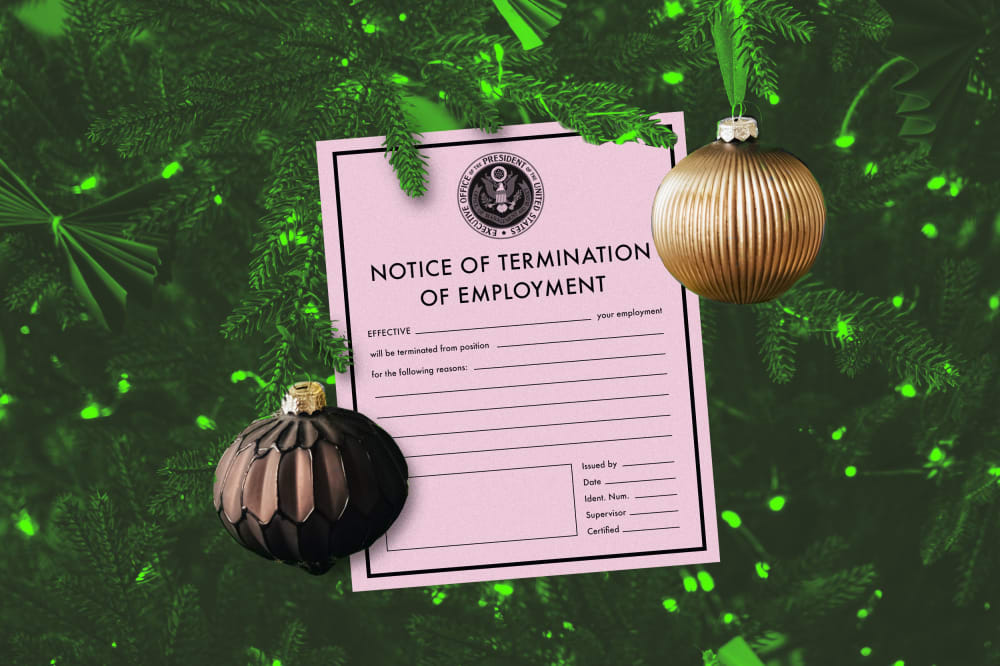
Holiday cheer is in short supply this season for federal workers.
The Trump administration is poised to overhaul regulations to make it easier to terminate more career civil servants, on top of the hundreds of thousands who have already been fired, taken buyouts or voluntarily quit.
And the threat of yet another government shutdown early in the new year — carrying the risk of fresh layoffs — isn’t making spirits brighter.
“There is fear in the air. We are walking on eggshells everywhere,” an employee at the Centers for Disease Control and Prevention said.
Another worker, at NASA, added, “There’s no stability at all anymore. And the thing about it is, I don’t know that there ever will be again.”
The CDC and NASA workers, along with three other current federal employees, were granted anonymity to air their concerns and experiences freely in interviews with MS NOW without fear of retribution.
Nonpolitical government workers who have evaded slashes by the so-called Department of Government Efficiency and weathered the longest government shutdown in U.S. history are now concerned they may be laid off or fired after Jan. 30, when the temporary funding fix — and its accompanying job protections — is set to expire.

Legislation to keep the government afloat for two months included language that revoked more than 4,000 layoffs issued by the Trump administration during the shutdown, according to court filings. It also prohibited federal agencies from terminating more employees until after the short-term funding runs out.
After that, it may be open season again for the administration.
Trump’s Office of Personnel Management plans to reclassify tens of thousands of career civil jobs as “at-will” positions to increase “accountability to the president.” Additionally, Trump officials reportedly are finalizing a new regulatory framework to prioritize performance over tenure.
“It doesn’t even matter that there were laws that protected us,” the NASA worker said. “They’ve all been thrown out the window.”
The extraordinary occupational insecurity gripping the federal workforce was foreshadowed by Office of Management and Budget Director Russell Vought, a key architect of Project 2025, the ultraconservative government blueprint from which Trump initially distanced himself, but that mirrors many of his second-term policies.
In videos unearthed by ProPublica last year, Vought called civil employees “villains” and boasted that he wanted “the bureaucrats to be traumatically affected.” In a 2023 speech, he said, “We want to put them in trauma.”

Vought’s wish has come true, judging by the current prevailing mood almost a year after Donald Trump was sworn in as president for a second time.
Denys Lau, former director of the health care statistics division at the CDC, said Vought “lacks total empathy.” Lau, who joined the agency in 2013, resigned in June.
“At the CDC, I felt I was part of a larger organization dedicated to the mission to protect people’s lives and promote their well-being,” Lau said. “Public health is my chosen career, and I was doing exactly that at the CDC.” He’s now editor-in-chief of the American Journal of Public Health, whose parent association is leading litigation efforts against Trump administration policies that threaten public health, including those related to disease-fighting vaccines.
Neither the White House nor the OMB responded to requests for comment on the concerns expressed by federal employees or the extent to which Vought and others plan to further slash the size of the federal workforce. The OPM gave no timeline for its plan to reclassify scores of jobs as “at-will” positions and did not respond to questions about other potential mass reductions.
Trump embraced Vought’s slash-and-burn tactics in an Oct. 2 post on his social media platform, referring to his OMB director as “he of PROJECT 2025 fame” and boasting that the shutdown presented an “unprecedented opportunity” to shrink the federal bureaucracy. On the same day, the president posted a video generated by artificial intelligence that depicted Vought as the grim reaper.

Federal judges across the country have ruled that mass layoffs of federal workers during the 43-day shutdown were illegal. The administration has repeatedly appealed those lower-court rulings to the Supreme Court, often successfully, this year. And the court’s conservative majority appears poised to hand Trump a significant win on his power over federal agencies.
Meanwhile, if Congress and the president are unable to strike a deal by Jan. 30 on the remaining nine appropriations bills needed to fund federal agencies and programs for the rest of fiscal year 2026, the government will partially shut down — and job protections for federal workers will expire.
“Our future is very unstable and uncertain,” a second CDC employee said. “I feel like it’s likely to happen, and so I’m only planning through the end of January. In my mind, nothing else happens after that.”
Once coveted for their stability and lifetime benefits that include pensions, federal employees say their jobs have become anything but steady.
“The fact that we had our OMB director make threats to traumatize federal employees has changed that. So many things have changed that since this administration came on board,” said Yolanda Jacobs, president of Local 2883 of the American Federation of Government Employees, the largest union representing federal workers. Jacobs said many members of her union chose to skip Thanksgiving and will forgo the upcoming holidays because of their financial uncertainty. “All of these actions that the Trump administration has done reduces the productivity of the federal workforce.” Experts say the upheaval caused by Trump, Elon Musk (who led the DOGE effort), Vought and other Project 2025 planners serving the president has created more anxiety than efficiency in the bureaucracy. Perhaps, they say, by design. “All of these actions that the Trump administration has done reduces the productivity of the federal workforce, which of course I think plays into his arguments that the federal workforce is not effective and is not productive,” said Wendy Edelberg, a Brookings Institution senior fellow who served in the George W. Bush and Obama administrations. Furthermore, the reductions have resulted in a lack of experience in critical technological and scientific sectors. The NASA employee interviewed by MS NOW said the agency has lost 20% of its workforce, many of whom held senior positions, through deferred resignation programs. “You don’t land people on the moon successfully or on Mars successfully without people that have already done it. There’s a lot of trial and error in getting it right,” the worker said. Gutting the federal civil service and giving political appointees more power was a core tenet of Project 2025, which took special aim at career senior executives and their “lack of responsiveness to political leadership.” The reductions in force, or RIFs — bureaucratic parlance for layoffs — were ultimately reversed last month as part of the deal to end the shutdown. But, along with a slew of layoffs in the first few months of Trump’s presidency, they have led many federal workers to no longer trust their employer. “Would I suggest federal service for anyone else? No, absolutely not. Never again,” an employee with the National Oceanic and Atmospheric Administration said. Someone who works at the Consumer Financial Protection Bureau described agencywide concerns about RIFs, saying, “The fear — or that anxiety about that — is there.” The number of federal employees who have been fired, offered buyouts or voluntarily left their jobs since the start of Trump’s second term will amount to approximately 317,000 by Dec. 31, according to the OPM. The rapid reduction has the remaining government workforce on edge. “When I leave, I won’t come back,” the NOAA employee said. “I will absolutely tell you that I don’t care what administration comes in, because it’s just not worth it. It’s simply not worth it.” Edelberg, a former economist at the Federal Reserve Board and former senior economist at the Office of Economic Advisers under both Bush and Obama, understands why. “I think the damage to the federal workforce has been done,” she told MS NOW.
Emily Hung is an associate White House producer for MS NOW. Recommended


