








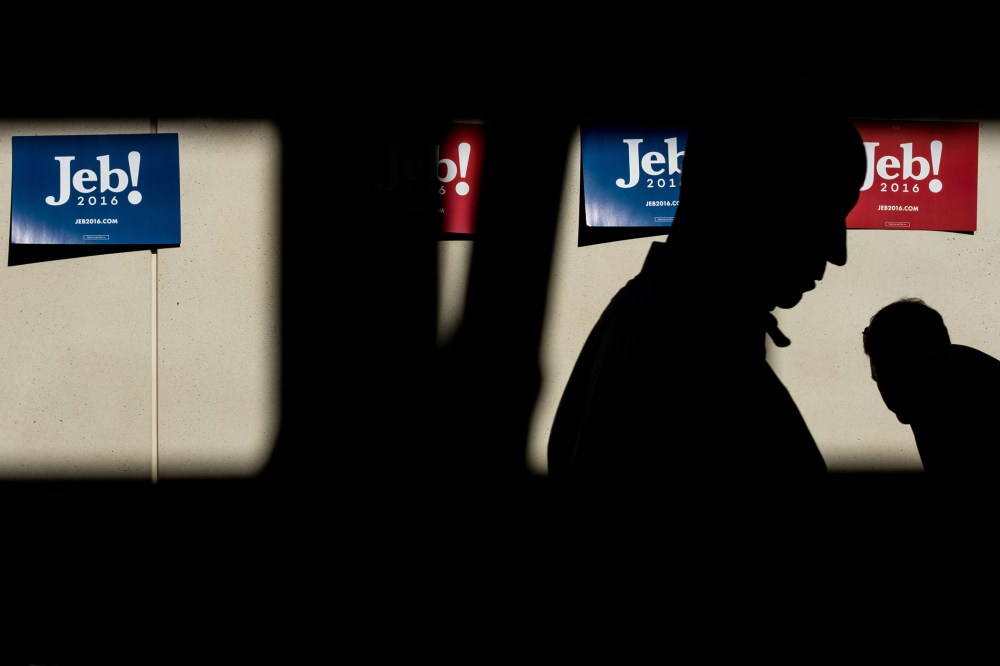
Jeb Bush did a lot of things wrong on the campaign trail. One thing he did right, though, was raise money — lots and lots of money.
Pro-Bush super PAC Right to Rise spent almost $81 million on TV ads extolling Bush and attacking his rivals, and the campaign and its allies spent $130 million overall in the race. All of that spending netted him four delegates out of the 1,237 needed to win the nomination, or roughly $32.5 million per delegate.
Bush’s failure to turn dollars into votes is creating something of a mini-PR crisis for campaign finance watchdogs warning that the flood of dollars released by the Supreme Court’s 2010 Citizens United decision is corroding democracy.
RELATED: Seven moments that explain why Jeb Bush’s plan failed
Critics of their reforms are seizing on Bush’s nine-figure implosion, as well as less pricey disasters from other candidates, as evidence that money in politics is an exaggerated threat.
“Bush’s failed campaign and Scott Walker’s and Chris Christie’s — I could go on — all indicate how overblown the complaints are about Citizens United,” Floyd Abrams, an attorney and commentator who’s defended Citizens United on free speech grounds, told MSNBC in an email.
“Has there ever been a better example than Jeb Bush of the fact that voters decide the outcome of elections, not money?” David Keating, president of the Center for Competitive Politics, said in a statement.
“Jeb has given us all one more lesson proving that these sermons about money buying elections are bunk,” Jonathan S. Tobin wrote in Commentary after Bush dropped out.
This week “Meet The Press” host Chuck Todd asked Democratic candidate Bernie Sanders, who has renounced super PAC spending and made overturning Citizens United a major focus of his campaign, whether the Bush disaster undermined his message.

“If you look at Jeb Bush’s campaign, it’s more than just money,” Sanders said. “It’s the nature of the candidate and the message and all that stuff.”
He cited Hillary Clinton’s support from “Wall Street and very wealthy individuals” via super PACs as evidence that the issue was still relevant.
Sanders isn’t the only one dealing with the fallout. Campaign finance reform activists are making an effort to get ahead of the inevitable wave of skepticism that comes with Bush’s exit from the race.
“It’s one of those myths that comes from a very high profile fail,” David Donnelly, CEO of progressive advocacy organization Every Voice, echoed to MSNBC. “Money can’t buy Jeb love or the presidency, but that’s because he was a flawed candidate for this moment.”
Donnelly, whose group issued a memo in response to Bush’s defeat, said the main impact of Right to Rise’s spending was that it gave him a guaranteed place in the conversation, while candidates like Mike Huckabee on the Republican side and Martin O’Malley on the Democratic side were left out. He noted that campaign survivors like Senators Marco Rubio and Ted Cruz benefited from tens of millions of dollars in outside support.
Other reformers argue that putting the emphasis on presidential election results in the first place misses the point.
“The crass liberal refrain that money buys elections is counterproductive and wrong and the focus on corruption is wrong,” Rick Hasen, author of Plutocrats United: Campaign Money, the Supreme Court, and the Distortion of American Elections, told MSNBC in an interview
RELATED: Jeb Bush leaves behind a party he can barely recognize
The damage from big donors isn’t that they single-handedly flip votes, Hasen argues, it’s that they monopolize candidates’ focus and influence their platform at the expense of ordinary citizens.
The effects are felt less on the presidential level, where voters follow the broader election beyond ads and lawn signs, and more the policy level, on which legislators are easier prey to donor influence on obscure issues. The most emblematic cases of money influencing politicians aren’t negative ads campaigns, but casino and hotel lobbyists convincing leaders to slip a 54-word loophole into a 2,000 page spending bill that saves them $1 billion in taxes.
To the extent voters themselves are likely to be swayed by pricey ad campaigns, the bigger opportunities are at the state and local level. “The presidential race is where we least expect the money to be dispositive, because there’s so much money there overall,” he said. “Spend that money on a New York assembly race or an L.A. city council race and you can have a very large effect on an election outcome.” Harvard professor Lawrence Lessig, who ran for the 2016 Democratic nomination advocating public financing of elections, also downplayed the effect money had on raw vote counts. “The corruption is not in the spending, its not that [voters] are corrupted by the money,” Lessig said. “The corruption is in the raising of the money.” In Lessig’s eyes, the primary problem is that candidates are stuck spending so much of their time raising money from elite donors that it’s impossible for them not to internalize their views more than they would the average voter. Lessig is much more concerned with money’s impact on Congress, but there are examples on the presidential stage as well. Most of the top Republican contenders strongly support raising the retirement age for Social Security, for example, or slashing taxes for the ultra-wealthy, ideas that are popular with donors but unpopular with the party’s own voters. “This was exactly Donald Trump’s point way at the beginning, where he blew Jeb’s candidacy out of the water in the first debate,” Lessig said. “He said that a guy raising $1 million a pop can’t help but be influenced by the people he’s raising money from.” To reformers, Trump’s candidacy is also an exception that proves the rule. He defeated Bush while spending comparatively little, aided by his universal name recognition and constant media attention, but he also made a major issue out of super PAC spending, which he renounced early in his campaign. His stump speeches regularly include warnings that his rivals will pay off their donors with sweetheart deals once in office. RELATED: Was Trump right about Bush supporters? “This was the first time Republicans could begin to acknowledge the corrupting influence of money and it’s been a constant message throughout his campaign,” Lessig said. While Trump has no plans to reform the system beyond electing himself, his emphasis on big money is an under-appreciated factor in his popularity. This demonstrates another danger of money in politics: It undermines trust in the political process. The more people believe the system is itself illegitimate; the more room there may be for someone pledging to blow it up. “The public correctly understands those with wealth have much more political power than the rest of us,” Hasen told MSNBC. “That doesn’t mean money is simply buying elections.”
Benjy Sarlin Recommended


