








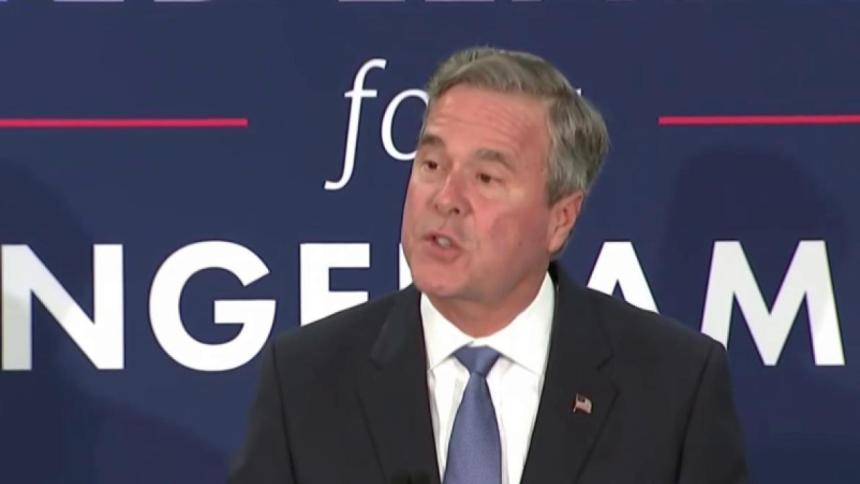
Columbia, South Carolina — There were tears and confusion at the hotel where Jeb Bush said goodbye once and for all to the presidential dream that his brother and father fulfilled before him.
Sergio Pino, an old family friend from Miami, couldn’t believe the news. Why did he drop out? Surely there was some way Bush could have pressed on with the campaign?
“He was the guy with the most ideas, the most energy, the one guy who took on stupid Donald Trump,” he said, his eyes red with tears.
RELATED: Jeb Bush suspends 2016 presidential campaign
In the corner of the hall, a dewy-eyed husband and wife nursed their wine. A few feet away, two crying women embraced. “I’m so devastated, “ one said.
On a narrow level they were watching a failed candidate drop out. But the voters weeping in the hallways knew that this was a broader loss. This was a candidate who stood for an entire generation of Republican Party building, who was the figurative and literal heir to the family brand that had graced nearly every GOP ticket for a generation. And he ceded the race to a candidate whose campaign was a walking middle finger to his family legacy and everything Bush’s supporters told themselves the party stood for.
“I feel like the Republican Party as I know it suspended its campaign tonight,” said Lee Spieckerman, a Texas commentator who had knocked on doors for Bush in New Hampshire and in South Carolina
Bush ran for all the right reasons. He told voters he had a “servant’s heart,” and in private and public, his campaign always appeared motivated by duty rather than personal ambition right up to his final speech. He saw a party that had crashed in 2012 by complaining to itself about the Obama administration rather than offering a positive policy agenda that could appeal to voters outside the conservative base, especially Latinos. In his eyes, no one else had the experience or resources to fix the problem. It was up to him.
“I don’t know if I’d be a good candidate or a bad one,” Bush said on the precipice of his unofficial campaign launch in December 2014. “I kind of know how a Republican can win, whether it’s me or somebody else – and it has to be much more uplifting, much more positive, much more wiling to be ‘lose the primary to win the general’ without violating your principles.”
You could see his sense of duty mainly in how unhappy he often looked running. By Bush’s own account, he was an introvert forcing himself through a gauntlet that rewarded tireless backslapping extroverts. In contrast to rigidly disciplined rivals like Rubio and Cruz, he kept his feelings in plain sight. When things went badly — and they did, early and often – the frustration poured out.
What went wrong? The easiest explanation – which has the benefit of being true – is that Bush’s problems started with his last name.
The entire rest of the campaign — his disconnect with the base, his failure to put down rival upstarts, his clashes with Donald Trump, his inability to turn spending into votes — were to some degree tributaries flowing from the family river.
Bush entered an environment dominated by the tea party movement that had grown up after his brother left office and defined itself primarily by its angry opposition to core planks of his brother’s candidacy: Bailouts, expanding the safety net, passing immigration reform, intervening in education. This movement would power candidates like Sens. Ted Cruz and Marco Rubio, who spoke its language more naturally than Bush. At the same time, the damage left over by the financial collapse that occurred in the waning days of his brother’s presidency would help fuel an unfocused populism that would power Trump.
“He was a great candidate,” Spieckerman said. “He just ran in the wrong end of the decade.”
RELATED: Bush supporters left to consider other candidates
The campaign always knew the Bush family legacy would be a problem. In the early days of the race, Bush said he was “my own man” when it came to policy and pledged to “show my heart” even as he steadfastly praised his brother and father.
He began with considerable advantages. He had spent two terms as a popular conservative governor in Florida. His family and personal connections gave him access to an unprecedented fundraising machine that would raise well north of $100 million for his super PAC.
These advantages helped him muscle out an early obstacle in Mitt Romney, who considered a run, but even from the beginning, potential rivals sensed weakness. Those suspicions that Bush was mortal were confirmed when he stumbled out the gate over the single most predictable issue surrounding his family, the Iraq War, which he struggled to take a position on before conceding it was a mistake.
Sen. Marco Rubio, his old acquaintance from Florida, decided to run even though Bush took the lion’s share of his donors and endorsements. Wisconsin Gov. Scott Walker saw an opening as a conservative alternative to Bush. New Jersey Gov. Chris Christie threw his hat in the ring despite his own weaknesses. Ohio Gov. John Kasich decided to give it a whirl. Others, like Texas Gov. Rick Perry and Louisiana Gov. Bobby Jindal, hopped in. Before long, it was the deepest field anyone could remember.
And then, a whole six months into Bush’s unofficial run for the presidency, came the one absolutely no one had expected: Donald Trump.
Trump took off like wildfire, running against “rapists” and “criminals” coming in across the border, the polar opposite of Bush’s message of immigration reform and compassion for undocumented immigrants, who he said came primarily as an “act of love.”
Yet Bush hesitated to engage him. It seems crazy to imagine now, but the assumption among the pundit class and the Bush campaign alike was that Trump’s arrival was a good thing. It would prevent other candidates from gaining traction before eventually imploding like Trump’s birther-fueled dress rehearsal had in 2011, leaving Bush to swoop in with superior resources and head into the general election as the guy who’d exorcised the party’s nativist demons.
He was partly right. Trump utterly devoured coverage of the race, and he blocked out many of Bush’s rivals. Walker, who seemed like a front-runner himself at one point, was soon gone. Others would follow. But Bush failed to pick up their support as they collapsed. If anything, he kept dropping.
Meanwhile, Trump was on TV 24/7, calling into shows, having his rallies carried live, giving exclusives to conservative outlets, and tweeting away — and his favorite target was “low energy” mama’s boy Bush. He was the perfect foil for Trump, who pitched himself as a lone incorruptible man of the people whose money insulated him from special interests while candidates like Bush were bought off by millionaire super PAC donors. Summer turned to fall, and Trump continued to suck the entire campaign into his orbit. As the insults piled up, Bush looked smaller and smaller, and he eventually changed course and began to respond to Trump directly. “Donald Trump’s view is that the end is near,” Bush told a town hall audience in New Hampshire during his anti-Trump kickoff in September. “His pessimistic view is ‘let’s close the borders, let’s create tariffs, let’s do this, let’s do that,’ all based on negativity, and the net result is that all of us will suffer if that philosophy gains favor.” When he was finished, a voter stood up and offered a telling response: “We are pissed off right now.” RELATED: Jeb Bush wouldn’t join a Donald Trump ticket The dynamic was deadly. It kept Bush from getting his message out, but in the Bush campaign’s eyes, it also meant the tougher candidates still in the race avoided sustained negative coverage as voters’ eyes stayed glued to Trump. “Trump blocked out the sun for seven months,” one Bush aide said on Saturday. “None of the other candidates got the scrutiny they would have otherwise in that period.” Bush held out hope through the fall that the race was still just a show. He told reporters to wait until his super PAC, Right to Rise, started spending its nine-figure budget on ads. They did. Nothing happened. At the same time, Bush’s ongoing weakness created a major opening for candidates like Rubio and, within New Hampshire, Kasich and Christie, to make the case that it was time for someone else to rescue the establishment. With Rubio rising, Bush finally was forced to go negative in October and started criticizing his rival over his lack of experience – he said the senator “followed [his] lead” in the statehouse. But Bush was never comfortable going on offense, and it showed. The confrontation came to a head at the debate, and when Bush raised the issue of his attendance, the younger politician eviscerated him. At that point, the die was cast and Bush was stuck with the loser label. He would never shake it off for the duration of the race, despite an unprecedented spending campaign to do just that. Bush and the outside groups supporting him spent almost $81 million in TV ads over the race, according to ad tracker SMG Delta. They dropped $36 million on their must-win target, New Hampshire – far more than any candidate – yet finished fourth and were happy to make it that far. Along the way, they received a hefty share of criticism from Republicans for using their cash primarily to target rivals like Rubio, Christie and Kasich rather than Trump, who by then even critics acknowledged was the obvious front-runner. Bush’s campaign always thought this was unfair – after all, it’s not like anyone else in the race, including Rubio, was setting the world on fire while Bush languished. Nor were they attacking Trump much either, electing to avoid his withering gaze and try to steal each other’s voters as long as they possibly could. Now Bush has ceded the field to others to mount their last-minute counteroffensive, and his supporters are grappling with cold, hard reality. The man who seemed their white knight turned into a dark horse and then a dead horse, and the man who beat him remains, carrying the four horsemen of the old GOP’s apocalypse behind him.
Benjy Sarlin Recommended


