









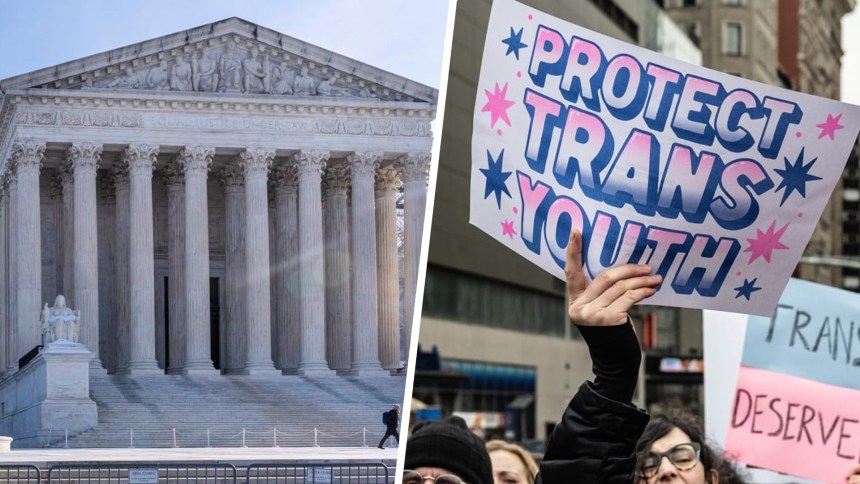

The Supreme Court won’t let South Carolina enforce its restroom policy against a transgender boy while his challenge to the policy proceeds in the lower courts.
A federal appeals court blocked the state from enforcing its transgender bathroom ban against a student referred to in court papers by the pseudonym John Doe. The ban says public school multistall restrooms “designated for one sex shall be used only by members for one sex” and defines sex as “a person’s biological sex, either male or female, as objectively determined by anatomy and genetics existing at the time of birth.”
In eighth grade last year, Doe was suspended for a day for using the boys’ room. Faced with potential expulsion for further violations, Doe’s parents withdrew him from in-person school and he participated in school online the rest of the year, which his family considered educationally and socially inferior.
Doe sued. In July, a South Carolina district judge halted the litigation, citing the Supreme Court’s recent decision to take up the issue of transgender sports participation and the guidance that would flow from the high court’s impending decision. Doe appealed to the U.S. Court of Appeals for the 4th Circuit, which in August granted his motion for an injunction pending appeal. A three-judge panel cited the circuit’s 2020 ruling in the case of Gavin Grimm, in which the court deemed illegal a policy requiring transgender students to use multistall restrooms “matching their ‘biological gender.’”
One of the judges on Doe’s panel, George W. Bush-appointee Steven Agee, specified that he only sided with Doe because of the Grimm precedent but maintained that Grimm was wrongly decided. Agee expressed his hope that the Supreme Court would step in quickly.
South Carolina appealed to the justices, seeking an emergency lift of the circuit’s injunction. The state told the high court that relief is warranted “not only because Grimm was wrongly decided and should (and may soon) be overturned, but because in the absence of this Court’s immediate intervention, the State, the school district, and its students are suffering actual, ongoing, material harms.” The state said the issue should be guided not by the circuit’s Grimm case but by the high court’s recent ruling in the Skrmetti case, which upheld a ban on gender-affirming care. The Supreme Court rejected South Carolina’s application on Wednesday. “The denial of the application is not a ruling on the merits of the legal issues presented in the litigation,” the court said in its order. “Rather, it is based on the standards applicable for obtaining emergency relief from this Court.” The order noted that Justices Clarence Thomas, Samuel Alito and Neil Gorsuch would have granted the application. Doe’s lawyers urged the justices to stay out of it, reminding them that the state’s emergency application “concerns one ninth-grader’s restroom use.” They noted that the circuit’s injunction applies only to Doe and thus doesn’t stop the state from enforcing it otherwise, making it “hardly an emergency warranting a stay from this Court.” Subscribe to the Deadline: Legal Newsletter for expert analysis on the top legal stories of the week, including updates from the Supreme Court and developments in the Trump administration’s legal cases.
Jordan Rubin is the Deadline: Legal Blog writer. He was a prosecutor for the New York County District Attorney’s Office in Manhattan and is the author of “Bizarro," a book about the secret war on synthetic drugs. Before he joined MS NOW, he was a legal reporter for Bloomberg Law.
Latest Post
Recommended


