








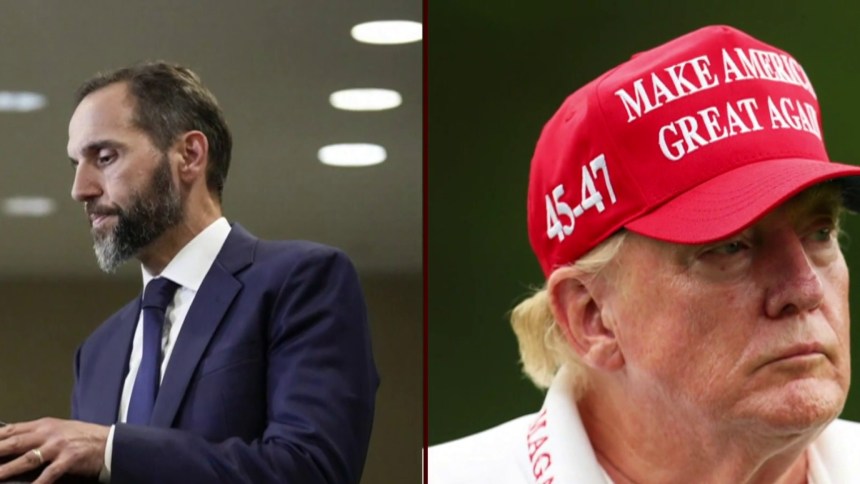

Ever since Donald Trump was indicted in the federal election interference case in 2023, a lingering question has been why special counsel Jack Smith didn’t charge him under the Insurrection Act. We just got an answer in the volume of Smith’s report on the election case that was released overnight.
The federal insurrection law says that
[w]hoever incites, sets on foot, assists, or engages in any rebellion or insurrection against the authority of the United States or the laws thereof, or gives aid or comfort thereto, shall be fined under this title or imprisoned not more than ten years, or both; and shall be incapable of holding any office under the United States.
In his report, Smith observed that it didn’t appear that anyone had been charged with that crime in more than 100 years. Explaining why his office didn’t bring it against Trump, the special counsel wrote that cases interpreting that statute “are scarce and arose in contexts that provided little guidance regarding its potential application in this case.”
More specifically, Smith noted that he would’ve had to prove that the violence of Jan. 6, 2021, was an “insurrection against the authority of the United States or the laws thereof” and that Trump “incite[d]” or “assist[ed]” the insurrection, or “g[ave] aid or comfort thereto.”
The special counsel was mindful that courts have called the Capitol attack an insurrection, including the Colorado Supreme Court in the case that deemed Trump ineligible for office (until the U.S. Supreme Court reversed the state court and effectively ended nationwide challenges to Trump’s eligibility). Smith wrote that his office was “aware of the litigation risk that would be presented by employing this long-dormant statute.”
Among the reasons the special counsel held back, he wrote, was that Trump was trying to stay in power as the current president rather than overthrow the government from the outside. “The Office did not find any case in which a criminal defendant was charged with insurrection for acting within the government to maintain power, as opposed to overthrowing it or thwarting it from the outside,” Smith wrote, concluding that applying the law in this situation “would have been a first, which further weighed against charging it, given the other available charges, even if there were reasonable arguments that it might apply.”
Smith further noted that he couldn’t find a case in which anyone had been charged with inciting, assisting or giving aid or comfort to rebellion or insurrection. “The few relevant cases that exist appear to be based on a defendant directly engaging in rebellion or insurrection, but the Office’s proof did not include evidence that Mr. Trump directly engaged in insurrection himself,” he wrote.
He added that there were “reasonable arguments to be made” that Trump’s speech on Jan. 6 could qualify as incitement under Supreme Court precedent but that his office “did not develop direct evidence — such as an explicit admission or communication with co-conspirators — of Mr. Trump’s subjective intent to cause the full scope of the violence that occurred on January 6.”
So Smith declined to pursue the charge, given the potential legal challenges in doing so, as well as what he called “the other powerful charges available.” Trump was charged with conspiracy to defraud the United States, conspiracy to obstruct an official proceeding, obstruction of and attempt to obstruct an official proceeding and conspiracy against rights. He pleaded not guilty. The case was set for trial last year but never made it that far, due in part to Trump’s pretrial appeal in which the Supreme Court granted him broad criminal immunity. Trump’s presidential victory cut short the pending litigation in the trial court over how much of Smith’s case survived the immunity ruling. After the election, the special counsel moved to dismiss the case, citing Justice Department policy against prosecuting sitting presidents. Ultimately, Smith’s explanation reflects a cautious approach. As his analysis concedes, reasonable minds can differ on the subject. With that said, it’s hard to see why the novelty of the situation is a reason not to proceed with a given charge; on the contrary, one could argue that the novelty of Trump’s conduct was reason to press forward. However, if there was any concern about the strength of the evidence — as Smith noted, in part, was the case — then that makes it a clearer decision in favor of not proceeding. Of course, the wisdom of Smith’s charging decisions is a historical discussion at this point. The case is over. Had Trump been charged with and convicted of insurrection, then that could have strengthened the case for his disqualification from office — but that, too, is a hypothetical we’ll never know the answer to. Even though Trump appointee Brett Kavanaugh suggested that a conviction under the insurrection statute could have barred Trump from office, had Smith brought that charge, Kavanaugh and his colleagues’ immunity ruling still would have kept a trial on that charge from going to a jury before the election. Subscribe to the Deadline: Legal Newsletter for expert analysis on the top legal stories of the week, including updates from the Supreme Court and developments in Donald Trump’s legal cases.
Jordan Rubin is the Deadline: Legal Blog writer. He was a prosecutor for the New York County District Attorney’s Office in Manhattan and is the author of “Bizarro," a book about the secret war on synthetic drugs. Before he joined MS NOW, he was a legal reporter for Bloomberg Law.
Latest Post
Recommended


