








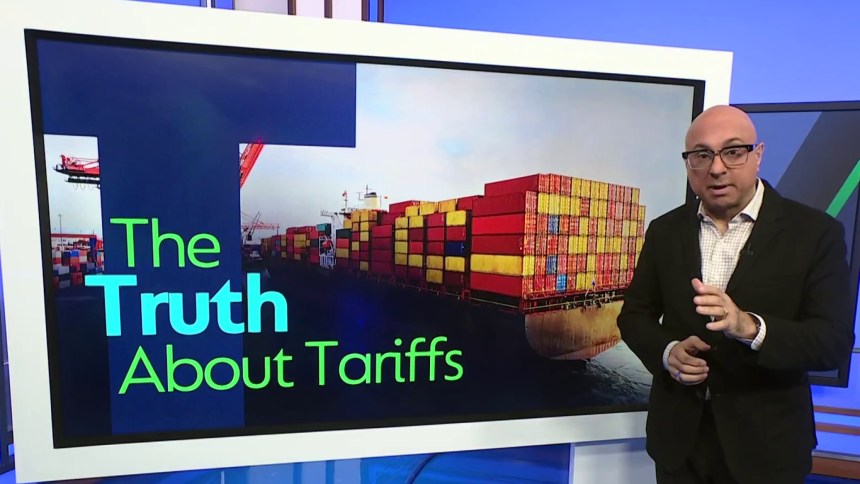

This is an adapted excerpt from the Nov. 17 episode of “Velshi.”
Donald Trump ran on a promise to lower inflation and fix the American economy — an economy that most experts say is, right now, one of the strongest in the world. However, much of Trump’s economic plans for a second term lack detail, including his promise to impose sweeping tariffs on other countries, particularly China.
Trump has favored tariffs as a solution to economic problems for years, even saying on the campaign trail that tariff is “the most beautiful word in the dictionary.” The bottom line is, tariffs are neither inherently good or inherently bad. They are a tool which, when used strategically, can remedy trade imbalances, protect certain domestic industries, or influence other countries to improve their trade, wage or human rights practices.
The president-elect already imposed considerable tariffs during his first term in the White House and the Biden administration has maintained $360 billion dollars’ worth of Trump’s China tariffs, along with imposing some of their own.
Trump has favored tariffs as a solution to economic problems for years, even saying tariff is “the most beautiful word in the dictionary.”
Trump now says he plans to increase tariffs in his next presidency, floating the idea of a blanket 20% tariff on every U.S. trading partner and up to 60% on most goods imported from China. He’s even said that in order to keep Chinese electric vehicles from undercutting American electric vehicles, he would impose “whatever tariffs are required — 100%, 200%, 1,000%.”
China dominates the electric vehicle industry. In 2023, China was responsible for 58% of the global EV market, five times the size of the U.S. market. However, Chinese electric vehicles are not sold here in the U.S. thanks, in part, to restrictions imposed by Trump in his last presidency and later upheld by the Biden administration.
One of the most popular Chinese electric vehicles in the world is the sleek BYD Seagull, made by BYD, which stands for Build Your Dreams. Right now, it costs approximately $10,000 to buy a BYD Seagull in China.
If that vehicle was imported to the U.S., with the current tariff on Chinese EVs at 100%, you would pay $20,000 for it. And that $20,000 would still be $8,000 cheaper than the least expensive electric vehicles made in America, like the Nissan Leaf or Chevrolet Bolt. In order for the U.S. to have a competitive edge with China in the electric vehicle industry, these tariffs can clearly help even the playing field.
It’s worth noting that there is an American-made electric vehicle company that happens to benefit from tariffs like these. That is, of course, Elon Musk’s Tesla. Trump named Musk to co-head the new, so-called Department of Government Efficiency.
But here’s the downside of tariffs: They almost always, at least in the immediate future until markets can adjust, make goods more expensive for the American consumer. Tariffs are not, in fact, paid for by foreign countries. It is the importers, aka the American companies, that pay tariffs. And those companies, universally, end up passing that “tax” onto the consumer in the form of higher prices.
So in the end, you, the American consumer, end up footing the bill for tariffs or you don’t buy the product.
But here’s where things get even more complicated. If you impose tariffs on another country, that country will return the favor. They will impose tariffs on you and then you will have a trade war. Trump sparked a trade war with China during his last presidency when he slapped a series of tariffs on the country’s imports and the government of China retaliated against U.S. exporters. As a result, U.S. exports, particularly of agricultural goods, dropped significantly. American soybean farmers were hit the hardest since China is the largest buyer of American soybeans in the world. To help fix this crushing blow, you, the taxpayer, then had to subsidize American soybean farmers to the tune of about $28 billion. In the end, you paid for the tariffs twice. I’m not here to argue for or against tariffs. Aas I said, sometimes they are a useful and necessary tool. But a policy of this magnitude needs to take into account the whole picture. As economic journalist Bethany McLean writes in an essay for The Washington Post: A targeted tariff that’s part of a broader policy could be the right thing to do, even if there are economic costs. But we need to be humble about what we don’t know and think in a nuanced, careful way about exactly what problem we’re trying to solve and what the costs could be.
Sage advice. Unfortunately, Trump’s policy-making vibe is not what one would call humble, nuanced or careful. Allison Detzel contributed.
Lauren Winn
Lauren Winn is an anchor producer for NBC News Senior Business Correspondent and MSNBC anchor, Stephanie Ruhle.
Ali Velshi is the host of “Velshi,” which airs Saturdays and Sundays on MSNBC. He has been awarded the National Headliner Award for Business & Consumer Reporting for “How the Wheels Came Off,” a special on the near collapse of the American auto industry. His work on disabled workers and Chicago’s red-light camera scandal in 2016 earned him two News and Documentary Emmy Award nominations, adding to a nomination in 2010 for his terrorism coverage.
Latest Post
Recommended



