








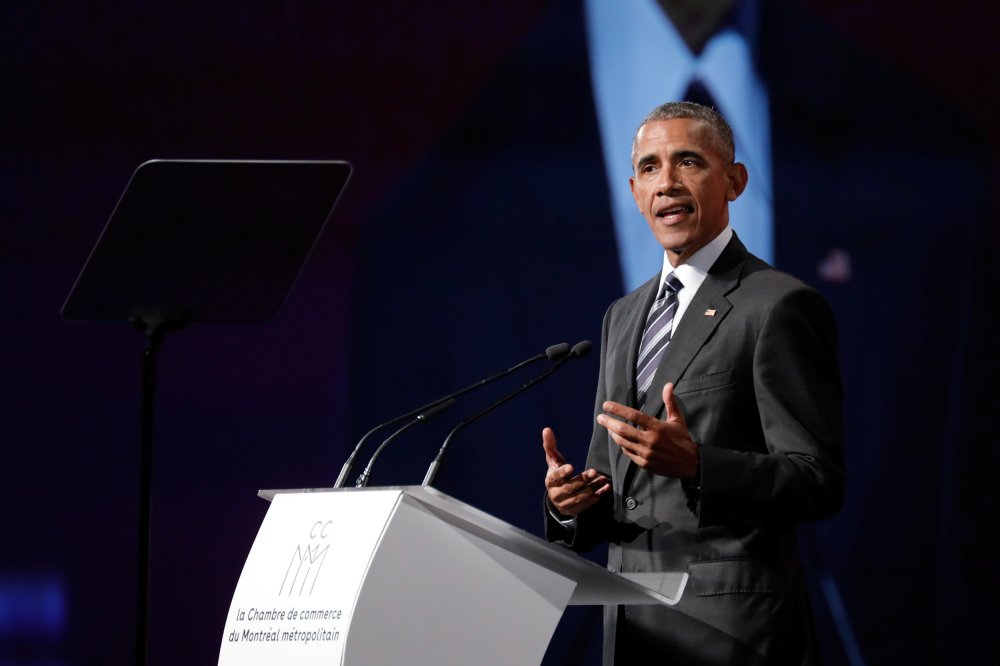
Former President Barack Obama made a rather big splash last week, taking on a high-profile electoral role for the first time since leaving the White House, and delivering a hard-hitting speech at the University of Illinois. There was one line from his remarks, however, that continues to linger.
“Democrats aren’t just running on good, old ideas, like a higher minimum wage,” Obama said, “they’re running on good new ideas, like Medicare-for-all, giving workers seats on corporate boards, reversing the most egregious corporate tax cuts to make sure college students graduate debt free.”
Part of this list comes directly from Sen. Elizabeth Warren’s (D-Mass.) agenda, which is itself interesting, but seeing Obama express support for a Medicare-for-All plan seemed new.
And for some on the right, it also seemed like evidence of a previous deception. The Weekly Standard, a prominent conservative magazine, published an item this morning alongside a cartoon of the former Democratic president with a long Pinocchio nose.
“Medicare-for-all” … signifies the full-on nationalization of the health-care industry so that everybody can enjoy the benefits of America’s most expensive and worst-run health-care program. It also signifies a plan that’s not remotely affordable for a nation with the budgetary obligations of the United States — $32 trillion over 10 years.
But hold on. We seem to remember that in 2009 Obama specifically disavowed any intention of nationalizing the health-care industry. “What are not legitimate concerns are those being put forward claiming a public option is somehow a Trojan horse for a single-payer system,” Obama said to the American Medical Association soon after taking office. “I’ll be honest. There are countries where a single-payer system works pretty well. But I believe—and I’ve taken some flak from members of my own party for this belief—that it’s important for our reform efforts to build on our traditions here in the United States. So when you hear the naysayers claim that I’m trying to bring about government-run health care, know this: They’re not telling the truth.”
There are a few glaring problems with this.
First, to condemn a Medicare-for-All plan as being prohibitively expensive is to take an incomplete view of the nation’s health care finances. The United States will spend tens of trillions of dollars over the next decade on health care anyway, and by some measures, a single-payer model would actually cost Americans less, not more.
Second, Obama has long made clear — even as a candidate in 2008 — that if he were designing a health care system “from scratch,” he’d prefer a single-payer model. But as quickly became obvious, this wasn’t his plan: Obama, reluctant to disrupt the market, and recognizing existing political constraints, instead chose a more Republican-friendly model, built largely around subsidizing private insurance.
To suggest that Obama somehow hid his support for a Medicare-for-All-like system until last week is at odds with his actual record. Third, a Medicare-for-All” model does not, in fact “signify the full-on nationalization of the health-care industry.” The Weekly Standard appears to be describing a British NHS-like system, but there are real, systemic difference between this and single-payer. But even if we put these relevant details aside, let’s not overlook the context of the debate and the broader policy landscape. Republicans not only falsely condemned Obama’s Affordable Care Act as “government-run health care,” and not only made clear that they will never tolerate “Obamacare” or any system like it, they’ve also taken a series of steps to sabotage the system and undermine the marketplace. In effect, GOP officials have left the nation with a binary choice: by rejecting the more conservative ACA, Republicans have said we can move toward a single-payer model or we can leave millions of Americans behind. Obama would’ve been perfectly content to allow the Affordable Care Act to remain in place indefinitely, but GOP leaders continue to take steps to remove that option. It’s against this backdrop that the former president is willing to tout a Medicare-for-All system as a “good, new idea.” To see this as a contradiction of his previous positions, or proof of Obama’s deception, is to make an unfortunate mistake.
Steve Benen is a producer for "The Rachel Maddow Show," the editor of MaddowBlog and an MS NOW political contributor. He's also the bestselling author of "Ministry of Truth: Democracy, Reality, and the Republicans' War on the Recent Past." Recommended


