









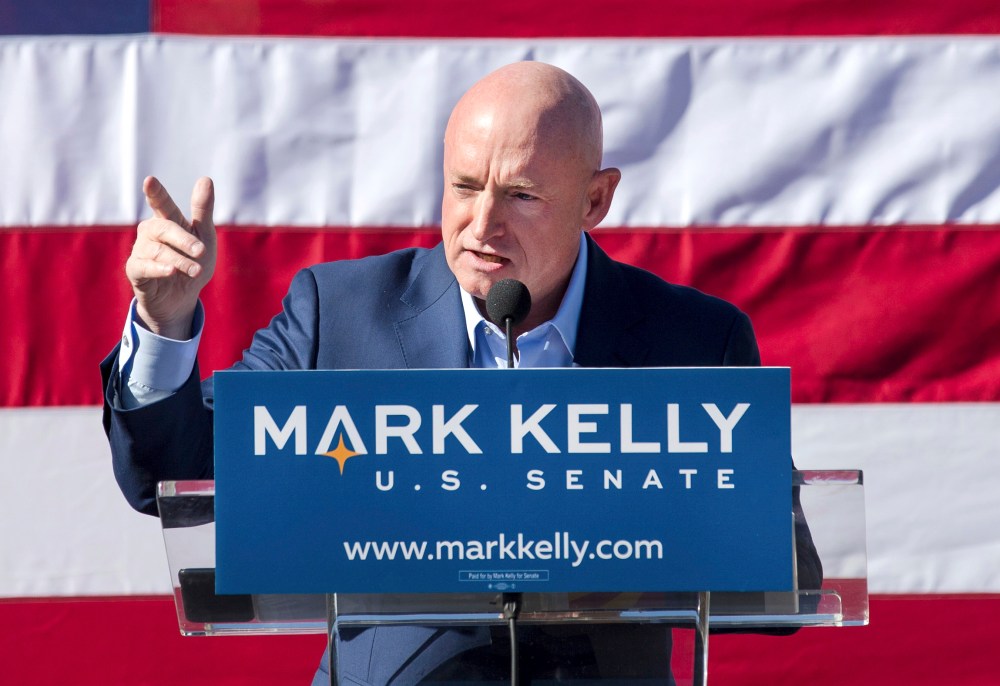

Arizona earned a reputation as a reliably “red” state. Over the last 70 years, it’s backed the Republican presidential ticket 16 times in 17 election cycles, and over the same period, it’s always had at least one GOP senator.
It makes Mark Kelly’s success in the state’s U.S. Senate race all the more striking.
Democrat Mark Kelly has defeated Republican Sen. Martha McSally in Arizona, NBC News projected on Friday, giving Democrats a Senate pickup in the state. Kelly, a former NASA astronaut, declared himself the winner earlier in the week…. Kelly, 56, is the husband of former Rep. Gabby Giffords, who survived being shot in the head in 2011 at a constituent event. The couple founded the Giffords Foundation, which supports gun control laws around the country.
This was Kelly’s first bid for elected office. McSally, whom I do not believe has yet conceded, appears to have now lost two Senate campaigns in successive elections.
Of course, there’s an important larger context to the results. For example, there’s Arizona’s history to consider: the state now has two Democratic U.S. senators — Kyrsten Sinema was elected two years ago — for the first time since the early 1950s.
As some battleground states start to look more like Republican strongholds — see Florida, Ohio, and Iowa, for example — and Democrats start looking for “red” states that are starting to look “bluer,” it’s clear Arizona belongs on that list.
There’s also the regional history to consider: Democrats now hold all of the U.S. Senate seats in Arizona, Colorado, Nevada, and New Mexico. According to The Atlantic’s Ron Brownstein, this is a first since 1941. Bronstein added that if Joe Biden ends up winning Nevada and Arizona — states where he’s currently ahead — in addition to his victories in Colorado and New Mexico, it’ll be the first time the Democratic ticket won these four states and won their eight U.S. Senate seats since 1936.
And then, of course, there’s the race for control of the U.S. Senate in the upcoming Congress. According to NBC News’ tally, Kelly’s victory brings the Democrats’ new total to 48 seats — 46 Democrats and two New England independents who caucus with the party — which reflects a net gain of one compared to where they are now.
There are, however, four races remaining. In alphabetical order:
Alaska: Incumbent Sen. Dan Sullivan (R) is generally seen as the heavy favorite over Al Gross — an independent who accepted the Democratic nomination — but only about half of the votes have been counted. (Gross, incidentally, sounded surprisingly optimistic about his prospects yesterday, though he’s currently trailing badly in the preliminary count.)
Georgia: With votes yet to be tallied, incumbent Sen. David Perdue (R) is narrowly leading Jon Ossoff (D), though a runoff is still possible if neither candidate reaches 50%. In Georgia’s Senate special election, Raphael Warnock (D) was the top vote-getter in the large field, and he’ll take on appointed incumbent Sen. Kelly Loeffler (R) in a January runoff.
North Carolina: Incumbent Thom Tillis (R) currently has a slight edge over Cal Cunningham (D), but it’s among the too-close-to-call races. Following up on our coverage from yesterday, if Sullivan and Tillis prevail in their respective contests, it raises the possibility of having to wait until January, when Georgia holds its special elections, to know for sure which party will be in control of the Senate. By any fair measure, the Democrats’ path is narrow, though it isn’t necessarily closed. If the Biden/Harris ticket prevails, and Perdue falls short of 50%, it raises the prospect of Senate control coming down to two Georgia runoff races on Jan. 5. If Jon Ossoff and Raphael Warnock managed to prevail, it would create a 50-50 split, though Democrats would have effective control — including naming committee chairs — so long as there’s a Democratic White House. It’s a longshot, but it’s already been a strange year in so many ways, so I’m reluctant to rule anything out. Postscript: To reiterate a point that remains on my mind, the political world may soon wonder about the direction of the United States in the 2020s were it not for Cal Cunningham’s extramarital difficulties.
Steve Benen is a producer for "The Rachel Maddow Show," the editor of MaddowBlog and an MS NOW political contributor. He's also the bestselling author of "Ministry of Truth: Democracy, Reality, and the Republicans' War on the Recent Past."
Latest Post
Recommended


