









A couple of weeks ago, Donald Trump published a tweet ahead of a congressional special election in California, insisting that the race was “rigged.” The president was predictably wrong — the talking point mysteriously disappeared after the Republican candidate won — but it came on the heels of a lengthy effort in which Trump condemned voting by mail as a “horrible” and “corrupt” scheme that he should be able to take advantage of, but most voters should not.
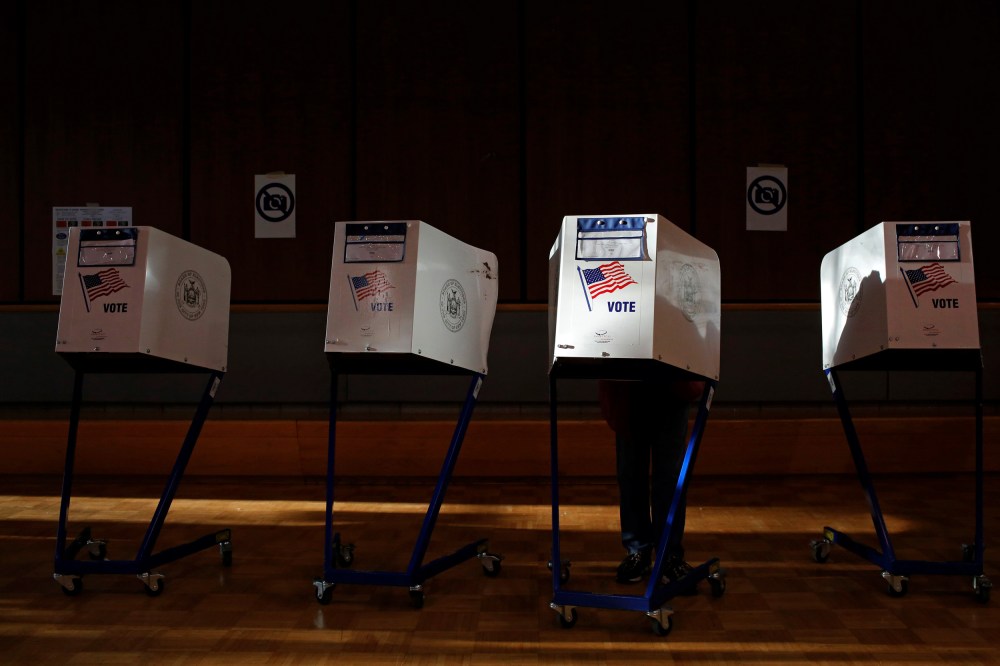
Away from the weird rhetoric emanating from the White House, there’s a larger campaign underway that goes well beyond the president’s posturing. The New York Times reports today on the Republican Party, the Trump campaign, and conservative activists who are collectively “mounting an aggressive national effort to shape who gets to vote in November — and whose ballots are counted.”
The Republican program, which has gained steam in recent weeks, envisions recruiting up to 50,000 volunteers in 15 key states to monitor polling places and challenge ballots and voters deemed suspicious. That is part of a $20 million plan that also allots millions to challenge lawsuits by Democrats and voting-rights advocates seeking to loosen state restrictions on balloting. The party and its allies also intend to use advertising, the internet and President Trump’s command of the airwaves to cast Democrats as agents of election theft.
At a certain level, this may not sound altogether new. The president and his party have sought to undermine public confidence in their own country’s electoral system repeatedly in recent years, and ridiculous claims about “voter fraud” have been a GOP staple for a long while. Democratic claims about the Republican “war on voting” have been common for a decade.
But it’s worth appreciating what will make 2020 different.
Let’s revisit some of our earlier coverage and review how we arrived at this point. In 1981, there was a very competitive gubernatorial race in New Jersey, which the Republican National Committee was eager to win. The party was so eager to prevail that the RNC launched a program called the “Ballot Security Task Force,” which involved having Republican operatives and off-duty law enforcement personnel hanging around dozens of minority-voting precincts, looking for evidence of election irregularities, and intimidating local voters.
The campaign was not subtle: Republicans put up warning signs, telling locals that their precincts were being monitored, and creating quasi-official arm bands for the party’s monitors to wear while physically patrolling polling places in areas made up mostly of minority voters.
In one sense, the heavy-handed scheme worked: the Republicans successfully intimidated people of color and narrowly won New Jersey’s gubernatorial election that year. But the victory came at a price: the RNC’s scare tactics were so egregious, and the scheme targeted black voters so brazenly, that the Republican Party faced a court fight that they lost.
At the time, the RNC felt compelled to accept a 35-year consent decree that included legal restrictions on the party’s efforts to monitor polling locations.
Four years ago, soon after Mike Pence was added to Donald Trump’s ticket, the Indiana Republican assured voters, “I will tell you that the Trump campaign and the Republican National Committee are working very, very closely with state governments and secretary of states all over the country to ensure ballot integrity.” The RNC wasted little time announcing that Pence had no idea what he was talking about, and he’d really just made all of that up. There was no great mystery as to why party officials scrambled: Republicans were desperate to get out from under the court-imposed constraints. If Pence were right, it meant the RNC was failing to honor the terms of the agreement, so the party made clear that Pence was wrong. The RNC’s efforts ultimately succeeded. A court agreed that the consent decree expired in December 2017 and would not be extended — all of which means that this year will feature the first presidential election since 1984 in which Republicans can approach “ballot integrity” issues without court restraints. To that end, the RNC and the president’s re-election campaign has set aside $20 million to help pay for voting-rights lawsuits. Politico recently reported that the budget was doubled, and Trump “has taken a personal interest in the project.” Buckle up.
Steve Benen is a producer for "The Rachel Maddow Show," the editor of MaddowBlog and an MS NOW political contributor. He's also the bestselling author of "Ministry of Truth: Democracy, Reality, and the Republicans' War on the Recent Past."
Latest Post
Recommended


