








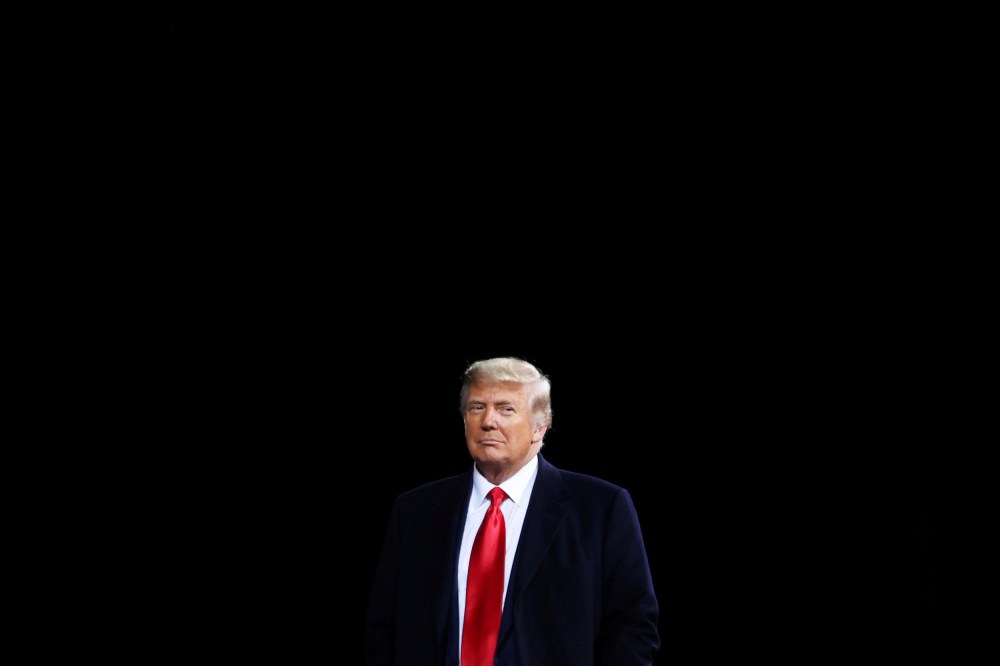

Throughout his presidency, Donald Trump made up polling data that purportedly showed his widespread popularity. Independent surveys pointed in very different directions, but the Republican dismissed those polls by insisting they were part of an elaborate conspiracy against him.
During his semi-retirement, very little has changed. Trump recently appeared on Dan Bongino’s show, and when asked about the possibility of a third presidential campaign in 2024, the Republican said, “I am giving it the most serious consideration as you can imagine and based on every poll that I’m seeing and everything else. It’s something that is, you know, very positive, nobody’s seen anything more positive.”
At face value, it stood to reason that some polls might actually show Trump’s standing improving now that he’s no longer in office. In fact, that would be consistent with recent history: former presidents routinely see their support climb after they leave they White House.
But with Trump, it’s a bit more complicated.
First, his boasts notwithstanding, the former president appears to have lost support in recent months. In NBC News polling, Trump’s national favorability rating stood at 43% shortly before Election Day. By January, as he prepared to exit the White House, that total had dipped to 40%, and as of two weeks ago, the Republican’s favorability rating had slipped further to just 32%.
These are not results to be proud of. While most modern presidents have seen their standing improve after their terms have ended, Trump is seeing the opposite.
And second, inconvenient details like these are apparently being kept from Republican members of Congress. The Washington Post reported over the weekend on a Republican retreat held last month that featured a polling briefing for GOP members.
When staff from the National Republican Congressional Committee rose to explain the party’s latest polling in core battleground districts, they left out a key finding about Trump’s weakness, declining to divulge the information even when directly questioned about Trump’s support by a member of Congress, according to two people familiar with what transpired. Trump’s unfavorable ratings were 15 points higher than his favorable ones in the core districts, according to the full polling results, which were later obtained by The Washington Post.
In these battleground districts, “strongly unfavorable” views of the former president were twice as high as “strongly favorable” views.
According to the Post‘s report, House Republican Conference Chair Liz Cheney (R-Wyo.) wasn’t just interested in Trump’s weak support in key congressional districts, she was also “alarmed” by the fact that the National Republican Congressional Committee had omitted this information from GOP members during a polling briefing, which was ostensibly designed to give lawmakers information they needed to know. In fact, Cheney reportedly told others that Republican campaign officials “had also left out bad Trump polling news at a March retreat for ranking committee chairs.” In other words, NRCC officials are aware of Trump’s unpopularity, but rather than make Republican members aware of the facts, the party believes Republicans would be better off not knowing. As a rule, willful ignorance is an unwise strategy for a political party.
Steve Benen is a producer for "The Rachel Maddow Show," the editor of MaddowBlog and an MS NOW political contributor. He's also the bestselling author of "Ministry of Truth: Democracy, Reality, and the Republicans' War on the Recent Past."
Latest Post
Recommended


