









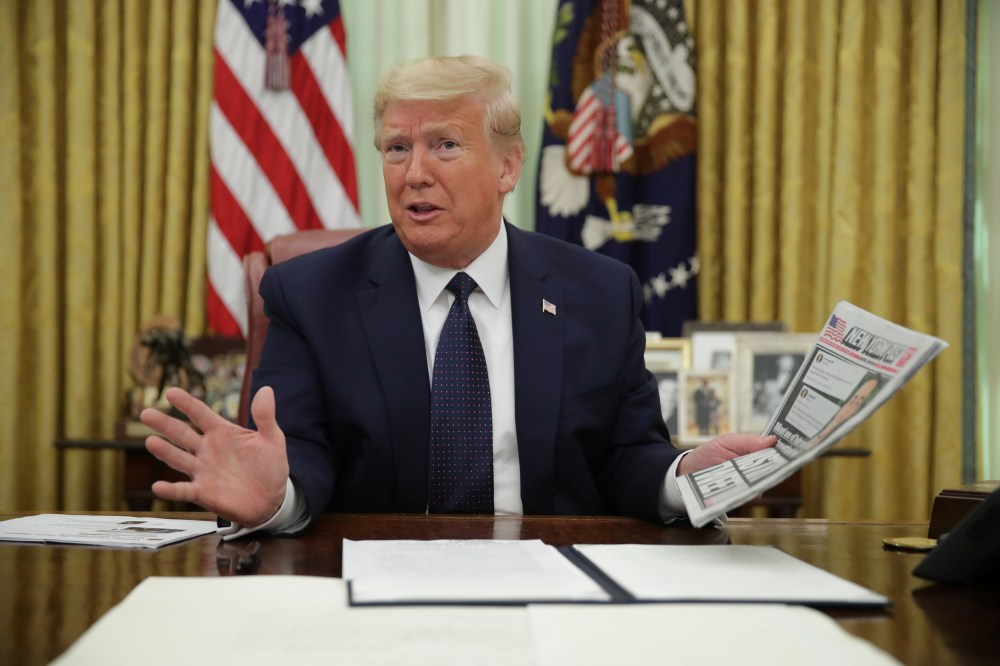

At a White House event yesterday, a reporter asked Donald Trump whether he’s spoken yet to the family of George Floyd, an African-American man who was killed in Minneapolis after a white police officer kneeled on his neck.
The president conceded that he hadn’t talked to Floyd’s loved ones, but Trump nevertheless tried to sound sympathetic. “I feel very, very badly,” the Republican said, adding that the video of Floyd’s killing was “very shocking” and “a very, very bad thing.”
On Twitter, the president continued to try to sound reasonable late yesterday afternoon, adding that he’s asked federal law enforcement to investigate Floyd’s death and his “heart goes out to George’s family and friends.”
Overnight, however, Trump’s posture changed with the publication of these missives, apparently in response to the violence and unrest in the streets of Minneapolis.
“I can’t stand back [and] watch this happen to a great American City, Minneapolis. A total lack of leadership. Either the very weak Radical Left Mayor, Jacob Frey, get his act together and bring the City under control, or I will send in the National Guard [and] get the job done right. These THUGS are dishonoring the memory of George Floyd, and I won’t let that happen. Just spoke to Governor Tim Walz and told him that the Military is with him all the way. Any difficulty and we will assume control but, when the looting starts, the shooting starts. Thank you!”
“When the looting starts, the shooting starts” is a phrase with an ugly and painful history. It also triggered a reaction from Twitter, which concluded that the president had violated the company’s policy against glorifying violence. As of this morning, Trump’s tweet is online, but it’s obscured on the president’s timeline behind a warning that reads, “This Tweet violated the Twitter Rules about glorifying violence. However, Twitter has determined that it may be in the public’s interest for the Tweet to remain accessible.”
That, of course, has only enraged the president further, the day after he signed an executive order that seemed intended to intimidate Twitter for having the audacity to alert the public to Trump’s willingness to lie about voting rights.
Part of the problem, of course, is that Trump’s tweets were needlessly excessive. The president saw images of Minneapolis burning and thought it’d be a good idea to add lighter fluid to dangerous and volatile conditions.
Indeed, this was a situation in which the president, for all intents and purposes, decided to publicly threaten the protestors. There’s nothing subtle about, “Any difficulty and we will assume control but, when the looting starts, the shooting starts.”
But it’s also worth appreciating the degree to which the president appears to have wildly different standards for different kinds of protestors.
It was an unsettling scene in Lansing late last month, when hundreds of protestors went to Michigan’s capitol building — many of them brandishing firearms, including military-style rifles — to condemn efforts to prevent the spread of the coronavirus. By any fair measure, as we discussed soon after, the confrontations and apparent attempts to intimidate elected officials were frightening. It was very likely the point: the armed protestors were trying to scare elected officials and local law enforcement.
Trump, of course, sided with the armed protestors, urged Michigan Gov. Gretchen Whitmer (D) to give them at least some of what they wanted, and praised the protestors as “very good people.” Soon after, the president told Fox News, “All those people out there that are protesting, they’re right.” The comments came nearly three years after Trump defended some racist protestors in Charlottesville as “very fine people.” Trump’s magnanimity has been far more limited toward American protestors he doesn’t like. Immediately following his inauguration, for example, the new president denounced his detractors who took to the streets as “professional anarchists, thugs and paid protesters.” When Brett Kavanaugh’s Supreme Court nomination sparked activism, Trump repeatedly dismissed the jurist’s critics as “paid protestors.” When athletes took a knee to protest racial injustices, the president suggested it could be seen as a deportable offense. He argued in 2018, in reference to the athletes, “Maybe you shouldn’t be in the country.” And overnight, Trump suggested he’s prepared to target “thugs” with violence — a message the official White House twitter feed has now echoed. Those waiting to see the president praise protestors in Minneapolis as being “right” and “very good people” will probably be waiting a very long time.
Steve Benen is a producer for "The Rachel Maddow Show," the editor of MaddowBlog and an MS NOW political contributor. He's also the bestselling author of "Ministry of Truth: Democracy, Reality, and the Republicans' War on the Recent Past."
Latest Post
Recommended


