











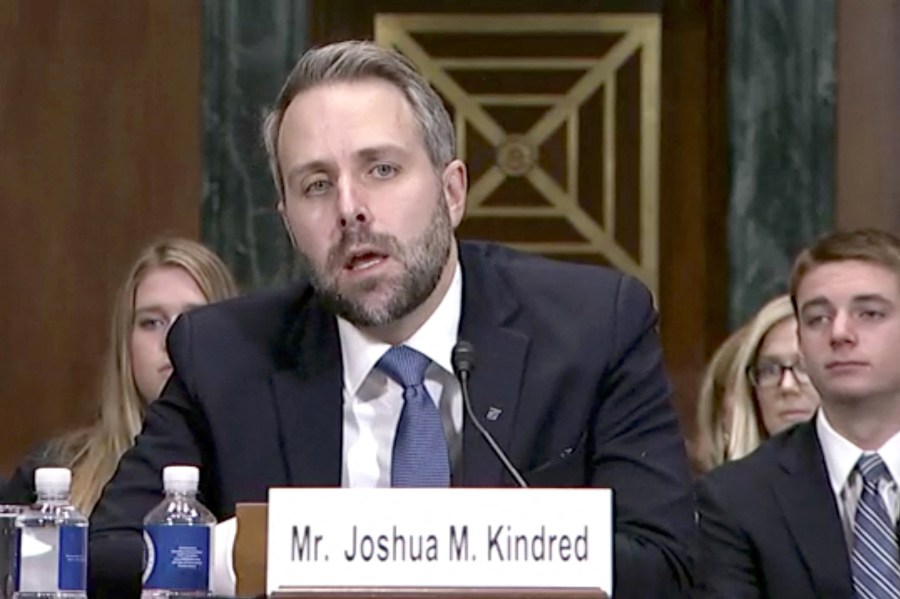
In December 2019, after Joshua Kindred was nominated by then-President Donald Trump to a federal district court judgeship in Alaska, he fielded questions from senators tasked with assessing his fitness for the job.
One of them — Sen. Mazie Hirono, D-Hawaii — asked him a question she poses to all judicial nominees: “Since you became a legal adult, have you ever made unwanted requests for sexual favors, or committed any verbal or physical harassment or assault of a sexual nature?”
Kindred, a state prosecutor-turned-Department of Interior lawyer, answered, “No.” Ultimately, he was confirmed by the full Senate in mid-February 2020 by a vote of 54-41.
Yet Kindred, who is only in his 40s, has now resigned from the job he could have held for life. And, perhaps not coincidentally, his resignation came the same day a judicial council overseeing misconduct complaints for his court publicly released an order summarizing the evidence collected through its “thorough investigation” of a complaint against Kindred and reflecting its judgment that Kindred should voluntarily resign. Specifically, the order “reprimanded and admonished” him for “creating a hostile work environment for his law clerks and … having an inappropriately sexualized relationship with one of his law clerks both during her clerkship and after she became [a federal prosecutor].”
Kindred’s two-sentence resignation letter, submitted to President Joe Biden on July 3, did not address the allegations.
There’s no proof Kindred lied when he told Hirono he had never sexually harassed or assaulted anyone. But even the limited evidence discussed in the order suggests he was no novice, especially in fostering a hostile work environment.
In particular, “nearly all” of his current and former law clerks sat for interviews, despite their stated “reluctance or discomfort at being involved in the investigation,” according to the judicial council’s report. And collectively, they revealed his pattern of highly sexualized workplace talk, including “encouraging rating people based on ‘fuckability,’” or soliciting a clerk’s romantic advice after a federal prosecutor had sent him nude photos of herself. His 628 pages of texts with his clerks were filled with similar vulgarities and seemingly more frequent; with one law clerk, he exchanged 278 pages of texts in just 11 months, “only a small fraction of which had any relationship to her legitimate job duties.” Calling himself her “biggest cheerleader,” he predicted he would become an “emotional wreck” when her clerkship ended.
But what reads like an unrequited, consuming crush over texts escalated into something more pernicious in real life: at least two incidents of sexual contact, each of which seemed unwelcome from the report’s narrative. For example, before the more significant of the two episodes, the clerk told the investigators, “I just remember thinking like there’s nothing I can do about this, like this is about to happen.” That doesn’t exactly sound consensual.
Did Kindred’s attitudes about gender, sex and sexuality, whether owned or implicit, impact how he ruled in the cases before him?
Yet when Kindred was given the opportunity to argue his case before the judicial council, he reflected that his “great sin” was that he “treated [his] law clerks as friends rather than employees.” The judicial council, on the other hand, framed his misconduct more starkly: “Judge Kindred created an atmosphere in which he was inappropriately inserting himself into the personal lives of his law clerks, engaging in a sexualized relationship with one of his law clerks, and having sexually suggestive and explicit conversations with his law clerks.” Kindred has not publicly addressed the allegations. He did not immediately respond to NBC News’ request for comment.
Some of his alleged conduct might have come to light sooner if Congress had passed legislation, like that proposed by Hirono in past years, that would protect federal judicial employees from retaliation and sex discrimination. Still, even that doesn’t go far enough. Beyond his impact on the careers of courthouse employees, did Kindred’s attitudes about gender, sex and sexuality, whether owned or implicit, impact how he ruled in the cases before him? A survey of his opinions suggests Kindred did not encounter any sexual harassment claim he deemed worthy of a trial, let alone a verdict. Among the plaintiffs whose claims he dismissed is an Alaska state trooper trainee who alleged a fellow recruit entered her dorm while she was sleeping and later commented to her about watching her and also entered the women’s locker room while she was undressed — both alleged acts violate academy rules. Kindred threw out her claims because while “inappropriate, these two instances of harassment were relatively isolated, not ‘extremely serious,’ and were investigated.” Another plaintiff, a National Park Service employee, alleged that her boss grabbed her by the arm, hugged her and rubbed her back without her permission — and also would “stalk” her as she walked to her office or as she waited for an office printer. Yet none of her allegations were sufficiently pervasive and severe to constitute a hostile work environment either, Kindred found. In the wake of Kindred’s resignation, neither of them will ever achieve redress. Meanwhile, justice for federal litigants in Alaska may be delayed, as Kindred’s resignation leaves the state with only one active federal district court judge. And until we find a more probing, less punitive way of vetting judicial nominees, we too are doomed to award federal judgeships to those who collect brass rings and political patrons, without sufficient attention to what matters most: character.
Lisa Rubin is MS NOW's senior legal reporter and a former litigator.
Latest Post
Recommended


