









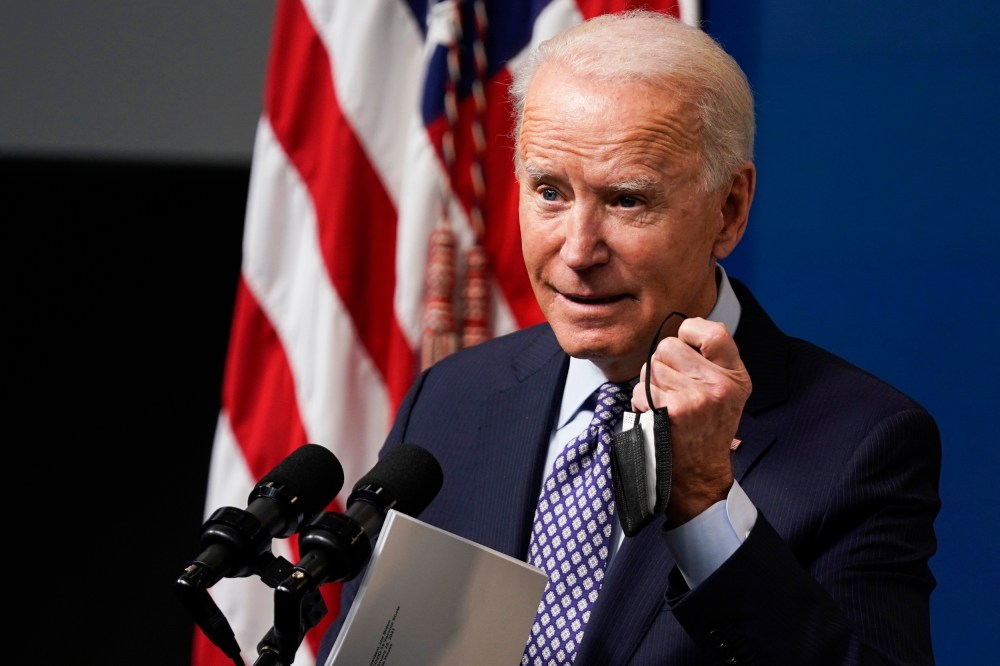

The most likely outcome was failure. On Jan. 14, about a week before his presidential inauguration, Joe Biden unveiled a $1.9 trillion American Rescue Plan in a prime-time address, and there was reason for skepticism about its chances.
After all, the Democrats’ majority in the U.S. House offered party leaders little room for error; the party’s majority in the U.S. Senate barely existed at all; and the idea of keeping competing Democratic constituencies on the same page was daunting.
And yet, after a dramatic process, the ambitious legislation has cleared the Senate and will soon be signed into law. [Update: It passed on Wednesday afternoon.] How in the world did the bill defy the odds? There are a handful of elements to keep in mind.
Republicans weren’t serious about negotiations
It wasn’t altogether obvious at the time, but one of the most important moments in the process came in late January, when a group of 10 Republican senators presented the White House with an alternative COVID relief package — which carried a roughly $600 billion price tag.
The GOP blueprint left little doubt that Senate Republicans weren’t serious about striking a bipartisan deal, forcing Democrats to move forward with the budget reconciliation process. We’ll never know for sure, but if these GOP senators had approached Biden with a more realistic proposal — perhaps something in the $1.3 trillion range — it’s likely the White House and some congressional Democrats would’ve been willing to pursue bipartisan talks in earnest. But with Republicans effectively removing themselves from the process, it became easier for Democratic leaders to aim high.
Proponents assembled a credible, bipartisan coalition of supporters
The American Rescue Plan was backed by voters, health care advocates, labor unions, and a great many corporate executives. Just as importantly, governors and mayors — from both parties — urgently called on lawmakers to approve the bill.
For on-the-fence members, there’s little doubt that this breadth of support offered some political cover to support the package.
The lessons of 2009 still loom large
It’s hard to overstate the degree to which Democratic leaders were preoccupied with 2009 over the last several weeks. While the Recovery Act helped rescue the nation from the Great Recession, Republicans and some conservative Dems forced it to be smaller than it should’ve been, resulting in a slower and more tepid economic recovery.
When Senate Majority Leader Chuck Schumer (D-N.Y.) sat down with Rachel in late January, he insisted, “We’re not going to make that mistake” with the COVID relief bill. Moments later, again referencing 2009, Schumer added for emphasis, “We will not repeat that mistake. We will not repeat that mistake.”
He wasn’t kidding.
Republicans effectively killed discussion of the deficit
When pressed, GOP opponents of the American Rescue Plan would occasionally reference supposed burdens the relief package would put on “future generations,” but their heart obviously wasn’t it in, and no one took the rhetoric seriously anyway. For the last half-century, Republicans have played a ridiculous fiscal game, pretending to care about the deficit when a Democrat was in the White House, and dropping the pretense when one of their own was in the Oval Office. Much of the political world took this posturing seriously for years, but it’s worn thin. Indeed, it helps explain why so many Republicans were more interested in talking about Dr. Seuss than the $1.9 trillion legislation: the GOP’s go-to talking point wouldn’t work, and they couldn’t think of anything else to say. With a steady hand, Democratic leaders would bend but not break Whenever there were meaningful disagreements between Democratic factions, they called the president to make a call. Biden, to his credit, set the initial vision, and tolerated some tinkering on the margins, but quietly worked with Schumer and House Speaker Nancy Pelosi to keep the train on track. The pandemic has jolted American politics Ronald Reagan routinely generated laughs when he’d say, “The nine most terrifying words in the English language are, ‘I’m from the government, and I’m here to help.’” In 2021, the sentiment no longer resonates the same way. From the start of the coronavirus pandemic, surveys have consistently shown broad support for a robust public-sector response. Former Rep. Barney Frank (D-Mass.), who helped craft Congress’ response to the 2009 crisis, told the Washington Post, “It’s been a major shift. People have gone from being anti-government, to beyond being even neutral on it, to thinking: ‘We need the government; it has to help us.’ … You have a new consensus in America — that the government has an important role, and that Ronald Reagan was wrong. For the first time in my lifetime, people are saying that the government has done too little rather than doing too much.” The result is a $1.9 trillion success story.
Steve Benen is a producer for "The Rachel Maddow Show," the editor of MaddowBlog and an MS NOW political contributor. He's also the bestselling author of "Ministry of Truth: Democracy, Reality, and the Republicans' War on the Recent Past."
Latest Post
Recommended


