









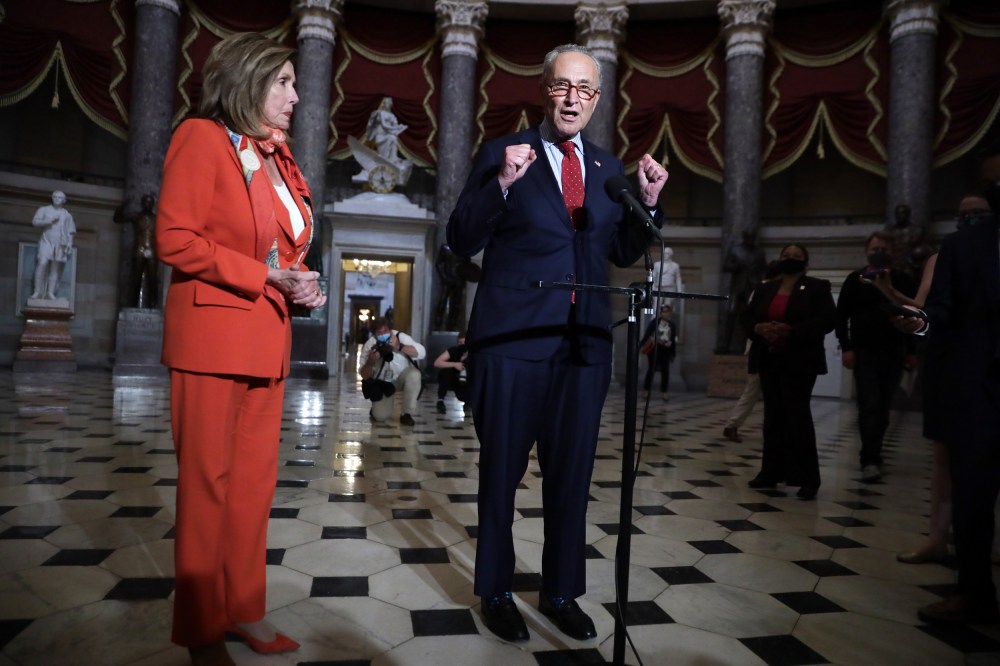

When Senate Majority Leader Chuck Schumer (D-N.Y.) sat down with Rachel last week, he made frequent references to the events of 12 years ago — the last time voters put Democrats in control of the White House and Congress. When Rachel noted that the Recovery Act was made “smaller and significantly less effective” in order to get Republican votes, and nearly all GOP lawmakers voted against it anyway, Schumer nodded in agreement.
“We’re not going to make that mistake” with the COVID relief bill, the Democratic leader said. Moments later, again referencing 2009, Schumer added, “We will not repeat that mistake. We will not repeat that mistake.”
The “mistake” was Democratic efforts to pass key legislation with Republican support, and it happened over and over again. On the economy, the Recovery Act was made smaller at the GOP’s insistence, but more than 99% of Republicans voted against it. On immigration, GOP lawmakers told then-President Barack Obama to focus on security and enforcement first. He met their demands, at which point Republicans killed a comprehensive reform bill anyway.
On health care, Republicans pushed for a market-based system, largely dependent on private insurers, and Democrats spent literally months trying to make GOP members happy. It didn’t matter. In Obama’s new book, he shares an anecdote in which Sen. Chuck Grassley (R-Iowa) was asked whether he’d support a health care reform bill that included all of the changes to the ACA the Iowan wanted to see. “I guess not, Mr. President,” Grassley replied.
Another Senate Republican from 2009, Wyoming’s Mike Enzi, later conceded that he negotiated with Democrats in bad faith, stringing Dems along for months and weakening the Affordable Care Act blueprint, though he didn’t have any intention of voting for it.
The lesson is hardly subtle: Democrats investing months of effort, and watering down their own worthwhile proposals, is a pointless exercise. As the L.A. Times reported over the weekend, it’s a lesson the party has become preoccupied with.
The experience was a searing one for Democrats, not least because it followed Republicans’ near-total rejection of Obama’s economic-rescue package amid the worst recession since the Depression. The episodes haunt Democrats today as they try to advance President Biden’s $1.9-trillion COVID relief plan, balancing his desire for bipartisanship — he promised, after all, to work with Republicans — against the lesson many took from their 2009-10 experience: Seeking Republican support for an ambitious program is likely a fool’s errand. That’s a major reason why most Democrats in Congress, as well as White House advisors and Biden too, are pushing a go-big, go-fast strategy.
Flagging the article via Twitter, Sen. Sheldon Whitehouse (D-R.I.) wrote, “Fool us once…”
The New York Times had a related report yesterday on the Democrats’ long memories. Their strategy can be traced to 12 years ago, when Barack Obama became president, Democrats controlled both houses of Congress, and they tackled both an economic rescue package and a sweeping health care overhaul. In retrospect, in the quest to win Republican backing for both, Democrats say, they settled for too small an economic stimulus and extended talks on the health care measure for too long. To be sure, I’m not inclined to characterize the events of 2009 and 2010 as a total failure. They weren’t. The Recovery Act rescued the United States from the Great Recession, for example, and the Affordable Care Act has been a life-saving breakthrough that brought health security to tens of millions of families. But the fact remains that these measures should have been, and could have been, far better — and they were made worse at Republicans’ insistence, following lengthy negotiations that, in the end, produced near-universal GOP opposition anyway. As several GOP lawmakers whine incessantly about Democrats exploring ways to govern without them, these Republicans need only review recent history to understand what’s driving the Democratic majority.
Steve Benen is a producer for "The Rachel Maddow Show," the editor of MaddowBlog and an MS NOW political contributor. He's also the bestselling author of "Ministry of Truth: Democracy, Reality, and the Republicans' War on the Recent Past."
Latest Post
Recommended


