








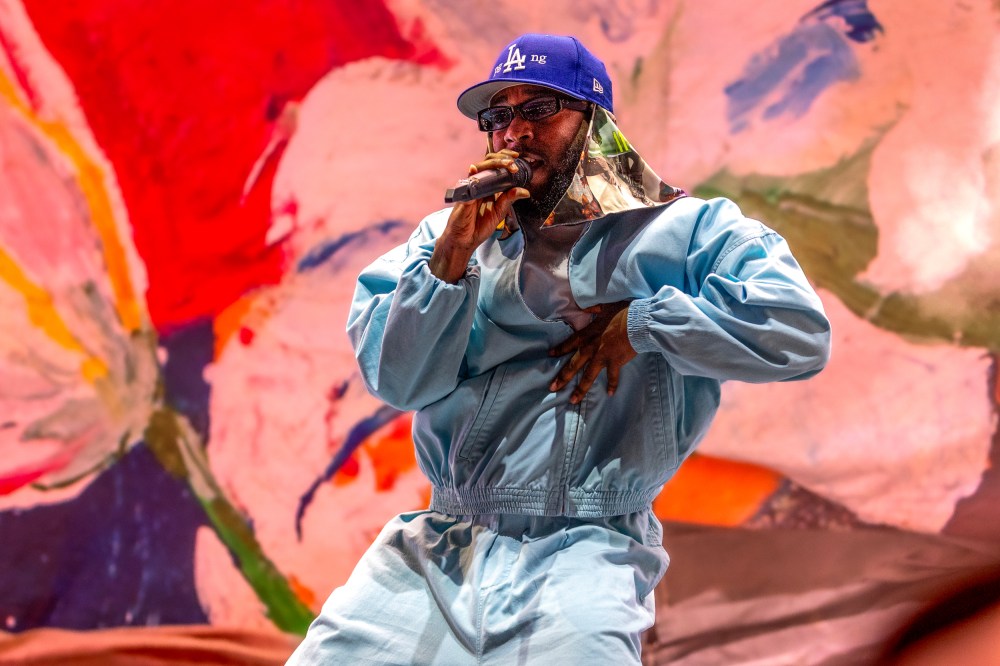
At the 2016 Grammy Awards, as the cry “Black Lives Matter” was still reverberating across the world, hip-hop star Kendrick Lamar, who took home five Grammys that night, used a masterful performance to call out America’s history of racial violence. He appeared chained outside a prison cell before leading a chain gang to the center of the stage. His performance of “The Blacker the Berry,” where he was accompanied by Black warrior women dancing around him, was followed by “Alright,” the unofficial anthem of the Black Lives Matter movement with its powerful mantra “We gon’ be alright!”
It’s not easy to put together a stage performance that leaves people talking, but Kendrick Lamar has met the challenge throughout his career.
It’s not easy to put together a meaty stage performance that leaves people talking, but the Compton-born Kendrick has masterfully met the challenge throughout his career. Not only did he stand out at the 2016 Grammys, but he also shined in a performance with Beyoncé at the 2016 BET Awards and again at the 2018 Grammys with U2 and comedian Dave Chappelle. What’s remarkable is that an artist whose work is so deeply political and who hasn’t chased pop stardom was picked as the artist for Sunday night’s Super Bowl.
It would have been far easier to imagine Drake, the perennial hitmaker who’s the subject of Kendrick’s ubiquitous Grammy-winning diss track “Not Like Us,” being picked for the Super Bowl halftime stage. But Kendrick comes from a particular tradition of MCs who have achieved commercial success while opposing America’s racist machine. It’s likely that Jay-Z, executive producer of the NFL halftime performances and entertainment strategist, intentionally chose Kendrick because of his opposition to anti-Blackness, a stance Jay-Z has consistently taken. In fact, Jay-Z joined forces with the NFL to contribute to the league’s activism campaign called Inspire Change, which addresses criminal justice reform, educational outgrowth and police reform.
“Kendrick Lamar is truly a once-in-a-generation artist and performer,” Jay-Z said in a press release. “Kendrick’s work transcends music, and his impact will be felt for years to come.”
Kendrick appeared on the national scene in 2011 with his debut album, “Section.80.” Much like Jay-Z’s early music did, Kendrick’s criticized Reaganomics for its role in institutional racism, and shaping the self-hate, nihilism and drug culture seen in his neighborhood. While “Section.80” was regarded as a solid debut album, it was Kendrick’s 2012 album “good kid, m.A.A.d city” (GKMC) that cast him into the best-rapper-alive conversations.
Subtitled “A Short Film by Kendrick Lamar,” GKMC is one of the greatest conceptual albums. The events he raps about — witnessing a friend’s murder, breaking into someone’s home, being passed PCP-laced marijuana — take place in one day. The events on GKMC mirror actual events in Kendrick’s life: witnessing two murders, being shot at, experiencing two raids by the Los Angeles Police Department and being beaten by a crew of teenagers in front of his mother.

The commercial success continued with his 2015 album, “To Pimp a Butterfly,” where he metaphorically tells the story of America pimping Black men for their artistic talent. His commercial success peaked with the 2017 release of “DAMN.,” where he wrestles with faith in God and America. “DAMN.,” which won the Pulitzer Prize for music, the first recording that was not jazz or classical to do so, solidified Kendrick’s place in hip-hop as a lyricist and performer who can deliver politically charged messages in a digestible manner.
Jay-Z choosing Kendrick to perform before millions of viewers speaks to Kendrick’s ability to tell stories about racism, politics, religion and DEI for a mass audience. This is not an easy feat to accomplish. When asked by Apple Music commentators Ebro Darden and Nadeska Alexis in a Wednesday news conference what to expect during his Super Bowl LIX performance, Kendrick said, “I think I’ve always been very open about storytelling throughout all of my catalog and my history of music. And I’ve always had a passion about bringing that on whatever stage. I’ve always had a form of that sense of making people listen, but also see and think a little.”
Kendrick’s masterful storytelling put him at a distance from other hip-hop artists.
Kendrick’s masterful storytelling put him at a distance from other hip-hop artists. The 37-year-old rapper’s genius is his ability to use his experiences to critique — and negotiate — America’s oppressive machine. Stories told on records like “Keisha’s Song,” “Sing About Me, I’m Dying of Thirst” and “Black Boy Fly,” among others, bring to life the day-to-day experiences of mostly poor Black people living in neglected neighborhoods. Kendrick’s storytelling isn’t limited to songs and conceptual albums. As he’s shown, his stage performances are just as evocative.
During the 2016 BET Awards performance with Beyoncé, he again called out America’s wrongdoing. While running through the lyrics to their collaboration, “Freedom,” a song from Beyoncé’s album “Lemonade,” the stage methodically flooded with water, fire and smoke, alluding to the residue of war.
In the 2018 Grammys performance, he called out America’s hypocrisy for its conflicting ideals of freedom and violence while performing his song “ELEMENT.” We see on that video an American flag flying in the background, and after he raps the first verse, the song abruptly ends with a gunshot. We see dancers dressed in army fatigues as Kendrick raps through the second verse, which also ends abruptly with a gunshot. Chappelle appears onstage to say that an honest Black man can be frightening to America. By the end of the performance, dancers, dressed in blood-red bodysuits, all fall down at the sound of gunshots. With each gunshot sound, Kendrick called out a term: integrity, job, children, land, preacher, brother, feelings, morals, comfort, culture, neighbor and equality. Kendrick isn’t the same performer he was in 2018. He’s much better. During his 2023 “Big Steppers” tour, promoting his fifth studio album, “Mr. Morale & the Big Steppers,” the 20-time Grammy winner used a piano, a white silhouette, beams of light and the voice of British actress Helen Mirren to tell the story of someone working through addictions, distractions and fruitless passions. Kendrick isn’t the same performer he was in 2018. He’s much better. Kendrick cannot separate his experiences with incarceration, violence, murder and racial exploitation from his craft as a rapper and performer. Each performance is like one piece of a puzzle that, when complete, will tell a full story: Hip-hop is spiritual for Kendrick and has been the medium to help him face and quell his addictions and everyday distractions, and to critique America’s racist machine. In Kendrick’s world, hip-hop saves lives. A week ago, Kendrick Lamar took home five Grammys. He won song of the year, best rap performance, best rap video, best rap song and record of the year, all for “Not Like Us.” Whether he performs the song — which Drake has claimed in a lawsuit amounts to character assassination — remains to be seen. But I’m guessing that Kendrick, with what will likely be his only time performing for a Super Bowl audience, doesn’t want to be remembered as the “Not Like Us” rapper and won’t perform that song.
Darryl Robertson
Darryl Robertson is a freelance writer, a research assistant for The New York Times, a section editor for Souls and a student at Columbia University. His research interests include hip-hop and understanding how the Black Power movement services its communities. He is also interested in understanding how social, geographical and historical factors contribute to hip-hop. 


