








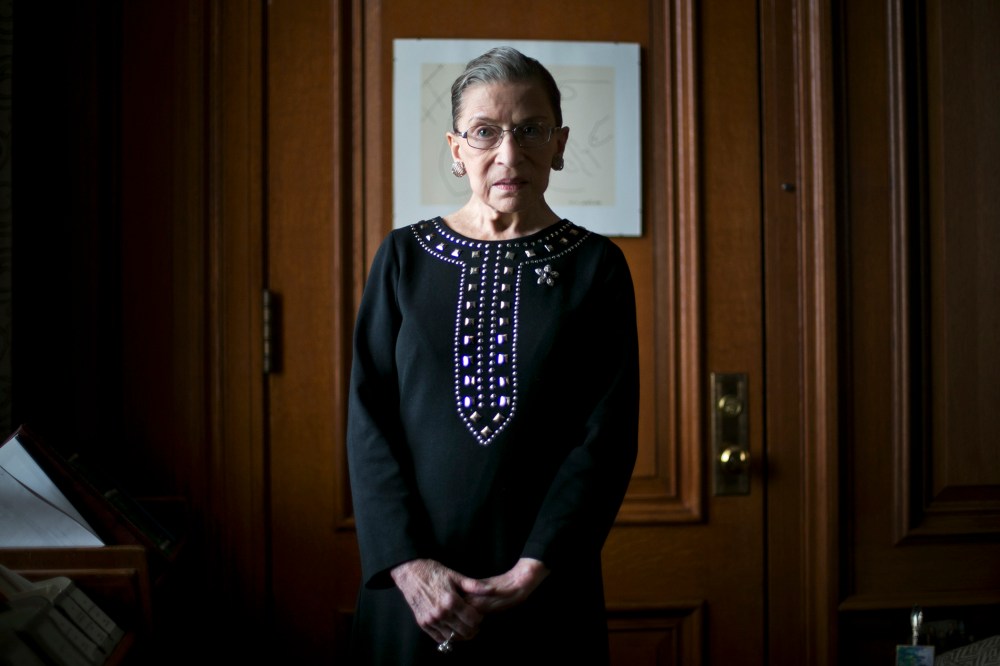
Liberals are praising Justice Ruth Bader Ginsburg’s pointed dissent from the ruling in the Hobby Lobby case, which found that “closely held” corporations can be exempt from having to provide insurance coverage to their employees that includes birth control. Ginsburg’s opinion savages the majority’s departure from precedent, its double standards regarding religious freedom, and its disregard for the impact of denying women coverage for contraception. But some legal experts say it might end up doing more harm than good.
Ginsburg’s dissent begins by calling the decision one of “startling breadth.” The high court ruled that under the Religious Freedom Restoration Act, the government cannot require “closely held” corporations–those with most of their stock owned by fewer than five individuals–whose owners possess “sincerely religious beliefs” against the use of contraception to provide health insurance to employees that covers birth control. Ginsburg fears that the majority has “ventured into a minefield” with the decision, which could allow corporations to “opt out of any law” that “they judge incompatible with their sincerely held religious beliefs.”
Two of the justices in the majority disagree with her–Justice Samuel Alito, writing the court’s majority opinion, wrote that “Our decision should not be understood to hold that an insurance coverage mandate must necessarily fall if it conflicts with an employer’s religious beliefs.” Justice Anthony Kennedy, in a concurrence, tips his hat to Ginsburg’s “respectful and powerful dissent,” but says that the opinion “does not have the breadth and sweep ascribed to it.”
Ginsburg’s opinion, some legal experts say, may turn out to be a self-fulfilling prophecy. By stating that the opinion is much broader than the majority claims it to be, she may be providing lower-court judges with a stronger foundation to provide more religious exemptions in the future.
“If the dissenters had simply taken Kennedy at his word in his concurrence, and simply agreed it was narrow, the lower court judges would have had to work very hard to say this applies broadly,” said Eric Segall, a professor at Georgia State University College of Law. “Now they can just cite Ginsburg, and say she thought it applied broadly.”
%22If%20the%20dissenters%20had%20simply%20taken%20Kennedy%20at%20his%20word%20in%20his%20concurrence%2C%20and%20simply%20agreed%20it%20was%20narrow%2C%20the%20lower%20court%20judges%20would%20have%20had%20to%20work%20very%20hard%20to%20say%20this%20applies%20broadly.%20Now%20they%20can%20just%20cite%20Ginsburg%2C%20and%20say%20she%20thought%20it%20applied%20broadly.%22′
If that sounds far fetched, consider that this kind of thing has not only happened before, it has happened recently. Last year, when the Supreme Court struck down part of the Defense of Marriage Act in U.S. v Windsor, Chief Justice John Roberts wrote that Kennedy’s majority opinion should not be construed as saying state laws barring same-sex marriage are unconstitutional. In another, much angrier dissent, Justice Antonin Scalia wrote that it pretty much did just that. “The majority arms well every challenger to a state law restricting marriage to its traditional definition,” Scalia wrote.
Since then, judges striking down same-sex marriage bans gleefully cite Scalia in doing so. Rather than stemming a flood of rulings in favor of same-sex marriage, Scalia’s dissent helped blow up the dam.
“Ginsburg’s ruling could be used by judges to justify granting corporations other exemptions from the law. Justice Scalia’s Windsor dissent highlights the risk,” said Adam Winkler, a professor at UCLA School of Law. “Scalia insisted that Windsor‘s logic undermined bans on same-sex marriage — and courts since have cited Scalia in striking down such laws.
“Ginsburg’s dissent was a surprise,” added Winkler. “She must know what’s happened with Scalia’s Windsor dissent.” That’s not to say justices should lie about their views for strategic reasons. “They should never lie,” said Segall. “Opinions can be read in many different ways, Ginsburg had a choice, she could have read it broadly or read it narrowly, and she could have done either one without lying.” The case can be made that judges are going to do what they want anyway, regardless of precedent and so Ginsburg’s dissent doesn’t offer anything more than pretext. After all, Justice Samuel Alito invented a new legal distinction in his opinion weakening public employee unions Monday, determining that home health-care workers were only “partial public employees” despite being compensated with federal funding. A judge committed to granting a religious exemption to the law would be able to find a way to use the Hobby Lobby opinion to justify doing so, even without Ginsburg’s dissent. Judges set against such exemptions, by contrast, will be able to look to Kennedy for support. Nevertheless, it’s possible that in the future, judges who want to let people “opt out of any law” for religious reasons will rely on Ginsburg’s dissent for cover.
Adam Serwer Recommended


