








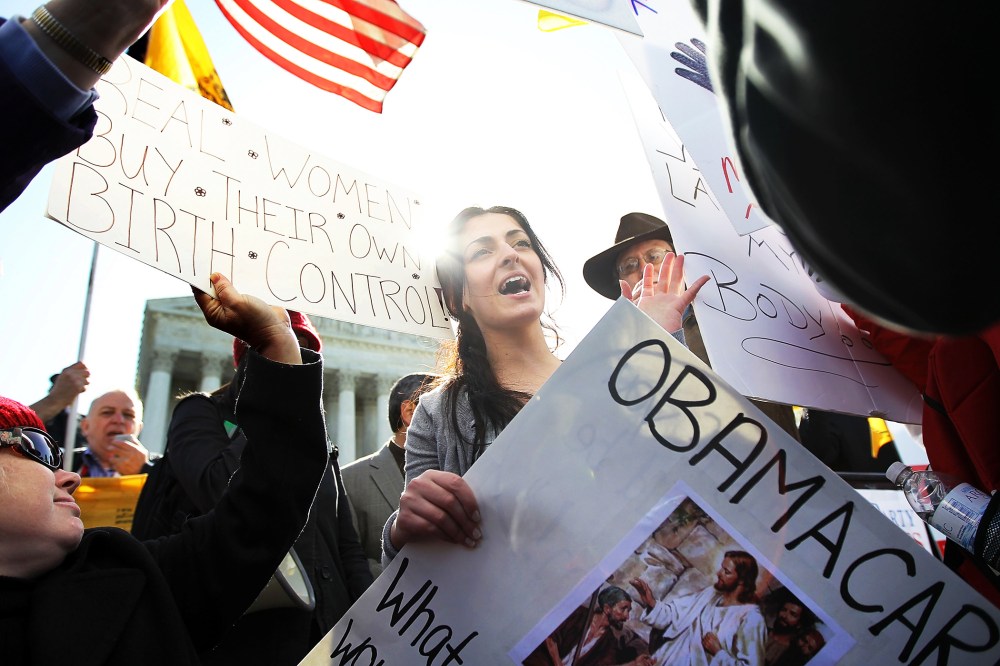
If the Supreme Court undermines the Affordable Care Act’s contraceptive coverage requirements in two cases it hears next week, there will likely be one law to thank. That would, ironically, be the one signed and celebrated by Democrats and civil libertarians, originally opposed by social conservatives, and meant to undo a decision written by Justice Antonin Scalia — the Religious Freedom Restoration Act, or RFRA.
At the Act’s signing ceremony in 1993, Bill Clinton joked, “The power of God is such that even in the legislative process, miracles can happen.” He was talking about the rare left-right coalition that eventually came together to pass RFRA. But that coalition has since fractured over how far religious exemptions from general laws can go in impeding others’ rights.
On Tuesday, the business-friendly Roberts Court hears two challenges to the Affordable Care Act’s requirement that insurance plans cover birth control without a co-pay, which they say violates RFRA. Hobby Lobby, a craft chain, and Conestoga Wood, a cabinet-maker, say that their owners oppose some forms of birth control, which they conflate with abortion, contrary to scientific consensus. They’re two of the 41 for-profit companies insisting that government mandating coverage of contraception as preventive care is burdening their religious freedom.

Although the Court has to say once and for all whether corporations even count as religious persons under RFRA, so far the law has been the best bet for such cases in lower courts.
That leaves many of the initial backers of RFRA, many of whom foresaw it as a protecting religious freedom against government interference, not as a license to foist one’s religious beliefs on someone else, somewhere between baffled and furious.
‘It was never intended as a sword as opposed to a shield,” said Rep. Jerry Nadler, one of the architects of RFRA in the House. “Once you went into the commercial sector, you couldn’t claim a religious liberty to discriminate against somebody. That never came up. It was completely obvious we weren’t talking about that.”
The vaunted left-right alliance on RFRA has fallen apart over such claims. “If anyone had ever come up with a scenario like what’s been proposed by Hobby Lobby, that coalition would have exploded like someone hitting a watermelon with a shotgun,” said Barry Lynn of Americans United for Separation of Church and State. “There would have never been a Religious Freedom Restoration Act.”
Even if the Court decides corporations count as religion persons, it has to decide whether the contraceptive provision violates RFRA — weighing whether covering birth control on insurance plans is a substantial burden on the companies versus the government’s interest in women’s health. If the Court does rule for Hobby Lobby — very much an open question — the door will potentially be open to much broader claims of religious exemption from neutral laws, including anti-discrimination statutes and in transactions between private citizens. That was precisely the fear provoked by so-called ‘religious freedom’ bills being proposed in several states.
The next step, Lynn warned, could be “let’s go after equal pay, let’s go after the civil rights acts, let’s just go after everything that every religious right group doesn’t like and doesn’t want to obey.” He added, “I don’t know how the justices will ever be able to draw a line.”
…
It all started with peyote.
Two members of the Native American Church in Oregon were fired from their positions as drug counselors for using the drug as part of a religious ritual, and then denied unemployment benefits because their drug use, though religious in nature, was considered work-related “misconduct.”
The two men argued that their First Amendment rights to free exercise of religion had been violated. The Supreme Court disagreed. Siding with the former counselors, wrote Justice Antonin Scalia in Employment Division v. Smith in 1990, would “open the prospect of constitutionally required religious exemptions from civic obligations of almost every conceivable kind.” The court majority lowered the legal standard by which governments were generally expected to accommodate individuals’ religious beliefs. The risk, Scalia wrote, would be “in effect to permit every citizen to become a law unto himself.”
The backlash to the decision was swift.
“Nothing mattered except that the religious community thought that the Supreme Court had slapped them in the face,” said William Galston, the former Clinton administration policy adviser who pushed for RFRA’s passage from the White House. “It wasn’t just the liberals, it wasn’t just the conservatives, it wasn’t just the mainstream Protestants, it was everybody.”
Shortly after the decision, Lynn said, activists across the political spectrum met with then-Democratic Massachusetts Sen. Ted Kennedy and Utah Republican Sen. Orrin Hatch to organize a coalition to overturn the decision.
Their main opponents, surprisingly enough, were the religious right. No less a fevered opponent of abortion than Rep. Henry Hyde initially opposed RFRA because he feared “proabortion groups” would claim that a woman had a right to an abortion on a religious basis. Hyde also thought it was probably unconstitutional to undo a decision by the Court that way: “We are a legislature, not the Court.” The Supreme Court later ruled that RFRA could only apply to federal laws, not state laws.
At that point, the Supreme Court was only months away from deciding a major abortion case, Planned Parenthood v. Casey, that many expected to overturn Roe v. Wade. Abortion opponents weren’t keen on potentially giving abortion rights another route.
That frustrated RFRA’s supporters, including Douglas Laycock, a law professor who remains a prominent voice in support of “religious liberty” bills. “I simply don’t understand why elements of the prolife community have allied themselves with people who are suspicious of all religious exemptions,” he testified before a House subcommittee in May 1992. “Conservatives need this bill as much as liberals. Mainstream liberals need it as much as minority faith.”
Laycock warned, “The most aggressive elements of the pro-choice, gay rights and feminist movements are not content to prevail in the larger society; they also want to impose their agenda on dissenting churches.” Reached by msnbc, Laycock said, “I said that in 1992? I was pretty smart. That’s what happened.”
Bill Clinton embraced the bill, which aligned with his identity as a New Democrat, comfortable with faith and seeking detente in the culture war. It also allowed the left to turn the tables on who, exactly, was defending religion, in what happened to be an election year.
On Crossfire, ACLU’s Nadine Strossen taunted Jerry Falwell, “It’s odd that the Republican party is touting its concern for religion and God when it is Bill Clinton who pledged that he would sign the Religious Freedom Restoration Act, something that President Bush did not say he would sign, and virtually every religious denomination in this country is vigorously supporting that, because it’s necessary to restore religious freedom that the Reagan-Bush Supreme Court has taken away.”
Once Clinton was elected, and with the Court having left the right to abortion formally in place with Casey, social conservatives figured Roe wasn’t going anywhere anytime soon and threw their support behind RFRA.
By then, the consensus was overwhelming. “The sort of amazing thing is that people on the left and right, people who disagreed about so many things, somehow they all convinced themselves that religious liberty was wounded and needed to be fixed,” said Ira Lupu, a George Washington University Law School professor who testified about the law before the House. He was one of the rare skeptics. “I thought Congress was being sold a bill of goods,” he says now.
RFRA passed by a voice vote in the House, and by 97-3 vote in the Senate, with the only of the “no” votes being cast by Democrats Robert Byrd and Harlan Matthews and Republican Jesse Helms–Helms didn’t like that the bill didn’t exempt prisoners from its protections.
Galston’s memory of the signing ceremony is rendered in Benetton colors.
“I wish a painter had been there to paint it,” says Galston. “There were representatives of every conceivable faith in the United States, many of them decked out in full ceremonial garb. if you wanted to do Norman Rockwell on freedom of diversity and religion in the United States, you couldn’t have picked a better picture.”
But all the examples cited that day were of individuals whose personal religious expression had been limited by the government. The idea that RFRA was intended to benefit religious minorities was so entrenched that Religious News Service (inaccurately) described it at the time as “legislation intended to protect indigenous religions in the United States.” To the law’s liberal supporters, the kind of protections conservatives would come to claim under RFRA were inconceivable at the time–like the right to refuse services to a same-sex couple, or a for-profit corporation citing religious belief to deny its employees birth control. But in the years following RFRA, it became clear that liberals and conservatives had very different conceptions of what “religious freedom” meant. In an case that would presage the current battle over gay and lesbian rights, in 1994, Evelyn Smith, a landlord in Chico, California, refused to rent an apartment to an unmarried, heterosexual couple because she thought they were living in sin. Smith’s refusal violated a state housing anti-discrimination law, but Smith argued that RFRA protected her right of refusal. The California Supreme Court disagreed, concluding that Smith was running a business, and “to permit Smith to discriminate would sacrifice the rights of her prospective tenants to have equal access to public accommodations and their legal and dignity interests in freedom from discrimination based on personal characteristics.” Within the Clinton administration, a young associate White House counsel named Elena Kagan watched the California case with interest. In a 1996 memo, she described the California Supreme Court’s reasoning that the anti-discrimination law wasn’t a substantial burden on Smith’s religious beliefs “quite outrageous,” warning that, “taken seriously, this kind of reasoning could strip RFRA of any real meaning.” Smith asked the Supreme Court to overturn the California verdict, and Kagan urged the Justice Department to get behind the landlady’s case. “Give the importance of this issue to the President and the danger this decision poses to RFRA’s guarantee of religious freedom in the State of California,” Kagan wrote, “I think there is an argument to be made for urging the Court to review and reverse the decision.” The Supreme Court declined to hear it. In 2010, Obama appointed Kagan to the Supreme Court. Kagan’s nineties-era enthusiasm for the landlady’s cause doesn’t necessarily mean she’ll take Hobby Lobby’s side now. Smith was one person, not a corporation employing 13,000 people, Samuel Bagenstos, a law professor at the University of Michigan and former Obama Justice Department Official, points out. “The burden on the landlady’s religious practice was at least plausibly much more direct than it is in Hobby Lobby,” he said. RFRA’s original supporters on the left however, took the opposite tack from Kagan on cases like Smith’s. The prospect that the bill could exempt someone from an anti-discrimination law, said Lynn, “made people nervous in the coalition. The only reason we supported RFRA at all was that we thought it was very narrow.” His organization filed a brief against Smith in that case. In 1999, the ACLU opposed a bill that expanded on RFRA, pointing to a similar case in Alaska where the U.S. Court of Appeals for the Ninth Circuit said landlords didn’t have to comply with local civil rights law and could refuse to rent to unmarried couples if they said it violated their religious beliefs. The group asked for “explicit language ensuring that the legislation will not undermine enforcement of state and local civil rights laws.” The ACLU has filed an amicus brief urging the Supreme Court to rule against Hobby Lobby, and to see it in the context of religious justifications for slavery and anti-discrimination laws. Nadler struck a similar note. “Once you went into the commercial marketplace, it was always understood you were subject to the law there,” he said. “You couldn’t say, I don’t want to obey this law, because it violates my religious liberty, I’m operating a soda fountain, I don’t want to let black people here. Some people tried that in the 1960s and the court said no.” Strictly speaking, the Affordable Care Act isn’t an anti-discrimination act. But the ACLU is arguing that because the contraceptive provisions help make women’s healthcare equal to men and ensure women’s full participation in society, it functions the same way. Among RFRA’s original proponents, Laycock seems the most comfortable with the turn it’s taken. “It’s true that no one was thinking about corporations in 1993,” he conceded. But he thinks it’s a valid claim, and he filed a brief urging the court to rule for Hobby Lobby. Laycock also thinks private businesses that want to deny services to gay people should at least get their day in court, and in some cases he thinks the courts should rule in their favor. In the case of the photographer who refused to take pictures at a same-sex wedding, he said, the religious service provider’s beliefs should prevail if other photographers are available, because the religious belief is more important than gay people being “insulted.” Laycock said, “I have trouble seeing the insult as a greater harm.” The death of the original RFRA coalition has allowed the fight over Hobby Lobby to largely divide along traditional partisan lines — and to give the right a chance to blame Obama for crushing religious freedom. As proposals to expand state-level Religious Freedom Restoration Acts failed across the country, National Review re-published Senator Ted Kennedy’s 1992 speech introducing RFRA with the headline, “hate-speech by an anti-gay bigot,” as though Kennedy was endorsing, from beyond the grave, a measure designed to allow business owners to discriminate based on sexual orientation. Kennedy is no longer around to defend his true intentions. But despite his consternation about how RFRA has been used, Nadler said, “I don’t have any regrets about the law. We thought it was necessary.” But he doesn’t think it should protect Hobby Lobby. “They’re trying an entirely wrong interpretation of it,” Nadler said, “and I don’t think the Court’s going to let them get away with it.” But given the current composition of the court, that is very much a matter of faith.
Irin Carmon
Adam Serwer Recommended


