








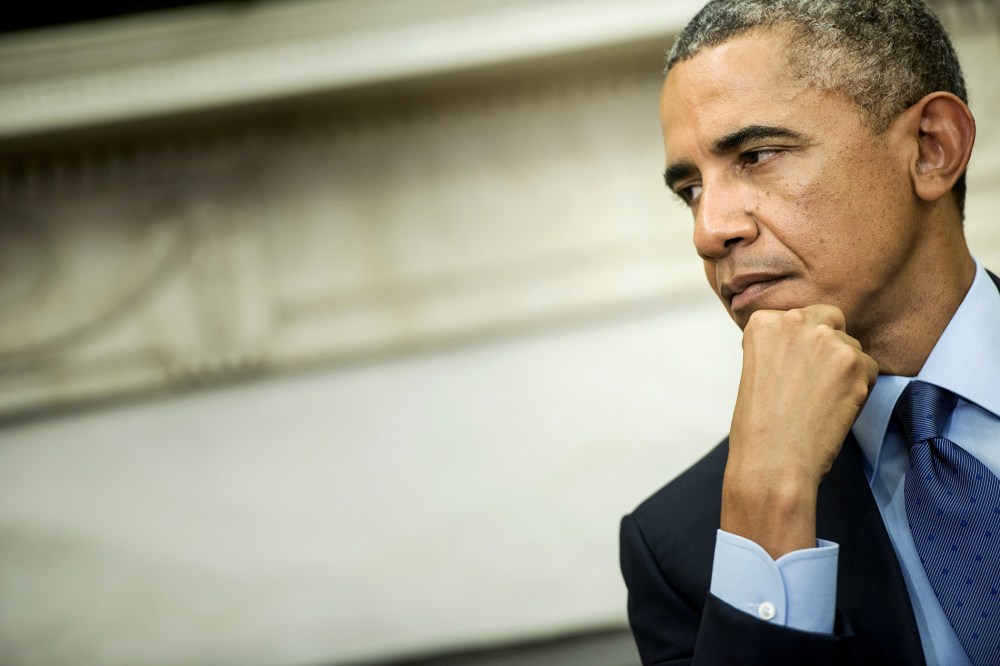
Barack Obama’s coalition has become a curse for Democrats, in addition to a blessing.
In 2008, running to become the first black president, Obama made history by inspiring Americans who don’t typically vote to get to the polls. The problem is that it’s difficult to reliably capture that kind of lighting in a bottle on the first Tuesday of November every two years.
There may be more people in Democrats’ “coalition of the ascendant” — young people, minorities, single women and others — than in the GOP grouping, which skews white and male and old. But the Democratic coalition is much more fragile, as Tuesday night’s victory proved.
There are lots of important numbers that help explain Democrat’s drubbing, but here’s the underlying landscape of Tuesday’s vote, as well as virtually every other election: There are more conservatives in America. Far more. And they vote in every election, not just in presidential years.
Exit polls from Tuesday night show 37% of voters identify themselves as conservative, compared to just 23% who say they’re liberals. About 40%, say they’re moderate.
That’s consistent with survey data going back decades, and the numbers have held more or less steady over time. In 1996, 20% of Americans said they were liberal and 40% conservative, according to Pew.
Ideological partisans tend to be the most dedicated voters and the ground troops of the party, so Democrats start every election with a deficit here. Lately, Democrats have only overcome that drag with the intensity of a presidential campaign and the inspirational force of a charismatic leader.
“There’s basically two Americas — there’s midterm America and there’s presidential-year America,” White House senior adviser Dan Pfeiffer told The Washington Post. “They’re almost apples and oranges. The question was, could Obama voters become Democratic voters?”
The answer to that question looks like a resounding “no.”
Part of what attracts Democrats to Hillary Clinton 2016 is the groundbreaking possibility of electing the first woman president. But is a reliance on history-making presidential contenders really a sustainable approach?
In North Carolina, which hosted this year’s most expensive Senate race, progressives have been trying to create a more durable coalition under the Moral Monday Movement banner.
Rev. William Barber, the president of the North Carolina NAACP and leader of the Moral Monday Movement, is trying to move past the “messiah” politics of the Obama era.
%22They%20just%20didn%E2%80%99t%20turn%20out.%20They%20weren%E2%80%99t%20as%20interested.%22′
Barber said the task moving forward would be building a wider coalition that isn’t simply charged by one charismatic politician, in this case, Obama. “If you’re going to change America you’ve got to break through that,” Barber said after a speech and rally the night before the election in Greensboro.
“If you get whites, blacks and women and young people and Latinos to begin to come together and begin to change their language and not be trapped by Democrat versus Republican, liberal versus conservative, but really begin to talk about coming together around five issues,” Barber said. He listed among those issues: Poverty and labor rights, educational opportunity, healthcare for all, fairness in the criminal justice system and protecting voting, LGBT, women’s rights and immigration reform.
RELATED: Latino vote hints at hope and danger for GOP
“Those five areas can garner and pull together a different kind of movement and we’ve seen that right here in North Carolina that does not back away from the race critique but allows people to come together across many, many different lines,” he said.
Still, the effort was ultimately unsuccessful in reelecting Sen. Kay Hagan. Even with the most sophisticated and expensive turnout operation ever deployed in a congressional midterm election, Democrats got crushed when the Obama coalition didn’t show up. The electorate skewed along racial and generational lines, very much similar to what happened four and eight years earlier. The drop-off among young voters, who fueled Obama’s insurgency in 2008, was particularly pronounced. Nationally, 18-29-year-olds made up only 13% of the electorate this year, while a quarter of voters were seniors, who lean Republican. That’s a steep drop from 2012, when 21% of the electorate was young. Across the country, voters were much older and whiter than they were in 2012, according to William Frey, a demographer with The Brookings Institution who analyzed exit polls and data from Tuesday’s election. INFOGRAPHIC: What changed in the battleground states Still, Frey said demographic and cyclical factors point to the sweeping Republican victory as more of an “aberration” than a trend indicator. Frey also said there are a few key points to distill from the election data. He said the data suggests less of a referendum on the president than a pattern consistent with a cultural and generation gap, where older whites are resistant to policies associated with a younger, progressive and more diverse America. In a way, Frey said, North Carolina even in this Democratic loss, is a sign that the Democratic coalition of hardcore whites, young and diverse voters isn’t going anywhere — even if it didn’t work this time. “They just didn’t turn out. They weren’t as interested,” he said. Democrats will have a much better shot during the presidential election in 2016, but Republicans will try to head them off at the pass. “What GOP really won yesterday was a huge opportunity to recast our brand before 2016, when the terrain will swing back toward the Ds,” longtime GOP strategist Mike Murphy tweeted. What Democrats gained among minorities and young people with Obama, they’ve lost among whites and older voters, who still make up the larger single segments of the voting population. And worse – those demographics are more likely to vote regularly. For instance, Democratic Senate Candidate Bruce Braley was been leading among women by several percentage points in the final polls, but Ernst easily doubled that margin in her lead among men. And in a state that’s 95% white, no amount of minority turnout could make up for Braley’s 11 point deficit among whites. One silver lining here for Democrats is that Hillary Clinton tends to do well among working class whites, and thus could make up for some of Obama’s major losses among those groups in 2016. But she’ll also have to contend with the possibility that blacks won’t turn out in the record numbers they did in 2008 and 2012 to vote for an African-American president. Clinton does have the potential to electrify a diverse coalition if she decides to run. But once again, Democrats may be lurching from one messiah to another.
Trymaine Lee
Trymaine Lee is an NBC News correspondent.
Alex Seitz-Wald Recommended


