








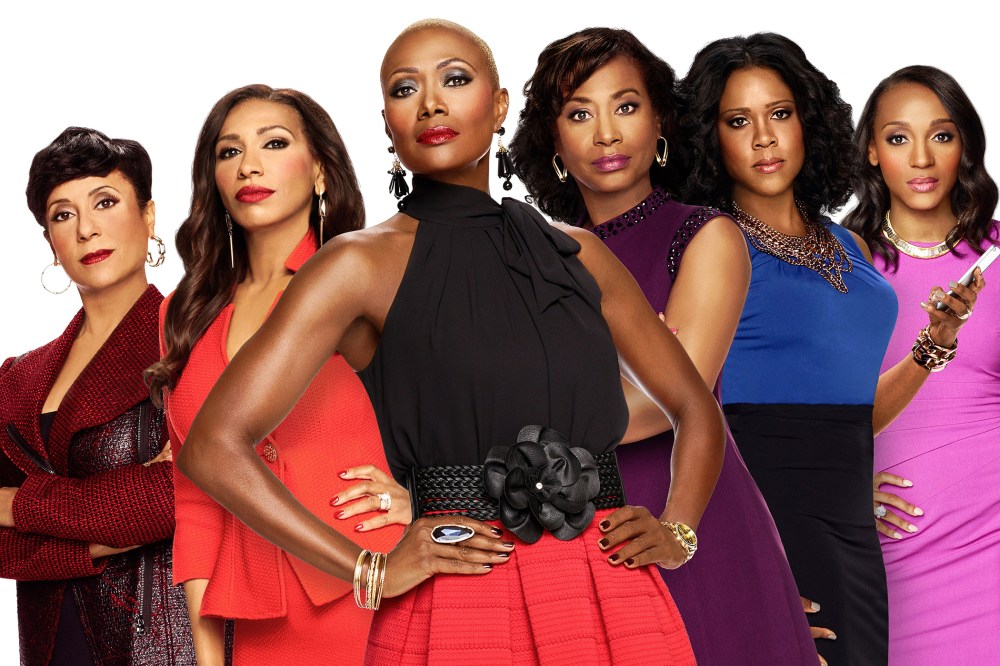
In many ways WE tv’s “Sisters In Law” shares the same DNA with several established reality show series. Copious amounts of shade are thrown. Parties erupt occasionally into shouting matches while large wine glasses are clutched in one hand. Eventually someone will probably utter the phrase: “I didn’t come here to make friends.”
But then there is an extended reference to Sandra Bland, the African-American woman who controversially died in police custody last year in Texas. The stars raise their drinks to toast “Black Lives Matter.” Donald Trump’s infamous surrogate Katrina Pierson (she once argued: “So what, they’re Muslim,” when defending the candidate’s proposed ban on people who practice the Islamic faith from entering the U.S.) makes a surprise appearance and engages in a spirited debate about who deserves credit for the Civil Rights Act.
“Sisters In Law” — which explores the lives of six, close-knit Houston-based black female attorneys, has the potential to be a stealthy vehicle for some poignant, topical commentary on the justice system, racism and the role professional black women play in their communities. Audiences may come for the feuds, but they may stay for the more subtle depictions of the real life of a working lawyer.
RELATED: Complexity of black women’s lives lacking in mainstream media
“People need to see that people like us care and that we fight every day for people,” Juanita Jackson, a public defender who came up with the “Sister In Law” concept and who co-stars on the show, told MSNBC on Tuesday. Jackson sees her “Sisters In Law” as an antidote to the vast majority of reality shows which she believes don’t provide enough positive role models, especially for women of color.
“That’s not the people that live in my world. The people around me are successful self-made women,” she said. Jackson recruited the co-stars, who have been her friends in some cases as long as a decade, under the mantra “let’s be role models,” and with an understanding that the show couldn’t do anything to cost them their prestigious careers.
“We had to come out of this and continue practicing law and have a client base,” she said.
The majority of the cast is made up of criminal defense attorneys, some of whom represent clients who are in desperate, dire straights — defense attorney and cast-member Jolanda Jones refers to them as “the least, the last, the lost.” The stars are also minorities within a minority — at the top of the show the fact that 66 percent of lawyers are men and 82 percent of them are white is front and center. The women all gravitated toward each other because they shared a unique perspective in a field that remains staunchly segregated. As Rhonda Wills, a civil litigator and self-described “dragon slayer,” says in the debut episode: “At the end of the day all we have is each other.”
“This is going to be game-changing,” Jones told MSNBC on Tuesday. “You see a case from the accused person’s perspective, usually it’s from the judge or a victim’s.” Although Jones admits that she is somewhat “scared” about how audiences will react to her no-holds-barred persona she believes the “educational” benefits of the show will outweigh any potential backlash.
Jones’ personal story takes center stage in the debut episode. She is representing a woman who is being charged with the murder of her abuser. As a victim of domestic violence herself, Jones believes her emotional investment in the case is unlike anything you might see in a scripted drama. In the same episode, Jones grapples with allegations that her son was racially profiled by police.
According to Jones, because of her son’s considerable height (he’s 6′ 5″), she “knew” he would be profiled someday. And she laments the fact that her now 24-year-old son is reticent to have children and fears for his life because of what he perceives to be a culture of gun violence. He now identifies as an activist, as his mother does. And as a native-born resident of Houston’s rough-and-tumble third ward, she feels a need to represent her community with pride.
“That’s one of the reasons why I agreed to do the show, because it’s a positive representation of women, not about who we slept with or whose baby mama we are,” Jones said. “We all feel this incessant need to help people who are downtrodden. We pride ourselves on being able to help people.” “Social justice issues are at (the) forefront of every episode because that’s how we lead our lives every day,” added Jackson. The show’s focus on the careers of its protagonists is a bit of a break from the “Housewives” and “Bad Girls Club” franchises, which seem to put a priority on manufactured drama. That said, the premiere episode is not without its fair share of conflict. “We are all different, we clash sometimes but it’s always intellectual,” said Jones. “This show is not purely based on a bunch of women who fuss, fight and make up.” “I think it’s a good balance,” said Jackson, who hopes that women who used to tune into shows where women “throw drinks on each other” will be more enlightened by the arguments on “Sisters In Law,” which have more to do with ethics and work-life balance. Ideally, she hopes the show could encourage more women of color to enroll in law school. “My goal was to be a role model for you women,” she said. “I want people to be inspired.” “Sisters in Law” debuts Thursday on WE tv at 10 p.m. EST.
Adam Howard Recommended


