








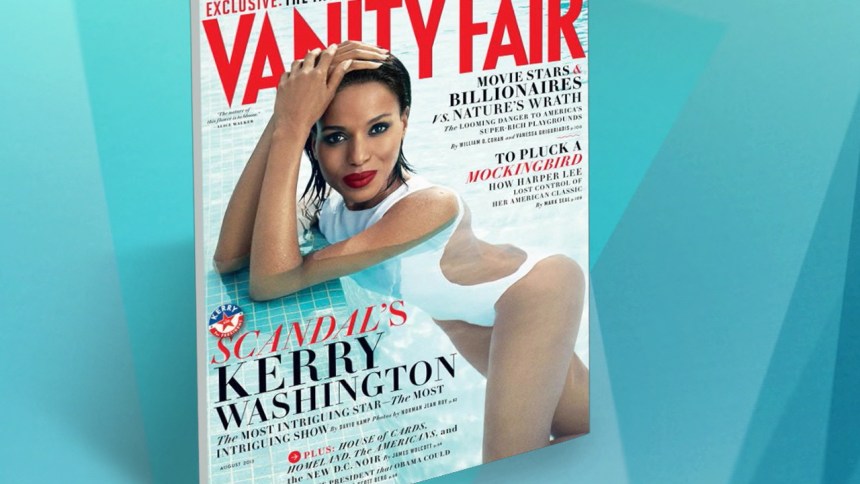
Scandal star Kerry Washington’s star keeps rising, as she made history as the first African-American woman in eight years to grace the cover of Vanity Fair alone (This follows her first high-fashion magazine cover on Elle’s June cover).
Host Melissa Harris-Perry and her Saturday panel discussed the American media’s representation of black women, often classified as lacking, misguided, incomplete, or simply erroneous. There was a consensus among the panelists that Washington’s successful cover turn is important to black women.
“It’s not to say that this means more, but it is an affirmation,” said Issa Rae, creator and star of the hit web series “The Mis-Adventures of Awkward Black Girl.”
Yet there were other representations that were more problematic for the panel. The choice to have actress Zoe Saldana portray legendary soul singer Nina Simone in the upcoming biopic has drawn much criticism not for the film’s star, but for the choice to have her portray someone who many feel she looks nothing like.
“I think casting someone who looks nothing like her and then happening to have the prosthetics added, just something about it doesn’t feel right. And it also doesn’t feel affirmative for all the actresses who look more like Nina Simone and who they could have cast,” said Joy Reid, the managing editor of theGrio.
University of Pennsylvania religion professor Anthea Butler took it one step further. “It’s like as though blackness is interchangeable for them.” She added, “To just put her in that spot I think denigrates all of us in a different kind of way because it just says we will set the standard of what your beauty is and you don’t know what it is.”
Despite their being ratings powerhouses mainstream media has also come under fire for their portrayal of African-American women in reality TV on shows like VH1’s Basketball Wives.
Yet Kenya Moore, a former Miss USA and one of the stars of Bravo’s The Real Housewives of Atlanta said that people “identify with what they’re seeing.” Moore also though the criticism went a little far because, “Our show is a reality show and you open yourself up to those vulnerable aspects of your life.”
Reid noted that the problem with reality TV wasn’t that it existed but there weren’t many other options. “There’s not enough of a variety and I think as long as there’s balance there’s room for everything.” According to Reid, variety is an important concern. “I do worry a little bit that the image of black women is becoming one-dimensional in terms of the way the rest of the world sort of looks at us. That we’re only seen as reality TV.” African-American producers and actresses are finding ways to make their mark but in new ways. For Rae her reasoning for creating her award-winning web series was simple. “I was tired of not seeing myself represented in mainstream media.” “By creating a space where it’s OK to be black you’re forced to relate to this girl who happens to be black and goes through these things that we all go through,” said Rae. For the discussions on reality television and “Awkward Black Girl,” see below.
Shanta Covington Recommended


