








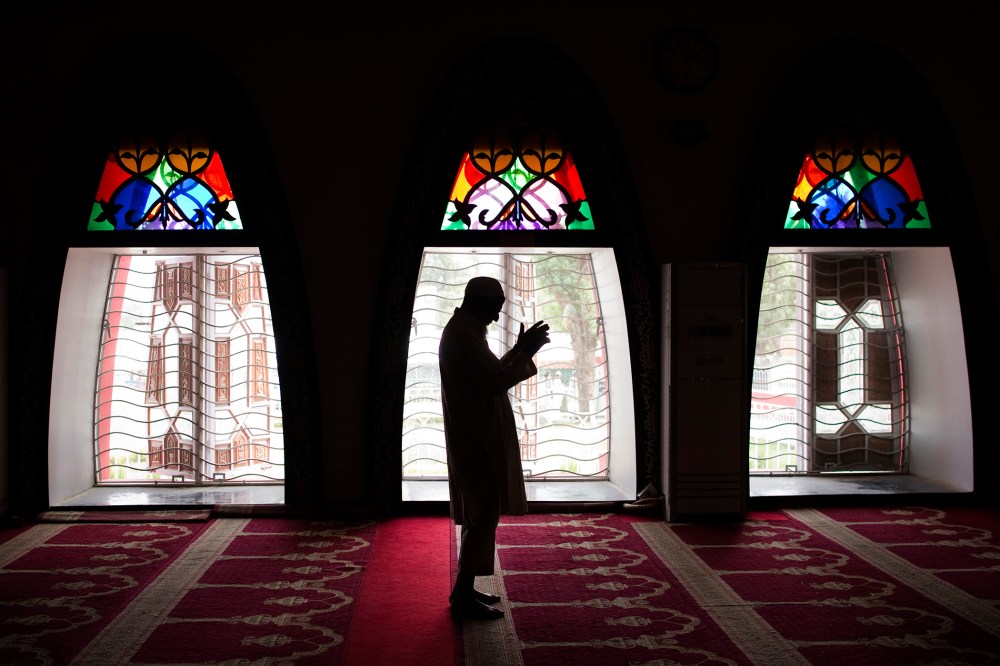
Debuting this year at the Tribeca Film Festival, “Among the Believers” takes viewers inside Pakistan’s infamous Red Mosque, a religious complex led by the firebrand cleric Abdul Aziz Ghazi that teaches thousands of children an extremist interpretation of the Koran. The documentary follows two teenage students, one attending the Red Mosque madrassa, and another who escaped and now goes to a public school in Pakistan.
On Saturday April 18, Directors Hemal Trivedi and Mohammed Ali Naqvi spoke with MSNBC in person about making the documentary. The following has been edited for length and clarity.
MSNBC: Many of the families that send their children to study at the Red Mosque can’t afford to support them. Can you elaborate a little on the conditions facing these families?
On the other hand, the madrassa machinery is working beautifully. It’s very well structured, it’s very well organized. Everything is well-funded. Children are provided with nutrition. And so when there’s such a disparity between a public education system and a madrassa education system, parents would obviously want to send their children to madrassas.
With a school, the option just doesn’t exist. It’s expensive, they don’t see any immediate returns and there is nothing to aspire to. That is one of the biggest reasons why madrassas are thriving in rural Pakistan as opposed to public schools which should have been thriving. A lot of it is because of government incompetence.
Naqvi: Pakistan is, of course, a developing country. It has severe economic problems and political instability. And if you are a family belonging to the rural underclass, where you have eight or nine children, you can barely afford to just take care of one or two. In comes this institution that is not only promising free food and an education but is also giving them lodging and a promise of heaven — it’s a no brainer.
Trivedi: I’m from India. Now if you look at rural India, the same social economic conditions exist as in Pakistan, exactly the same. Pick any third world country, Nepal, Bangladesh, Haiti, the same socio-economic problems exist. But the only difference in Pakistan is the vacuum is filled by madrassas. In India if someone is poor, their children might become day laborers or gangsters.
MORE FROM TRIBECA: ‘Electric Rifle’ documentary explores dirty truths about Taser
MSNBC: Cleric Abdul Aziz Ghazi is the head of the Red Mosque, which is known for teaching thousands of children to pledge their lives to jihad. How did you come to film this documentary, where you literally take us inches away from Aziz — one of the most influential extremists in Pakistan — and show us moments many Westerners could never normally witness?
Trivedi: The film was conceived after the Mumbai terror attacks. I lost one of my friends in the attacks. I was very angry and I’m an Indian woman who was Bangladeshi in Mumbai. I wanted to dig deeper into my anger.
Later on I realized, after a lot of research, that Pakistan is a deeply divided country and there is a fringe minority trying to take over the way of life of a majority of Pakistanis who are moderate and normal people just like Indians, and want to live normal lives. Pakistan’s own identity is under attack.
The biggest battle that is being fought is in education. It’s a battle for children’s minds. I decided I wanted to make a film about ideological conflict that is defining the modern day Pakistan. In the first few shoots I went to a school and shot with Zarina [a public school student] and went to a madrassa and shot with Talha [a Red Mosque student]. Slowly and steadily the film started crystalizing and I realized I needed access to the Red Mosque and I needed access to Aziz.
%22If%20you%20want%20to%20solve%20the%20problem%20of%20extremism%20in%20Islam%2C%20then%20it%20has%20to%20be%20done%20by%20Muslims%20themselves.%20Outsiders%20can%20never%20solve%20the%20problem%20of%20extremism.%22′
Trivedi: The first thing we knew we needed was to get into the mosque. One of our co-producers, Syed Musharaf Shah, comes from a very conservative Muslim family and he was able to get us to meet with Aziz for the very first time and it was very scary. Then the pleasure of story and craft sometimes overrides your fear, and it kind of forces you to make stupid decisions, which is what I guess we were feeling. Should we or should we not?
Then we collectively decided, “yes lets go.” We go there and we’re greeted in this small bungalow in this middle class neighborhood of Islamabad by bearded, stern-looking men with Kalashnikovs, and we thought we must be in the right place. They escort us inside and there is Aziz, sitting on the floor, and he’s very calm and humble. He’s of course surrounded by all these guards, so it was very intimidating.
I thought this would be the only interview we’d ever get with him. We had no idea that we’d get the access that we did. First, our co-producer Naziha interviewed him, and he refused to even look at her, so I stepped in. We covered a lot, but what became obvious was these initial questions weren’t just about the Red Mosque but about everything. I honed in on spirituality. We had no idea this project would take five years.
Naqvi: When you are shooting someone for five or six years, that relationship organically grows, and I feel like we got the best access. For me what become obvious was to disassociate with whatever personal bias I might have against this man, as a moderate Muslim and Pakistani myself. I had to disassociate with that and genuinely understand his spirituality and his dogma, and as such, understand my own spirituality.
MSNBC: Did he [Abdul Aziz Ghazi] know you were going to make this into a documentary? Naqvi: He knew we were making a documentary, and I think he was a bit surprised because the most people usually do is a one-day shoot, but we kept consistently coming back. He knew it would depict the ideological divide in Pakistan and has actually seen a really advanced cut of his own scenes and he was happy and pleased with it. Trivedi: It took a year and a half to edit this film and we did it very delicately because this is such explosive material, and if it’s not handled delicately it could be blasphemous and therefore not inspire the conversation that we genuinely want to inspire. It’s a conversation that needs to happen among believers about the faith, identity, and ideology. If this is handled incorrectly, it can lead to a conversation that is absolutely different and we didn’t want the film to be shunned. Even with Aziz, I would edit it and run it through other producers and editors. We feel that American intervention and outside forces coming in have failed spectacularly. The shift has to come from Muslims themselves. %22We%20didn%E2%80%99t%20know%20that%20at%20the%20madrassas%2C%20students%20didn%E2%80%99t%20know%20any%20meaning.%20They%20were%20memorizing%20for%20sixteen%20hours%20a%20day%20a%20book%20that%20is%20in%20Arabic.%22′ If you want to solve the problem of extremism in Islam, then it has to be done by Muslims themselves. Outsiders can never solve the problem of extremism. It has to be a war among the believers. MSNBC: There is a scene in the documentary when a boy at one of the madrassas reveals he does not know the interpretation of the verses of the Koran he is studying, which really resonated with the audience. What was your reaction to witnessing that? Trivedi: We were slightly aware but we didn’t know that at the madrassas, students didn’t know any meaning. They were memorizing for sixteen hours a day a book that is in Arabic. Most of the children spoke either Pashto, Urdu, or Punjabi, but not Arabic. I couldn’t believe it. Immediately I thought, that’s a great weapon for mind control. “Memorize it and don’t worry about the meaning” — it’s a very common traditional religious education system. MSNBC: Dr. Pervez Hoodbhoy is a Pakistani nuclear physicist, national security analyst, and author who is a very passionate advocate of fighting radicalism in Pakistan. What was it like reaching out to him and what do you think he brought to the table in this debate? Trivedi: The reason we got in touch with Pervez is because I wanted to understand the ideological conflict from a neutral point of view. He is the biggest education reformer in Pakistan, so that is why we contacted him and he’s actively working on educational reform. Madrassas already exist and are very strong, so he is working with the government to try to see if they can be used as a mechanism to educate children on normal subjects like math and science. MSNBC: How does this documentary speak to what’s going on in the entirety of the Muslim world? Trivedi: Islam is not about politics, it’s about spirituality. This needs to be shown to policymakers in D.C. because what we really want is to inspire this dialogue about books, not bombs. Terrorism cannot be destroyed but it can be defused. Instead of investing in nuclear bombs, just invest in books. That is the biggest thing that we want.
Mohamed Hassan Recommended


