








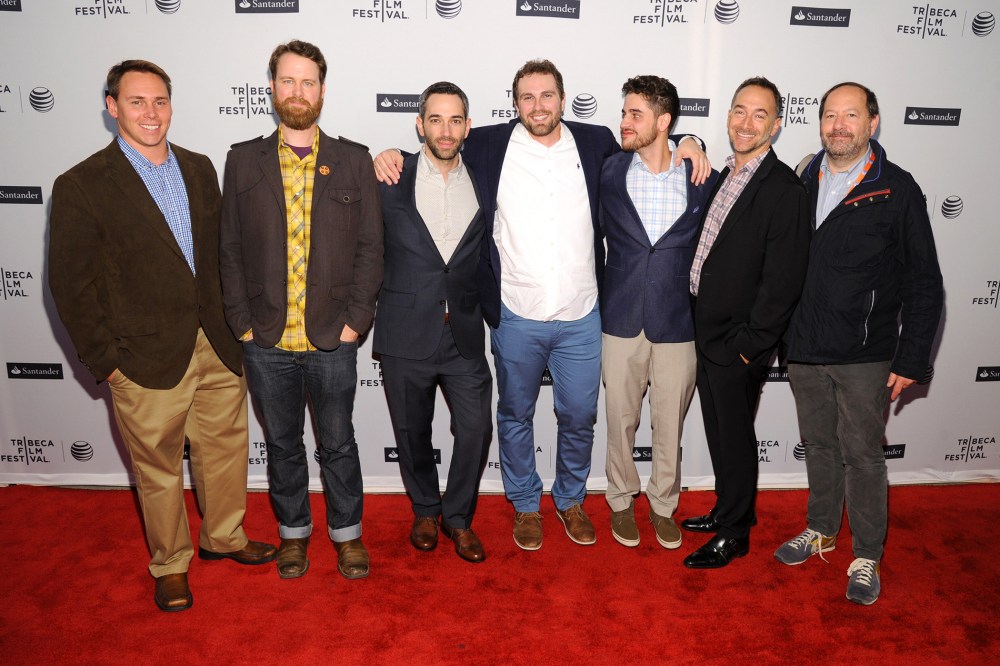
From 2001 to 2012, there were 500 Taser-related deaths reported in the U.S., according to Amnesty International. “Tom Swift and His Electric Rifle,” which made its debut at this year’s Tribeca Film Festival, tells the story of how TASER International, the company that supplies law enforcement with its namesake electroshock weapon, grew to become a corporate goliath despite mounting evidence of the product’s potential harm. The documentary takes an in-depth look at the TASER’s founding brothers, Rick and Tom Smith, and the controversial decisions behind their meteoric rise.
On Tuesday, April 21, msnbc sat down with Director Nick Berardini and Producer Brock Williams to discuss their new film and the naivete of trying to invent our way out of complex law enforcement challenges. The following has been edited for length and clarity.
MSNBC: How did you get access to TASER International and its founders Rick and Tom Smith?
Berardini: It’s tough because what I found fascinating was, as I looked into them more, they had sort of this victim’s mentality at that point. They are true believers, which makes them amazing characters. They did not really understand why at that point the public had kind of turned against them. They were starting to lose these lawsuits and they saw themselves as guys making a life-saving weapon. So that victim’s mentality really helped open them up and made them want them to speak. I gave them the promise that I would do my best to hear what they had to say and understand their perspective honestly.
MSNBC: Do you think they were aware of how public opinion toward the Taser changed over time?
Berardini: They definitely felt the pressure. When you’re a true believer, you have these opinions. They revolutionized law enforcement with Tasers. It’s been this way for a decade now since more departments have been using them and they believe wholeheartedly in that revolution. So I think they felt the weight of the damages without respecting the life involved. The liability really became an issue.
%22We%20need%20to%20have%20a%20more%20evolved%20conversation%20and%20get%20to%20the%20root%20of%20these%20problems%20that%20we%E2%80%99re%20having%20with%20policing%20instead%20of%20inherently%20just%20turning%20to%20technology.%22′
I don’t think that they’ve ever looked in the mirror and questioned the methods they took to get there. I think they feel like they are victims of a groundswell of cases and definitely public criticism from journalists who had little bits and pieces but not the whole story. They felt victimized by those people and misunderstood, so that’s really where I think they evolved. They never acknowledged the damage and I don’t think they have real sympathy for people killed because I don’t think they want to face it honestly.
MSNBC: If the government had regulated the Taser, do you think the outcome would have been different?
Berardini: I think one of the movie’s powerful messages is the issue of embracing a very simple solution to a very complicated problem. Its hard to just say, “If regulators had been there then none of this would happen,” because that’s not really the way things work in the United States in order to inspire entrepreneurs. The difference is they made a weapon that fell under a consumer product and so that was not an appropriate sphere for them to be able to do that.
For example, several doctors told me offhandedly that, “If this was a medical device, this would have never made it to market.” That’s where the lapse was. So I don’t think it’s as simple as saying it never would have happened had they been appropriately regulated, because there’s no established threshold to determine what makes this Taser safe. What regulation would have done was not allow them to sort of rush to market and then become so powerful that by the time anyone noticed there was something wrong, it was already too late.
MSNBC: In the documentary you introduce Stanley Harlan, a 23-year-old who died after he was stunned for a total of 31 seconds when he was pulled over by officers for speeding. Do you think that there was a danger associated with the officers using this weapon other than a lack of training and its lethality?
Williams: I think part of the message of the film is our desire as a society to try to find a simple solution to a complex problem. You see this idea that you no longer as a police officer have to deescalate a situation and talk somebody down who is angry. You have one solution that you can turn to, and that just solves all problems. I think that was irresponsible on the part of the company to kind of sell it that way.
Berardini: Early in the film, we set up the point of view of the police while they were being introduced to the weapon after all these years. They were just enamored by this ability to play god, so to speak, and stand there and take someone to the ground without touching them. it was so exciting to them. That allowed the company to then convince them, “Hey we’re on the same team and we’re doing this together.”
Williams: Everybody seems to have this idea that there’s probably someone out there that’s making sure everything’s ok. So I think the police department assumed that this company wouldn’t be able to sell its product and say that it’s completely safe if that was untrue, because they just assumed someone is keeping track of whether or not those claims can be backed up.
It was one of those eye-opening things for me, realizing there is not that person. I think people in general need to be more skeptical. In this case, a lot of police departments just accepted at face value the things they were being told by TASER and assumed that it was all true.
%22They%20never%20acknowledged%20the%20damage%20and%20I%20don%E2%80%99t%20think%20they%20have%20real%20sympathy%20for%20people%20killed%20because%20I%20don%E2%80%99t%20think%20they%20want%20to%20face%20it%20honestly.%22′
Berardini: We give police enormous responsibility and authority. Yet the way we contextualize giving them so much authority is to simply put our faith in them to maintain order — but that allows for these things to happen. We assume police are experts in making these decisions. The police assume that this company has their best interests at heart and won’t betray them. We’re all making these simplified assumptions instead of understanding that obviously there are multiple agendas. There is never just one agenda and that’s why the film works really hard to treat everybody as a three-dimensional person.
We need to have a more evolved conversation and get to the root of these problems that we’re having with policing instead of inherently just turning to technology. I find it ironic that everybody wants a body camera now, because they think that it will hold officers accountable, and yet TASER also makes the body cameras and is taking advantage of that. MSNBC: While you were filming, TASER International updated its training procedures to include that officers should not aim for the chest. When this initial change came out, how did you react? Berardini: When they get to changing the training, I believe it’s a betrayal of police officers because they are speaking out of both sides of their mouth. They’re trying to say that they’re changing this so we don’t all get sued, but really they’re changing it so they don’t get sued. And so that police continue not to worry and think it’s still safe. Williams: TASER has come up with so many warnings about ways that you’re not supposed to use the product, yet they’re still telling departments that it’s completely safe and the warnings are just there for legal reasons. But as one guy said in an interview, they’ve so warned themselves out of liability that the police almost have to break one of the fine print rules to even use the device. The liability has been shifted onto individual police departments because of those warnings. Berardini: It’s phenomenal because TASER has such great loyalty within police departments. It’s like these guys were cult heroes to law enforcement officers in the beginning, and they knew how to take advantage of that relationship really effectively. MSNBC: Did you guys know that you were going to release this film at such a significant time? %22I%20remember%20a%20couple%20of%20years%20ago%2C%20we%20were%20wondering%20if%20the%20film%20would%20still%20be%20relevant%2C%20and%20sadly%20it%27s%20far%20more%20relevant%20now%20as%20the%20problem%20with%20policing%20continues%20to%20get%20out%20of%20control.%22′ Williams: I remember a couple of years ago, we were wondering if the film would still be relevant, and sadly it’s far more relevant now as the problem with policing continues to get out of control. MSNBC: What are you hoping people will get out of this documentary? Berardini: I think the first step that we can take with this film is making sure that the police have a complete awareness of what they’re dealing with. This film questions the route taken by the company and makes sure that police, before they use these weapons, really do have a full understanding of what they’re capable of. MSNBC: “Tom Swift and His Electric Rifle” was originally a book written by Victor Appleton in 1911. Can you elaborate on why you picked that as the title? Williams: The word “Taser” is an acronym for Thomas A Swift’s Electric Rifle, because the [Victor Appleton] book is what inspired the invention. Jack Cover, who originally created the Taser, was inspired when reading that book. The film represents the naïve idea that an invention can fix our society.
Mohamed Hassan Recommended


