









UPDATE (Dec. 19, 2023, 7:29 p.m. ET): The Colorado Supreme Court on Tuesday ruled that Donald Trump is disqualified from holding the presidency for violating the U.S. Constitution.
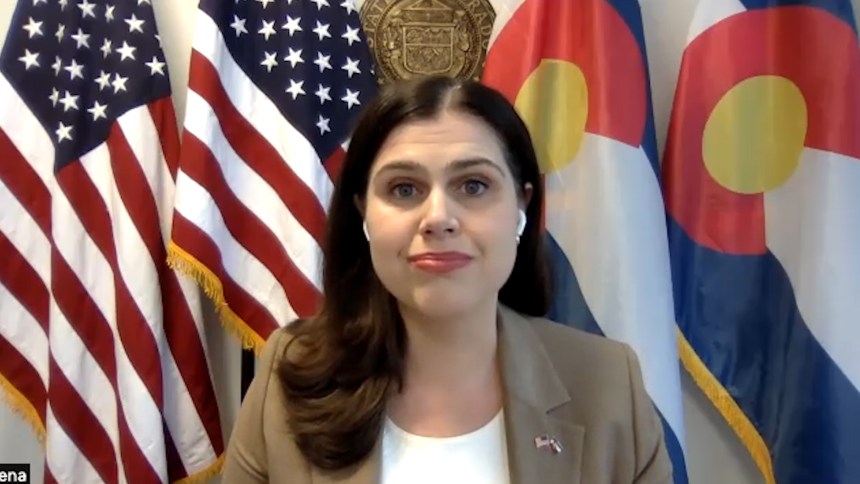
Hello, Deadline: Legal Blog readers! I had the chance on Thursday to interview Colorado’s secretary of state, Jena Griswold. She’s at the center of a lawsuit launched by voters hoping to keep Donald Trump off the ballot, citing the 14th Amendment’s ban on insurrectionists holding office. Ahead of the trial, which begins Monday, the Democratic official broke down the contentious legal issue, why Trump’s anticipated silence in the case is “deafening,” and the broader democracy threats on her mind ahead of 2024.
The interview has been edited for length and clarity.
Jordan Rubin: You’ve acknowledged that Trump incited the insurrection. Why then did you choose not to use your power to keep him off the ballot, but instead deferred to the court process in the first instance?
Jena Griswold: Well, there’s a couple of big topics in that question. First off, I do not certify the ballot until Jan. 5. So I actually have not taken any action one way or the other. Under Colorado law for presidential primaries, voters can challenge a decision of the secretary of state when it comes to qualifications. And the petitioners in this case argue that I’m about to make a decision, and that’s what they are challenging. Ultimately, under Colorado law, when there is a challenge to qualifications, that goes to a court. And that’s the posture we’re in right now.
JR: And in this case that’s about to start trial on Monday, can you talk about what we should expect there? Because people are familiar with criminal and civil cases like Trump’s ongoing civil fraud trial in New York. But what are we expecting to see play out in this Colorado election trial?
JG: This is a novel situation, and the petitioners who filed this lawsuit are six Colorado voters — Republicans and unaffiliated voters — who challenge that Donald Trump is disqualified under the U.S. Constitution. Section three of the 14th Amendment says that any person who swears to uphold the Constitution and then engages in rebellion or insurrection, or provides aid or comfort to the enemies of the Constitution, cannot take office. So that’s what the case is about.
This is a bench trial, meaning it’s just a judge. There is no jury. It’s a civil case, so that also means that the standard of evidence is lower than in a criminal proceeding.
JR: In terms of the setup of this case, it’s a little different from what someone might assume when they hear the case is about Trump’s eligibility. Because you’re being sued by voters, even though it seems to me that you and the people who are challenging you are perhaps of a similar mind when it comes to Trump. So you’re adversaries, it seems, in a technical sense, but the mechanism the voters have used to get this into court is by challenging you, at least in name. Is that right?
JG: What I can say in response to that is, Donald Trump is also a party. And the Colorado GOP intervened. And I think something really noteworthy about this case is, look, it’s going to the foundational question: did Donald Trump disqualify himself by engaging in the insurrection?
You would think, with such a big case, that the potential candidate would want to come and give their side of the story. He’s not planning to testify, he’s not giving deposition, and for someone who just loves to grandstand about the cases against him, his silence, compared to what his testimony would be under oath, is deafening.
It’s going to the foundational question: did Donald Trump disqualify himself by engaging in the insurrection?
In terms of the posture of the case, I think there are people who would say there are a lot of big open questions about section three of the 14th amendment. So it is a positive thing to have a court weigh in and, ultimately, it’s how Colorado’s system works.
JR: This aspect of Trump apparently not participating in the case, what does that mean for how it plays out if he’s not going to be there?
JG: I can’t get into too many specifics about how the case will play out, just given some of the orders around the case. But Trump’s counsel will be there representing him. So will the Colorado GOP. And I think one of the big takeaways of this case is it’s a novel situation, because we’ve never had a president try to steal the presidency. And then on top of that, we’ve never had a president who has tried to steal the presidency run for office again.
So at the end of the day, Donald Trump has proven himself a liar. Maybe he’s unwilling to lie under oath. I don’t know. I can’t get into his reasoning about why he is choosing to not show up. But this is a really big case. And we’ll see how the proceedings develop next week.
JR: This Colorado case is one of multiple 14th Amendment cases around the country. Different states have different procedures. I’m wondering, then, doesn’t it eventually have to be resolved by the Supreme Court? Obviously, the Supreme Court has discretion over its docket, but tell me why the following scenario could or couldn’t play out, where you have different states with different mechanisms for their own ballot procedures: Could Donald Trump be on the ballot in one state and not in another for the 2024 election?
JG: It’s premature to say if that will happen or not. These cases can be appealed. And then, just like any other case, if there’s a good reason, the Supreme Court could decide to weigh in. But it’s premature. We have to see what the judges say in these cases and then move on from there. I think one of the reasons this case has so much attention is that not only is the topic incredibly unique, it goes to the heart of how our nation works, how democracy works, but also because the scenario you’re playing out is a possibility.
JR: On the timing, do you have any idea when we’ll know the result here?
JG: Seeing the speed of this case from the get-go shows that the court understands the imminent nature of these decisions. So this case was filed on Sept. 6, and Monday we’re scheduled to be in court. That’s less than two months to go to trial. [Judge Sarah Wallace] has indicated that she would like to make a decision before Thanksgiving.
Donald Trump has tried to get this case kicked out three times. They have failed to do that three times. But we assume that the case will move quickly, and all I can say is, by all appearances, it looks like the court is taking the timeline very seriously. JR: I want to pick up on the broader democracy issue, because of course this is an important issue, but it’s not the only one that you have to deal with. Looking ahead to the 2024 election and anything else that you’re dealing with in Colorado, what else is keeping you up at night and are you thinking about to protect and administer these elections? JG: Well, very luckily, when I hit that pillow, I go to sleep! But to answer you, look, we are in the middle of the worst attack on democracy that our nation has seen in recent times. Just this year alone, there have been over 300 bills to suppress the vote introduced across the country. And that doesn’t take into account the bills in 2020, ’21, ’22. On top of that, we are seeing the lasting effects of the Big Lie, both as a basis to suppress the vote and to incentivize security breaches, to threaten election workers, and frankly, the election of [the new House speaker, Mike Johnson, R-La.], someone who is a known election denier that tried to thwart Americans’ vote in choosing their next president of the United States, shows the degree that election denialism and MAGA extremism has taken root in this country. So the state of democracy remains, I would say, fragile. I am optimistic that we will get through this period of our nation’s history with a strong democracy intact. But there’s a lot of work that needs to happen between today and Election Day next year. JR: You already started to answer what was going to be my next and last question, about the new speaker. JG: Well, look, someone who’s second in line to the presidency, who has shown that he will not uphold the Constitution or the will of the people, says everything you need to know about congressional Republicans. There is no way in my mind for a moderate Republican who voted for him to say that they don’t support election denialism and extremism in this country. The failure of Republicans in positions of power to stand up to this extremism is what allows it to grow. And I just want to make it really clear: the failure of Republicans in positions of power to stand up to this extremism is what allows it to grow. It’s what allows it to be used to incite actual violence against elected officials in this country. It’s the reason that many election officials have stepped down. And I just think it’s a shameful state for the Republican Party and for the nation to see what happened in that speaker contest. JR: And not that we need to make this any scarier, but what can a speaker of the House do to thwart an otherwise proper election in ’24? JG: They could introduce voter suppression bill after voter suppression bill. They could really weaponize the committees to try to undermine American democracy and confidence in elections. They could be a mouthpiece for domestic disinformation campaigns and, ultimately, when the certification by Congress happens, we would have to see how that plays out. My preference is to have elected officials who believe in the law, who believe in upholding the Constitution and the will of the American people to vote. I just think it’s horrific to have someone who has shown such a disdain to the very Constitution that they swear to protect, to be in such a position of power. But I’ll tell you, we’re going over some of the litigation, the trying challenges that lay ahead. But I also want to share why I’m optimistic. We’ve seen this attack on democracy for a while now, at least since 2017, this recent attack. And I’ll tell you what: American voters have defended American democracy over and over and over again. They did it in 2018, 2020, 2022. They’re standing up for fundamental freedoms such as supporting and protecting abortion access in places like Kansas. And although we talk about the extremism (and I’m talking about the extremism coming from MAGA Republicans in Congress), there are good people — Republicans, Democrats and un-affiliateds — all across this country who will stand up and protect our democracy at the ballot box. And they’ll have a couple opportunities next year to do that.
Jordan Rubin is the Deadline: Legal Blog writer. He was a prosecutor for the New York County District Attorney’s Office in Manhattan and is the author of “Bizarro," a book about the secret war on synthetic drugs. Before he joined MS NOW, he was a legal reporter for Bloomberg Law.
Latest Post
Recommended


