










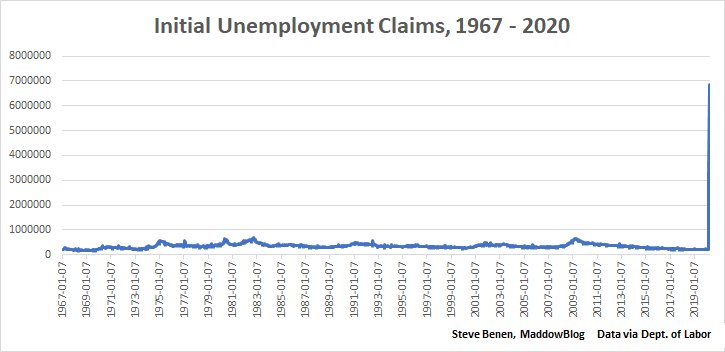
When Americans lose their jobs, they file for unemployment benefits, and the government has kept track of the number of these filings every week since 1967. Up until very recently, with a healthy domestic job market, the weekly tally has been about 210,000.
But as we’ve discussed, looking at historical data, we know what things look like when there’s an economic crisis. In early 2009, for example, near the height of the Great Recession, initial jobless claims reached 665,000 — roughly triple the totals from, say, a couple of months ago. During the U.S. recession in 1982, the number was a little higher, reaching nearly 700,000.
Four weeks ago, as the economy began to shut down in response to the coronavirus crisis, unemployment claims topped 3 million. As staggering — and record-breaking — as that number was, it was the first punch to the gut. The following week, that total more than doubled. Then another 6.6 million were added. This morning, the Department of Labor released yet another brutal report.
In the week ending April 11, the advance figure for seasonally adjusted initial claims was 5,245,000, a decrease of 1,370,000 from the previous week’s revised level. The previous week’s level was revised up by 9,000 from 6,606,000 to 6,615,000.
The results, which will be revised next week, are roughly in line with projections.
The total from the newest report is lower than the totals from two previous weeks, which may look like marginal progress. But a better way of looking at this is to say that things are getting worse slightly slower.
Indeed, keep the cumulative effects in mind: these 5.2 million Americans who’ve just filed for jobless benefits are in addition to the totals from the last few weeks. In other words, roughly 22 million Americans have filed initial unemployment claims over the last few weeks — a total unlike anything the country has seen in modern times.
This offers a hint of just how dreadful the upcoming unemployment rate will be: the U.S. labor force, as of a few months ago, was roughly 165 million people. Over the last month, 13% of those Americans have lost their jobs. Add those totals to the people who were already unemployed and it becomes easy to see why the actual unemployment rate right now is almost certainly north of 15%. It is worth emphasizing that these depression-level numbers coincide with the recent passage of an economic aid package that included significant resources for the unemployed. As we recently reviewed, the provisions of the new law add $600 — per week — to whatever out-of-work Americans would get from their state UI system. It’s a temporary lifeline that will make a significant difference to a lot of people. I put together the above chart, and at the request of some readers, it shows weekly unemployment filings since 1967, when the federal government started keeping track. The image may make it appear as if the last half-century has been relatively stable, but that’s really not the case: there were significant peaks and valleys throughout this period. But those fluctuations now seem minor by comparison.
Steve Benen is a producer for "The Rachel Maddow Show," the editor of MaddowBlog and an MS NOW political contributor. He's also the bestselling author of "Ministry of Truth: Democracy, Reality, and the Republicans' War on the Recent Past."
Latest Post
Recommended


