










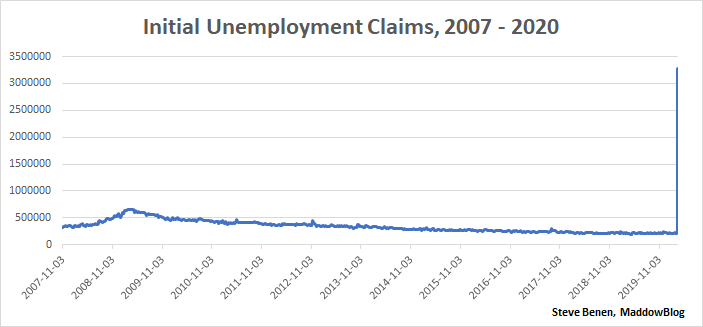
When Americans lose their jobs, they file for unemployment benefits, and the government has kept track of the number of these filings every week for more than a half-century. Up until very recently, with a healthy domestic job market, the weekly tally has been about 210,000.
But as we discussed last week, looking at historical data, we know what things look like when there’s an economic crisis. In early 2009, for example, near the height of the Great Recession, initial jobless claims reached 665,000 — roughly triple the totals from, say, a couple of months ago. During the U.S. recession in 1982, the number was a little higher, reaching nearly 700,000.
Keep these numbers in mind when assessing just how staggering the new data from the Department of Labor is.
In the week ending March 21, the advance figure for seasonally adjusted initial claims was 3,283,000, an increase of 3,001,000 from the previous week’s revised level. This marks the highest level of seasonally adjusted initial claims in the history of the seasonally adjusted series. The previous high was 695,000 in October of 1982. The previous week’s level was revised up by 1,000 from 281,000 to 282,000.
As analysts started to come to grips with the economic impact of the coronavirus crisis, there was some early talk that 1 million initial jobless filings would point to a disaster. Soon after, a report from Goldman Sachs projected 2.25 million. Some then raised the prospect of maybe 3 million.
And now we have the actual data: 3.28 million. As bad as things got at the height of the Great Recession, today’s report is roughly five times worse.
Circling back to our earlier coverage, imagine in baseball that the single-season homerun record was 61. Then imagine someone came along and hit 300. It wouldn’t just be surprising; it wouldn’t just set a new record; it would be a number at odds with our perception of reality. Similarly, this report is at odds with our perception of reality. We have no frame of reference for this. I put together the above chart, showing weekly unemployment filings since the start of the Great Recession in late 2007. The trouble, obviously, is that today’s report makes it seem as if the reporting from the previous 12-and-a-half years was relatively stable. It really wasn’t: there were significant peaks and valleys throughout this period. But they now seem minor by comparison.
Steve Benen is a producer for "The Rachel Maddow Show," the editor of MaddowBlog and an MS NOW political contributor. He's also the bestselling author of "Ministry of Truth: Democracy, Reality, and the Republicans' War on the Recent Past."
Latest Post
Recommended


