









President Donald Trump has been looking forward to 2026. Not in anticipation of this year’s midterm elections, but for his chance to oversee July 4’s 250th anniversary of the signing of the Declaration of Independence. Trump announced last month that as part of the yearlong festivities, America will hold its first ever “Patriot Games,” which many of the president’s critics likened to the dystopian spectacle that forms the basis of the fictional “Hunger Games.”
We don’t know what sports the athletes will compete in during the four-day event, or how the student athletes will be chosen.
The details were sparse in Trump’s Dec. 19 video message from the Oval Office announcing the games. The games will feature 100 high school athletes, according to Trump, with two drawn from each state and territory. (There are 50 states and 16 U.S. territories, so the math there doesn’t work out, and what about the District of Columbia?) Though the details remain unclear, Trump did emphasize that “one boy and one girl” will represent each state, which fits with his administration’s efforts to stamp out transgender participation in sports.
We also don’t know what sports the athletes will compete in during the four-day event, or how the student athletes will be chosen. Those details will theoretically come later via the games’ organizer, the White House’s “Freedom 250 Task Force,” which sounds more like a military operation than a party-planning committee. That task force and its associated nonprofit, Freedom 250, are not to be confused with America250, a bipartisan effort Congress established in 2016 that has commandeered the Times Square Ball and will be holding its own celebratory events this year.
The games aren’t the only event Freedom 250 has in store. The group has already partnered with conservative edutainment company PragerU for the semiquincentennial, releasing a set of weird A.I.-generated history videos that has left some historians deeply skeptical. Freedom 250 is also arranging a June 14 UFC fight on the White House lawn, a date that just happens to coincide with Trump’s 80th birthday. (Last year’s wasteful and narcissistic military parade in Washington was also held on the president’s birthday, though Trump said it was meant to commemorate the Army’s 250th anniversary.)
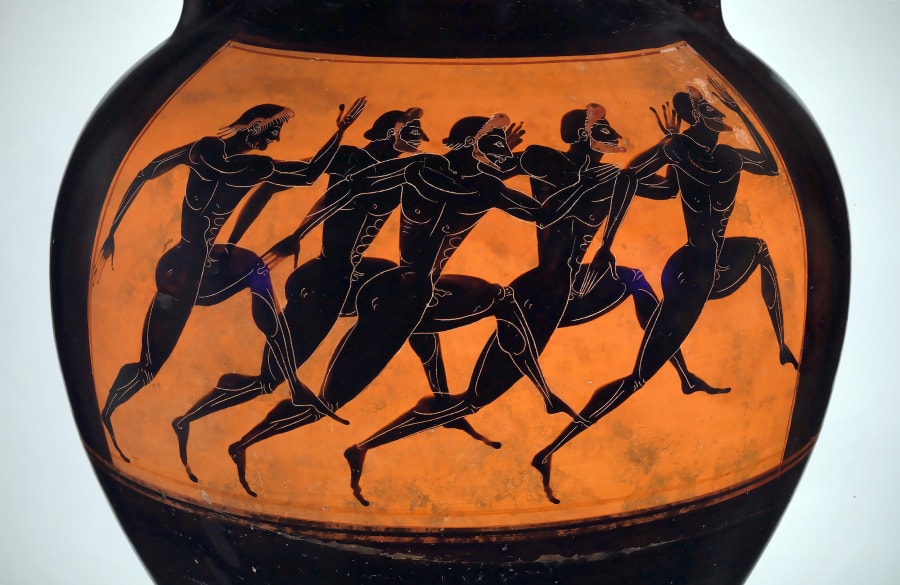
In an ideal world, next year’s games would bring the country together, with the Pan-Hellenic Games of ancient Greece being the most obvious comparison. Unlike the modern Olympics, athletics weren’t the sole focus of the Pan-Hellenic Games. According to Australia’s Hellenic Museum, there were also competitions in fields that included music, dance and other artistic endeavors. In most cases, the participants weren’t competing for their particular city-states but for individual glory. But at time when there was no unified “Greece,” the games provided a forum for competition without war and a shared praise of the gods worshipped across the region.
The Patriot Games thankfully won’t spiral into the deadly horror show of either the gladiatorial bouts or the Hunger Games — but the “bread and circuses” vibe is undeniable.
Given the focus on physical athleticism, though, ancient Rome makes for a more apt reference point for Trump’s Patriot Games. While the Romans emulated the Greeks in many ways, the “games” they held at the Coliseum and other amphitheaters weren’t the celebrations of human capabilities and praise of the gods their predecessors held. More often they were blood-soaked spectacles for the masses’ entertainment and included gladiator matches and public executions.
But given the dark mood currently gripping the country, the “Hunger Games” franchise is the comparison many Americans are making. In the series of books and subsequent movies, those games are used to placate the upper classes with violent entertainment as the children of Panem are forced to fight to the death. The games in that fictional universe also are used to subjugate the rest of the post-apocalyptic society with fear of the state. The fact that teenagers will be competing in Trump’s “Patriot Games” adds to the metaphor, which Democrats were happy to transform from subtext into text on X. The Patriot Games thankfully won’t spiral into the deadly horror show of either the gladiatorial bouts or the Hunger Games — but the “bread and circuses” vibe is undeniable. They also aren’t likely to bring the country together. In fact, they seem to be designed to make political points. By explicitly excluding trans athletes, for example, the cultural divisions the MAGA movement happily exploits are already front and center. As my colleague Jarvis DeBerry argued last month, this year’s semiquincentennial celebrations are more likely be about honoring Trump than the country he leads. Similarly, his idea of an athletic competition seems intended to push his backward-looking vision of America than elevating our shared history the potential for greatness each of us has within.
Hayes Brown is a writer and editor for MS NOW Daily. 

