








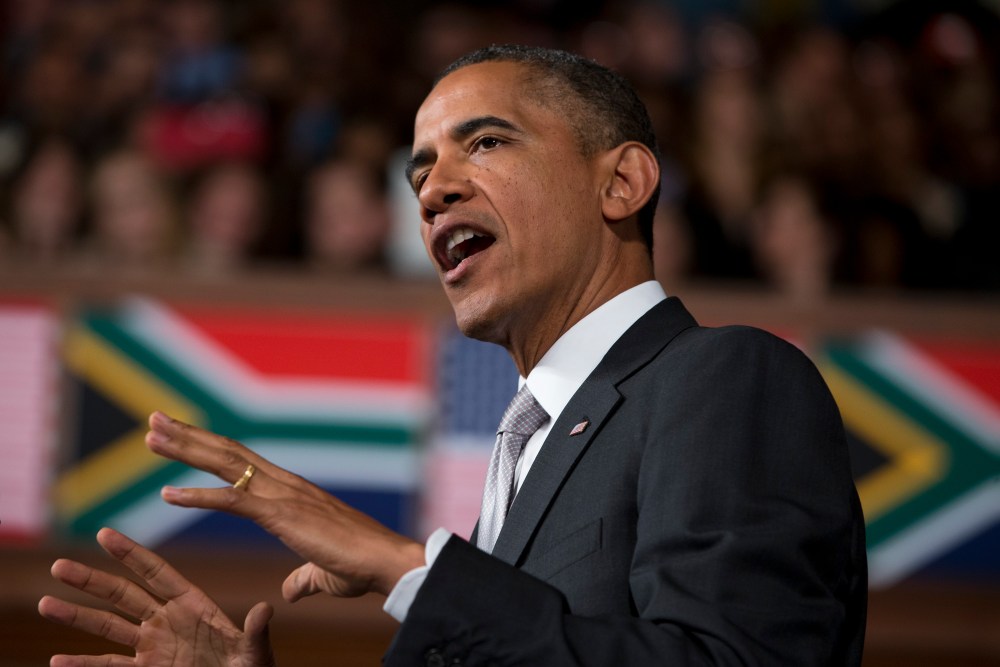
In what was billed as the keynote speech of his trip to sub-Saharan Africa, President Obama Sunday unveiled ‘Power Africa,’ a $7 billion plan to double the region’s access to electricity over the next five years.
Pointing to ailing former president Nelson Mandela as a symbol of democracy in Africa, Obama said that Africa today is experiencing, “a moment of great promise,” and that, “A historic shift taking place from poverty to a growing nascent middle class.” The president added that, “We’ve got more work to do,” and proposed “a new model of partnership between America and Africa, a partnership of equals.”
More than two-thirds of the population in sub-Saharan Africa lacks reliable power, the U.S. investment will be complemented by $9 billion in “initial commitments” from the private sector to add 8,000 megawatts of new electricity to the continent.
The $16 billion public-private partnership is mandated to focus on “villages and farms” as well as urban centers and is designed to “support clean energy to protect the environment and prevent climate change,” Obama said.
Speaking to a young audience in Jameson Hall at the University of Cape Town, the site of Robert Kennedy’s 1966 “Ripple of Hope” address, Obama reflected on the role that South Africa’s apartheid struggle played in his own politicization as a young man, telling the audience that he, “Took his first step in political life because of South Africa,” when he was 19-years-old.
The U.S. will lead efforts to end famine in Africa through the Feed the Future program that is targeted to reach more than 15 million rural households this year, Obama said. The program will “jelp shift 50 million people out of poverty in a decade,” he said by increasing global good security and nurturing African agribusiness.
Obama also addressed U.S. and South African efforts to combat disease, laying out, “An achievable goal—ending child and maternal deaths from preventable diseases,” and ushering in Africa’s first “AIDS free generation.” He went on to commend South Africa on becoming the first African country to fully manage its care of HIV, AIDS, and TB through a transition out of the U.S. PEPFAR program established in 2010 to combat the diseases.
The president closed with remarks about need for democratic accountability on the continent, lauding gains in Senegal and Ghana while cautioning that meaningful progress will be stalled if “The institutions that should be the backbone of democracy are infected with the rot of corruption.” He then announced plans to host an African summit in the US next year with African heads of states. Obama’s African trip has operated in the shadow Mandela’s illness, the 92-year-old former president has been hospitalized since early June. The first family visited with the Mandela family in Johannesburg on Saturday at the Nelson Mandela Center. “Madiba’s health is in our hearts and like billions around the world I and the American people have drawn strength from this extraordinary leader and the nation that he changed,” Obama said. Pres. Obama travels with the first family to Tanzania Sunday on the final leg of his Africa trip.
Max Lockie Recommended


