








Right now in Dickinson, North Dakota, the local McDonalds is offering a $300 signing bonus to new employees. You heard that right, with a 7.7% nationwide unemployment rate, and persistently sluggish job growth and wage stagnation, the labor market of this one town in North Dakota is so tight, and employers are so desperate for workers, they’re offering a signing bonus for a job slinging fries.
And it’s not just Dickinson, unemployment in the entire state is 3.1%, GDP growth for the state is 7.6%, and housing there is in such short supply that one bedrooms are renting for more than $1000. What economic miracle has taken place in the plains, you might ask, to bring this about?
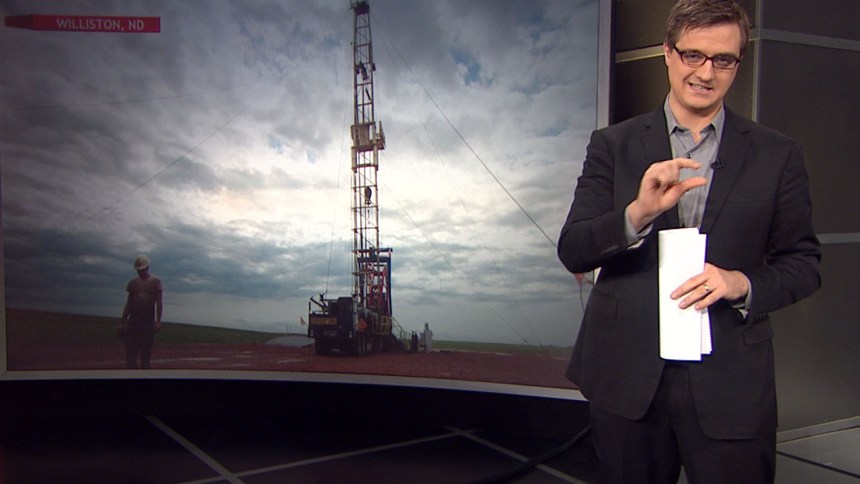
The answer is the Bakken formation, a subterranean rock formation that contains a thin, and until recently, more or less inaccessible, sea of oil within relatively hard rocks. But a revolution in the technology of extraction (including fracking) has helped unlock the oil in the Bakken and some speculate that the amount of extractable oil from just this one geological formation alone could surpass the reserves of all of Iraq and Kuwait combined.
Production from the area has skyrocketed, and this new production boom is driving a larger national trend, pushing U.S. oil production up for the first time in a generation, and arresting what many believed was a permanent decline.
Compare the growth in crude-oil supply among a number of non-OPEC countries, and what you see is the U.S. obliterating the rest of the world. Employment in oil and gas extraction has surged to the highest level since 1992, (though we should note they still provide a tiny, tiny sliver of the country’s jobs, just under 200,000). Our net oil imports are cratering. And now a number of analysts are predicting that in the near future, the U.S. will be producing more oil than any other country in the world.
“By around 2020,” a recent International Energy Agency report predicts, “the United States is projected to become the largest global oil producer…and starts to see the impact of new fuel-efficiency measures in transport. The result is a continued fall in U.S. oil imports, to the extent that North America becomes a net oil exporter around 2030.”
Yes, that’s right. The United States, which is, according to the spokespeople from the coal industry, already the “Saudi Arabia” of coal, which is, thanks to the fracking revolution, now essentially tied with Russia as the single largest producer of natural gas in the world, could also once again find itself the world’s biggest oil producer on a consistent basis for the first time since the first half of the 20th century.
In energy circles, you’re beginning to hear the phrase “Saudi America” used to refer to this future fossil fuel juggernaut. And you might look over all this and say: fantastic! America is finally within sight of that much mythologized, long promised destination: energy independence. Not only will we be able to cheaply supply our own power grid, vehicles and army, we’ll actually be able to make money exporting our resources all over the world, reversing the long trend towards ever-widening trade imbalances.
And indeed, during the campaign this was more or less the argument the president made: Obama: “We have increased oil production to the highest levels in 16 years…We’re actually drilling more on public lands than in the previous administration…We’re less dependent on foreign oil than any time in 20 years…We’re moving in the right direction in terms of energy independence…We’ve built enough pipeline to wrap around the entire Earth.” But delighting in our carbon extraction boom is staggeringly, almost psychopathically perverse. Because, well, it’s exactly that carbon extraction that is hurtling the world towards a dystopic future of possible 4-degrees Celsius global temperature rise, droughts, floods, storms, disaster, disease, death, crop failure, and on and on. In other words: you can’t separate energy policy from climate policy–they are one and the same, and based on calculations by Bill McKibben and the rest of the folks at 350.org, only one fifth of the current proven world fossil fuel reserves can actually be taken out of the ground and used without our planet passing the critical two-degree increase threshold. In other words, 80% of the fossil fuels that we at this very moment know we can take out–oil, gas, coal, all of it–have to stay in the ground. But there is another, related threat posed by the ramping up, and that is as America begins to ape Saudi Arabia’s productive capacity it also begins to more closely resemble its politics. Economists have long talked about the resource curse, the fact that countries with massive, lucrative natural resource bounties tend to be developmental and governance basket cases, ruled over by a feckless, ruthless, entrenched set of extractive oligarchs. And if you think that sounds foreign, go take a look at the local politics in places like West Texas and West Virginia. The promise of “energy independence” is a kind of liberation, but it is a false promise: if history or a look across the globe tells us anything it’s that the extremely lucrative industry of extracting and selling carbon fuel offers all of the actual freedom of the devil’s handshake.
Chris Hayes hosts “All In with Chris Hayes” at 8 p.m. ET Tuesday through Friday on MS NOW. He is the editor-at-large at The Nation. A former fellow at Harvard University’s Edmond J. Safra Foundation Center for Ethics, Hayes was a Bernard Schwartz Fellow at the New America Foundation. His latest book is “The Sirens’ Call: How Attention Became the World’s Most Endangered Resource” (Penguin Press). Recommended


