Paul Ryan suffered a horrible tragedy in his teenage years, when his father died of a heart attack. “It was just a big punch in the gut. I concluded I’ve either got to sink or swim in life,” the Wisconsin congressman and Republican vice presidential candidate told Ryan Lizza of The New Yorker.
Ryan chose to swim, and that choice has become a recurring theme in his speeches. Recently, Ryan raised this theme when he spoke to a defense industry roundtable last week: “Only in America do you have young people like this who are inspired by the ideals of our country and who have this pathway. And in this case, a pathway out of poverty and into a life of self-discipline, of self-sufficiency, of pride.”
Indeed, many single-parent homes, of which Ryan has become a prominent face, grapple with poverty. Ryan’s family did not face poverty, but Ryan and his family did wrestle with the financial and emotional hardships of losing a parent. And, as I can say from experience, they did not do it alone.
Paul Ryan and I have something in common: we both lost our fathers at a young age. I had just turned 15 when my dad died from a heart attack; Ryan was 16. Betty Ryan Douglas had four kids to look after, including Paul, the youngest. As Up host Chris Hayes has noted, Ryan’s family relied on help from multiple support networks, including the successful Ryan Incorporated Central, founded in 1884 by Ryan’s great-grandfather. As a lawyer, Ryan’s father, Paul Ryan Sr., had been a high wage earner.
Lizza documents the familial foundation Ryan maintains to this day — he lives in the same town where he was born, his aunt and uncle live across the street, his cousin is next door, his brother a block away. The Ryan clan has a considerable presence in Janesville, Wisconsin, one to which Ryan and his family could turn for support. The Ryan family also relied on assistance from the government, including Social Security, which paid out survivor’s benefitsafter Ryan’s father’s death. Social Security, Ryan said in 2005, “was there to help us when we needed the help.” Having experienced the same loss, I can say that that help is crucial.
Losing a parent — or anyone close to you — can be incredibly traumatic and destabilizing. But the benefit of financial stability, which Ryan and I were both lucky enough to have, steadies the loosened ground upon which you find yourself standing in the wake of a parent’s death.
Single-parent homes comprise 29.5 percent of all households in the United States, and Ryan would deal many of them a considerable blow with his proposed changes to Medicaid, the Supplemental Nutritional Assistance Program, taxes and Social Security. More than 31 percentof households headed by single women and more than 15 percent of households headed by single men are poor. These families rely on the social safety net.
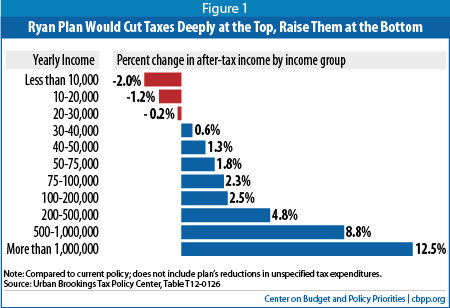
With Ryan’s proposed Path to Prosperity, states would receive one-third less of their current Medicaid funding by 2022. The Congressional Budget Office concludes that states would either have to dramatically increase funding to keep pace with medical costs or slash eligibility, benefits, and/or provider payments. Ryan’s suggested changes to SNAP further undermine single-parent households, which are more likely to rely on SNAP than those with married parents. Ryan’s plan would cut 17 percentof the program’s budget, or $133.5 billion, over a decade. More than one-fifth of single-father households and nearly two-fifths of single-mother households depend on SNAP benefits. Ryan’s plan would also raise taxes on many of these single-parent households. Any household making $30,000 or less would see a slight increase in their tax burden, while the top earners would all see more tax cuts. Ryan and I are lucky. We both had loving families who were also fortunate enough to be financially stable. We both had fathers whom we knew and who played major roles in our lives. We both have strong mothers who held our families together. That same cannot be said for many of the children living in the more than 10.5 million single-parent homes across the country.
Sal Gentile Recommended