










This is an adapted excerpt from the May 4 episode of “Velshi.”
You might think the end of Roe v. Wade, which returned the issue of abortion to the states, marked a pretty conclusive victory for the anti-abortion movement’s 50-year legal fight. But you’d be wrong.
As legal historian Mary Ziegler makes clear in her new book “Personhood: The New Civil War Over Reproduction,” states’ rights was never the endgame. It was just a stepping stone toward something far more radical and far-reaching: A pseudo-legal doctrine known as fetal personhood.
If fetal personhood is written into law, it would effectively ban abortion at every stage of pregnancy.
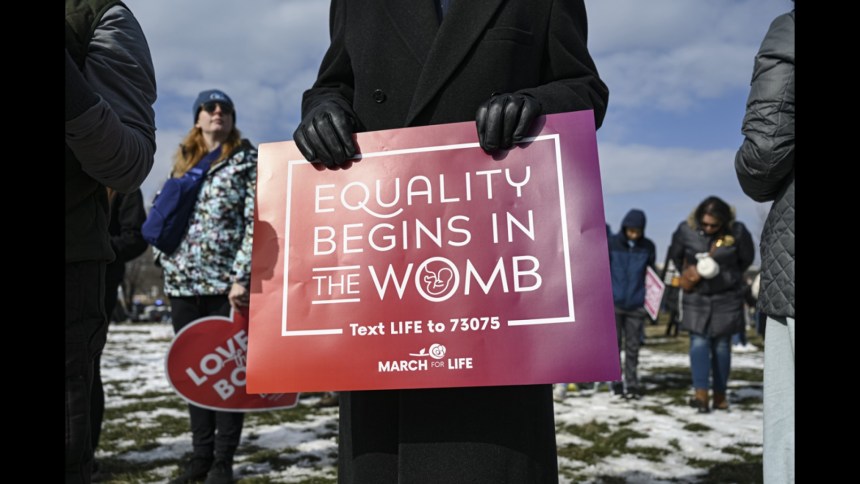
It might sound technical and obscure, but its implications are real — and incredibly serious. At its core, fetal personhood says a fetus, even a fertilized egg, is a full constitutional person under the 14th Amendment, which guarantees equal protection under the law to all citizens.
Last year, the Republican Party approved a platform that supports states using the 14th Amendment to establish fetal personhood. If that’s written into law, it would effectively ban abortion at every stage of pregnancy. It could open the door to criminalizing in vitro fertilization (IVF) and further empower the prosecution of abortion under state criminal codes.
That’s exactly what we’re already seeing play out across the country. Republican lawmakers in at least 10 states have introduced bills that define abortion as homicide. In some states, those laws have led to the prosecution of women who’ve miscarried.
According to Ziegler, the fetal personhood movement has been quietly taking shape since the 1960s. While it gained momentum after the 2022 Dobbs decision, it is rooted in that earlier era and is a reaction to the civil rights and feminist movements of the time.
Back then, constitutional ideas about equality were shifting rapidly. After Brown v. Board, as civil rights lawyers pushed to enforce desegregation, anti-abortion activists developed their own concept of equality, not one rooted in history or systemic injustice, but in vulnerability. They argued that fetuses were America’s most marginalized group, not because of discrimination, but because they were weak and voiceless. In their view, this — not race or gender — was the true concern of the Equal Protection Clause.
Over the next half-century, these anti-abortion activists adapted fetal personhood to fit the anxieties of each era. In the 1980s, amid the “tough on drugs” agenda, fetal personhood was reframed through the lens of criminal law. Anti-abortion leaders described the fetus as a “victim of violence,” pushing for laws that punished pregnant women for drug use and cast abortion as a crime scene.
By the 1990s, as support for women’s rights grew, the movement worked to soften its image. Leaders began claiming they weren’t punishing women, they were protecting them. Anti-abortion figures rebranded themselves as defenders of both women and fetuses, which they said were victims of a ruthless abortion industry, akin to Big Tobacco.

By the early 2000s, the movement tapped into conservative legal networks like the Federalist Society and embraced originalist readings of the Constitution. They took notice when the Supreme Court began recognizing corporations as legal persons. If businesses could be people under the law, the thinking went, why not fetuses?
In the 2010s, fetal personhood expanded again, this time co-opting the language of civil rights and religious liberty. It became an all-purpose vessel for conservative grievances, used to claim Christians were being persecuted, IVF clinics were committing genocide, and birth control amounted to state-sponsored murder.
But for all its rebranding and strategic pivots, the movement remains deeply unpopular with the American public. Most Americans say criminalizing abortion is wrong. They don’t believe frozen embryos are people. They don’t want IVF banned or birth control criminalized.
Still, Republican legislators in some states are aggressively pushing fetal personhood bills. Others have proposed “abortion trafficking” laws, seeking to criminalize women who cross state lines for care by treating the fetus as a trafficked human being.
So, how has this fringe idea gained so much traction since Dobbs, despite its deep unpopularity? Because the fetal personhood movement has stopped pretending it needs democracy. Instead of persuading the public, the movement is building legal machinery, counting on friendly prosecutors, ideological judges, and anti-democratic allies to do what voters won’t. Ultimately, it’s betting on five sympathetic Supreme Court justices. We see this in Texas, where prosecutors are trying to investigate abortion providers across state lines, not because those cases are likely to win, but because they could reach the Supreme Court. Though Donald Trump mostly avoided talking about abortion on the campaign trail, the legal infrastructure he helped build in his first term is still very much in motion. Most recently, Trump elevated fetal personhood in subtle but telling ways, one of them being his anti-trans executive order, which includes a coded reference to fetal personhood. The order defines a female as “a person belonging, at conception, to the sex that produces the large reproductive cell” and a male as “a person belonging, at conception, to the sex that produces the small reproductive cell.” Aside from the dubiousness of the claim that sex can be determined at conception, Trump’s referring to a fetus as a person from conception essentially legitimizes fetal personhood. Critics say it’s all part of a broader strategy to push the federal courts toward recognizing fetal rights under the Constitution. Anti-abortion activists saw this language as a quiet but significant nod to federal recognition. House Speaker Mike Johnson even praised Trump for declaring, in his words, “life as beginning at conception rather than birth.” Critics say it’s all part of a broader strategy to push the federal courts toward recognizing fetal rights under the Constitution. The movement’s biggest obstacle has always been the American people, but by aligning itself with authoritarian tactics, that’s no longer seen as a barrier to their goals, or so they think. As Ziegler notes, “It is more important than ever to think through what it means to value life, in the womb and for people who are pregnant — and to make sense of whether equality really requires punishment rather than support for the woman carrying a fetal life.” “That’s because regardless of what we mean by personhood — and whose rights or humanity it might erase — the truth is that fights over reproduction in the United States are just getting started,” she writes. “And the meaning of equality well beyond the context of abortion is on the line.”
Ali Velshi is the host of “Velshi,” which airs Saturdays and Sundays on MSNBC. He has been awarded the National Headliner Award for Business & Consumer Reporting for “How the Wheels Came Off,” a special on the near collapse of the American auto industry. His work on disabled workers and Chicago’s red-light camera scandal in 2016 earned him two News and Documentary Emmy Award nominations, adding to a nomination in 2010 for his terrorism coverage.
Amel Ahmed
Amel Ahmed is a Segment Producer for "Velshi."
Allison Detzel is an editor/producer for MS NOW.
Latest Post
Recommended




