








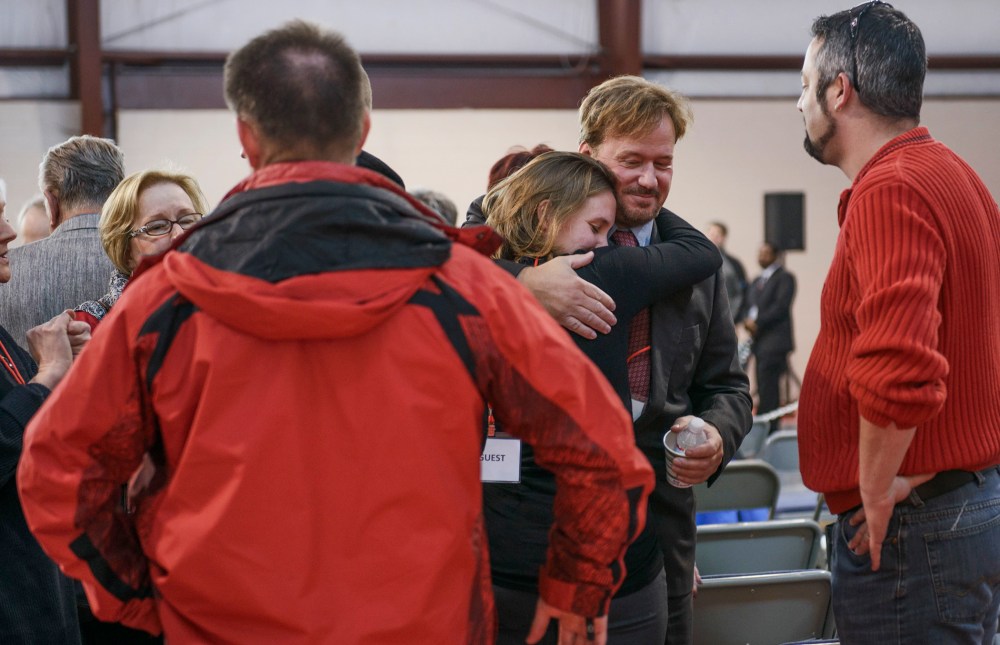
On the final day of his United Methodist Church trial, Rev. Frank Schaefer stood in defiance before a jury of his fellow clergy members, and placed a bright rainbow stole around his neck. The 51-year-old said he gave the jury “every excuse” to take away his credentials as he braced for the end of the life he’d known for nearly two decades.
Six years had passed since Schaefer bucked church law by presiding over his son’s marriage to another man. But it wasn’t until this April—just shy of when the church’s statute of limitations would have expired—that a complaint against him spiraled into a seldom used, yet highly secretive, disciplinary trial. The 13-member jury had found Schaefer guilty of breaking his pastoral vows. As he awaited his final penalty, Schaefer was ready to shed both his ordination credentials, and his role as a “silent-supporter” for gay rights.
Instead, the jury did something unexpected. Schaefer was given a 30-day suspension and a choice: abide by church law, or quit.
“That’s the painful aspect of what I’m going through,” he said recently in an interview with msnbc. “I love being a pastor–that’s where my heart is; that’s where my calling is. What will I do if I lose my credentials, which it looks like I will? That’s what I need to figure out.”
It’s a question a growing number of pastors are asking themselves, as more and more United Methodist leaders are finding it impossible to minister to all people–as their church instructs–while simultaneously denying rights to gay and lesbian congregants. Schaefer’s trial and the handful or so more on the horizon are spotlighting a deepening rift within the church in dealing with a national sea change on marriage equality.
The shift toward acceptance of gay rights is significant. The United Methodist Church is home to the nation’s second-largest group of Protestants, and third-largest group of any Christian denomination. Should the religious community see a change in heart toward LGBT congregants, advocates hope justifications for discrimination nationally will too break down and subside.
A growing dispute over church doctrine
At its core, the intensifying debate within the church lies in conflicting messages over how to address homosexuality. The Book of Discipline teaches its subscribers to accept gay and lesbian Christians as members. But church law also condemns the practice of homosexuality as “incompatible with Christian teaching.” Members of the clergy are forbidden from presiding over same-sex weddings, or from being “self-avowed practicing homosexuals” themselves.
Along with the murky guidelines, advances in marriage rights for LGBT people across the country have caused enforcement of church doctrine to take a new turn. Since the worldwide General Conference reaffirmed the denomination’s position on homosexuality last year, as many as five potential church trials have emerged, with more likely to follow. Critics describe the process as archaic and typically shrouded in secrecy.
In Schaefer’s trial, only four secular and four Methodist-related journalists were allowed to attend; recording of any kind was strictly forbidden, as was posting to social media accounts (a rule that many broke). The prosecution delivered two closing statements; Schaefer was granted one. And anyone who disagreed with the Book of Discipline on same-sex marriage was prohibited from serving on the jury, according to attendants and divinity experts.
“I do judicial affairs at a college (SUNY Sullivan), and if we handled our disciplinary system the way the church is, we would be sued in a second and we would lose,” said Rev. Sara Thompson Tweedy, who is currently facing a complaint and possible trial for being a “practicing” lesbian. “When you don’t allow the press in, when you restrict seating, when the prosecution gets to have the last word in the closing remarks, and the church prosecutor gets to go twice–where the hell does that happen?”
In order for a church trial to take place, a member of the congregation has to first file a complaint. Tweedy serves on the steering committee for the group Methodists In New Directions (MIND), which every Monday highlights a clergy person who has officiated at a gay wedding. The group’s aim is to essentially force enough complaints to break the system.
“Trials are a last resort; they’re not designed to resolve deep-seated conflicts or divisions,” said Rev. Tom Lambrecht, vice president of Good News, a group committed to promoting the Book of Discipline as it is written. “Trials are something we would hope not to see. But at this point, it seems like they’re the only way we have available to maintain adherence to church policy.”
That policy, now 40 years old, can only be changed by the General Conference, which next convenes in 2016. But because the United Methodist Church is a global religion, its top legislative body pulls representatives from all over the world, including countries where the gay rights movement has yet to accelerate or even begin.
Lambrecht believes the church’s policy on homosexuality is “gracious and loving,” and argues that the clergy has the right to withdraw from the church if they disagree. In terms of inherent contradictions within that policy, Lambrecht believes it makes sense to welcome gay and lesbian members but condemn their lifestyle. The church, he suggested, can provide a sort of conversion therapy.
“In welcoming all people, the church does not condone everyone’s sins but invites us to transformation and repentance,” said Lambrecht. “Jesus accepts all of us as we are, but he doesn’t want to leave us that way.”
A pastor’s “evolution”
In 2007, Schaefer tossed aside church doctrine when he agreed to marry his son, Tim, to another man. Like many members of the church, Schaefer grew up thinking homosexuality was a sin. But once exposed to different scholars and interpretations of the Bible in seminary, Schaefer began what he describes as an “evolution.”
“By the time my son came out, I was already tolerant,” he said. “I then became a supporter of the LGBT community, although because I was in a very conservative area I chose not to preach on this issue.”
After his oldest son came out at 17, two more of Schaefer’s children told him they were gay. “They had a much easier time coming out,” he said. “We were so affirming of [Tim].”
Because of what the church continued to teach about homosexuality, however, “it was a still a struggle” for his other children, he said.
Tim Schaefer’s marriage was legal in Massachusetts, where the ceremony took place, but to defendants of the United Methodist rulebook, his father’s actions amounted to a broken covenant.
Jon Boger, a member of Schaefer’s congregation, found out about the wedding earlier in the year, and filed a complaint with the Eastern Pennsylvania Conference bishop last April–one month before the statute of limitations was due to expire. Boger’s mother had recently agreed to resign from her position as choir director, leading critics to believe the trial was more about vengeance than it was about church doctrine. Boger maintains that his mother had no bearing on his complaint, but Schaefer suspects she “played a role in it.” A history of discrimination and repentance Many within the church are calling on the Council of Bishops to put a moratorium on church trials until a more reasonable way of dealing with the schism can be found. The church has a long history of enforcing, and then repealing, discriminatory policies, and gay rights advocates believe it’s only a matter of time before the ban on same-sex relationships is abolished. In the meantime, they don’t want to see every clergy person who disagrees with current doctrine put through a costly trial and suspended–or worse, defrocked. The Council’s president, however, told msnbc she doesn’t have the power to stop the trials, as much it pains her to see them continue. “It’s a difficult situation for all of us because we respect one another even though we have different opinions on the question of how to move forward on the issue of human sexuality,” said Bishop Rosemarie Wenner. But a moratorium is “not a decision the Council of Bishops could make,” she said. Wenner became the first woman elected to the United Methodist episcopacy outside of the U.S. in 2005, 50 years after the Methodist Church’s General Conference voted to no longer deny full clergy rights to women. From 1939 until 1968, Methodists also segregated their units based on race, a practice for which the church has since apologized. Gay rights advocates are all but certain the next policy the church will be repenting for is human sexuality. “It’s a form of institutional bigotry to have a law that says one group of people is less than another,” said Jimmy Creech, a former United Methodist Church pastor who was defrocked in 1999 for performing same-sex wedding ceremonies. “That is a violation of everything that Jesus talked about.” Like many church members, Creech grew up thinking homosexuality was some kind of deviancy, mental illness, or even dangerous condition. After finding out a man he deeply respected was in fact gay, Creech devoted years to reexamining the Bible and church history, and determined that religious leaders had for centuries warped the gospel’s teaching to justify discrimination. “The Bible does not deal with sexual orientation–it doesn’t deal with loving, committed relationships of the same gender,” he said. “People hold onto these [practices] as sacrosanct laws, and they don’t change. They defend their prejudices because they’re ‘church teachings.’ But many have been wrong. This is one we haven’t yet recognized.” In the 14 years since Creech’s defrocking, a movement to return the United Methodist Church to Christianity’s central tenets has picked up steam. At the 2012 General Conference, retired Bishop Melvin Talbert coined the term “Biblical Obedience” to encapsulate the act of resisting derogatory practices within the church’s doctrine. Talbert is the highest-ranking clergy member to have publicly presided at a same-sex marriage, which took place last month in Alabama. The wedding was symbolic, as that state does not allow gay couples to marry, but it was enough for the Council of Bishops to call for charges to be brought against him. The 79-year-old Talbert, who is African-American, equates his current stand for marriage equality to the one he made in the Civil Rights era, when he would fight against Jim Crow laws. “To commit oneself to nonviolence means that you are willing to pay the full price, even if it means your life,” said Talbert in a recent interview with msnbc. “That’s the spirit in which I approached this.” His views on homosexuality were forever altered at a church retreat in the mid-1970s that brought together an equal number of gay members as heterosexual ones. Talbert recalls speaking with a woman there about her sexuality, and asking her why it was she had to talk about it. “Have you ever heard of ‘Black Power?’” he remembers her asking. So he raised his right hand in the symbolic salute and said, “Oh yeah.” “Why do you have to talk about it?” she said.
Emma Margolin
Emma Margolin is a reporter at MSNBC.com. Recommended


