









When you try to erase history — like the Florida governor wants to do — you are doomed to repeat it.
Over the weekend, The New York Times published a stunning account of more than 100 migrant children, largely from Central America, who, according to the Times’ reporting, were working overnight shifts and dangerous jobs for companies large and small throughout the U.S.
According to the report:
In Los Angeles, children stitch “Made in America” tags into J.Crew shirts. They bake dinner rolls sold at Walmart and Target, process milk used in Ben & Jerry’s ice cream and help debone chicken sold at Whole Foods. As recently as the fall, middle schoolers made Fruit of the Loom socks in Alabama. In Michigan, children make auto parts used by Ford and General Motors.
In other words, nearly all of us are likely buying and using goods fabricated by children’s hands. We’re all implicated in this story. These migrant children, who have traveled thousands of miles, are under intense pressure to send money home to their families or to the people who sponsor them in the United States. Many of them are extorting the children for smuggling fees, rent and living expenses.
These children are ostensibly under the purview of the Department of Health and Human Services, which assigns them caseworkers to make sure they’re cared for while they are in this country.
The New York Times reports that “in interviews with more than 60 caseworkers, most independently estimated that about two-thirds of all unaccompanied migrant children ended up working full time.”
Michigan congresswoman Hillary Scholten, who has one of these factories in her district, is rightly appalled.
My number one priority is justice for these children, and that includes holding the guilty parties accountable. pic.twitter.com/BXeXMBlCtA
— Congresswoman Hillary Scholten (@RepScholten) February 27, 2023
To be clear, this is outsourced labor; none of these companies intentionally hire children, as far as the reporting has shown. And when asked by the Times, a number of them said they would investigate the claims or sever ties with the companies who help outsource the jobs. But again, their decisions implicate all of us, because we benefit from the blood, sweat and tears of these child laborers. You’ve probably chowed down on a bowl of Cheerios packed by a teenager or enjoyed a bowl of Ben & Jerry’s ice cream made from milk processed by a child laborer.
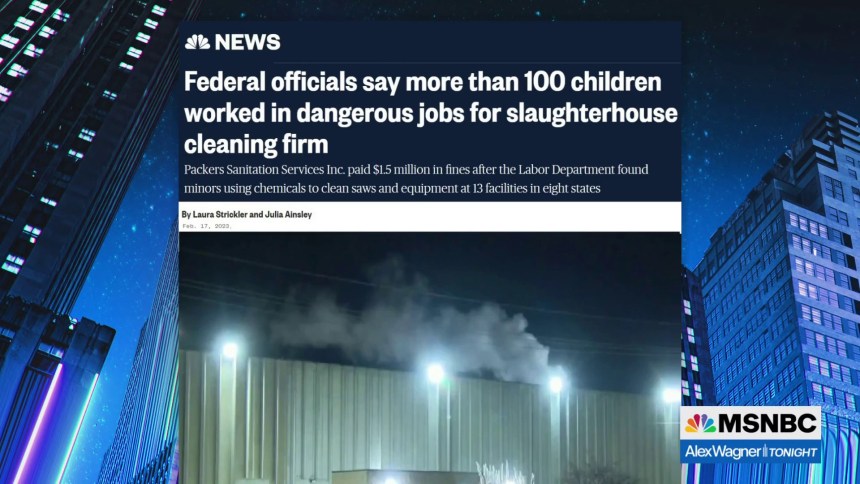
Earlier this month, Packers Sanitation Services paid a $1.5 million fine for employing 102 children to work in dangerous meatpacking facility jobs across eight states. And just last summer, Reuters discovered that kids as young as 12, many of them migrants, were working at a metal stamping plant owned by Hyundai.
Last week, NBC reported that Packers Sanitation Services disciplined an employee who hired the same “known minor” twice under two different identities.
And if this story sounds like some pre-20th-century horror story, that might be because you know history. And while some folks who just so happen to work in Tallahassee, Florida, might not want you to remember, America’s first big business was slavery and indentured servitude.
Literally millions of young enslaved men, women and children were the disposable fuel that created the booming economy of this country. And every consumer of cotton — or rice, coffee or any number of goods — produced by that labor benefited from it, from the insurance companies to the shippers to the end users here and around the world. It made Southern planters richer than they could have ever imagined back in England.
After the Civil War and during the Industrial Revolution, when American companies still wanted the cheapest possible labor and more and more of it, children became the ideal employees. They were smaller, cheaper and uneducated, which meant they were less likely to complain.
In 1938, Congress passed the Fair Labor Standards Act, which effectively banned “oppressive child labor,” barred children under the age of 16 from holding nonagricultural jobs, and made it so that teens from 16 to 18 could not do “hazardous employment.”
Now notice that they let the farms keep the exploitation going, which was why Southern senators fought successfully to exclude Black workers from those protections by leaving farm workers and domestic workers out, which were still the low-paid jobs held by most African Americans — including children.
Still, the Fair Labor Act did establish a standard rule for labor practices, practices that are being skirted to this day. According to data from the U.S. Labor Department’s wage and hour division, child labor violations have been on the rise since 2015. Modern-day Republicans — led by the twice-impeached former president — have led the charge on deregulation. And just like in East Palestine, Ohio, President Trump and his various agencies proposed rolling back regulations that protected workers and children. One USDA food safety official openly admitted that safety wasn’t a top priority because “we don’t regulate worker safety.” At the Occupational Safety and Health Administration, Trump officials sought to loosen reporting requirements for injury and illness data from large companies. States across the country took the baton from Trump and went even further. And at one point, Trump’s Department of Labor sought to unwind decades-old youth labor protections by allowing teenagers to work longer hours under some of the most hazardous workplace conditions. States across the country took the baton from Trump and went even further. In Iowa, Republican legislators — who have a supermajority — introduced a bill to expand the types of work that 14- and 15-year-olds would be permitted to do as part of approved training programs. The bill would extend allowable work hours and exempt employers from liability if these young workers are sickened, injured or killed on the job. Minnesota is looking to pass similar legislation. And on Monday, the Biden administration announced that it was creating a new task force to crack down on the illegal exploitation of migrant children for labor in the United States. Enforcement of child labor laws will most likely be a top issue for Julie Su, President Biden’s newly announced nominee for secretary of labor. If confirmed, Su would be the Biden administration’s first AAPI Cabinet secretary. This is an excerpt from Tuesday’s episode of the “The ReidOut.” It has been slightly edited for length and clarity.
Joy-Ann Reid
Joy-Ann Reid is host of “The ReidOut” at 7 p.m. ET on MSNBC. “The ReidOut” features one-on-one conversations with politicians and newsmakers while addressing provocative political issues both inside and outside of the beltway. Recommended


