









President Joe Biden announced this week that his administration is extending the pandemic-era pause on student loan payments through August.
And while some borrowers are surely excited about the delay, the fact this reprieve is only temporary leaves many of them uncertain about their future financial situations.
These repeated delays are hardly the godsend people think they are — a point Rep. Alexandria Ocasio-Cortez, D-N.Y., made this week.
I think some folks read these extensions as savvy politics, but I don’t think those folks understand the panic and disorder it causes people to get so close to these deadlines just to extend the uncertainty. It doesn’t have the affect people think it does.
— Alexandria Ocasio-Cortez (@AOC) April 5, 2022
We should cancel them. https://t.co/ZvkGRwliLT
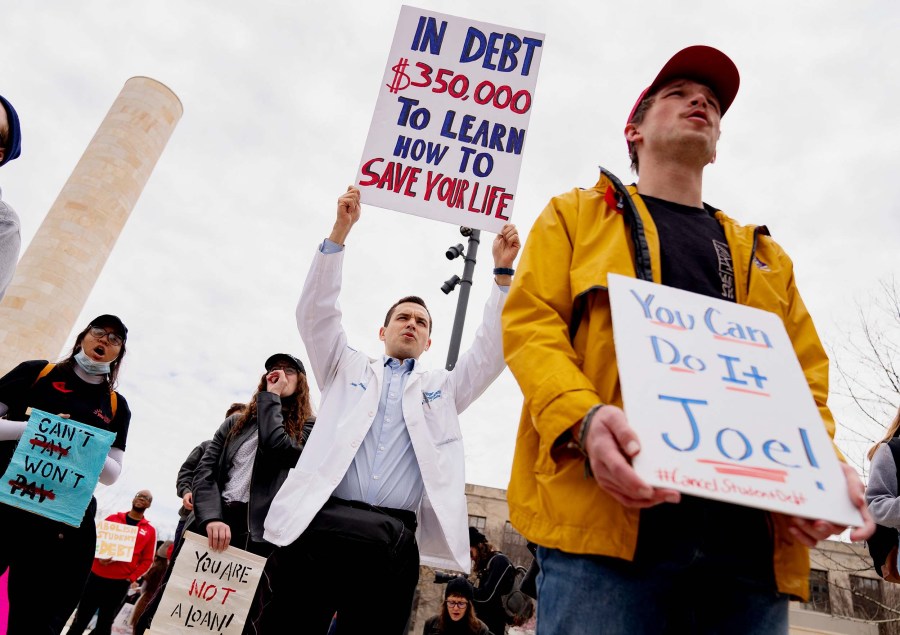
Student loan debt forgiveness is an economic issue, a racial justice issue, a gender equality issue and frankly, a political slam dunk the Biden administration should get behind. And a majority of Americans seem to agree.
While there are differences in the preferred amount, roughly 62 percent of voters think at least some Americans should get some form of student loan forgiveness, according to a Morning Consult poll conducted in December. Of those surveyed, 15 percent said student loan debt should be wiped out completely only for Americans with lower incomes.
And as Joy discussed with Sen. Elizabeth Warren, D-Mass., on Wednesday’s episode of “The ReidOut,” the positive impact debt forgiveness would have on marginalized groups is clear.
“African Americans borrow more money to go to school, borrow more money while they’re in school, have a harder time paying it back when they get out,” Warren said.
That claim is supported by a study published in the Federal Reserve Bank of St. Louis Review in 2017 that found Black students enter college with less financial help from their parents than white students (which the study says is “likely a result of differences in available resources”). What’s more, Black college graduates tend to have higher debt burdens and lower incomes than their white peers, according to the study.
There’s resounding evidence showing broad support for a permanent remedy rather than continually kicking the can down the road. A poll from Color of Change last year found 84 percent of Black voters support full or partial elimination of student loan debt. So making student loan forgiveness a priority would likely help the Biden administration revive Black voters’ weakened enthusiasm for Democrats. Warren also mentioned the majority of student loan debt is held by women. A recent analysis from the American Association of University Women found women hold roughly two-thirds of the county’s total student loan debt, with Black women owing around 22 percent more than white women. And we know this debt carries an emotional burden that can affect economic productivity, as well. Roughly 65 percent of women and 54 percent of men say student loan debt negatively affects their mental health, according to a CNBC survey from January. There may not be total agreement about whether and how much the Biden administration should forgive student loan debt, but there’s resounding evidence showing broad support for a permanent remedy rather than continually kicking the can down the road.
Ja’han Jones is an MS NOW opinion blogger. He previously wrote The ReidOut Blog. Recommended


