








Wednesday, Attorney General Eric Holder went to Ferguson, Missouri, in the wake of protests and unrest following the police shooting death of an unarmed 18-year-old named Michael Brown – who witnesses say was shot while surrendering with his hands in the air.
Calm is returning to Ferguson. But painful questions remain about the investigations into Officer Darren Wilson’s shooting of Brown, the police response to protests after his death – and, most importantly, the systemic national bias that helped create the crisis in Ferguson.
The mishandling of Brown’s August 9 death began with the appalling police display of his body for hours in the August sun in a community already reeling with pain, anger and confusion. It continued with a lack of information and empathy that fueled suspicion and outrage. While isolated agitators attacked police and looted businesses in days to follow, police offenses were of the Constitutional variety: militarized police tear-gassed citizens and treated them like enemy combatants, sometimes in their own yards. Police have also arrested and assaulted journalists.
Wednesday, a St. Ann, Missouri, police officer was suspended for pointing his semi-automatic assault rifle at a peaceful protestor and threatening to kill him Tuesday night.
If the message of Brown’s death, for many, is that blacks cannot expect due process, the message of the aftermath has been that our leaders have learned little from history about how to foster healing. Day after day, opportunities to create dialogue and transparency were lost in smoke, teargas and displays of force.
The mishandling of Brown’s killing has become an international spectacle. The message from the system, time and again, is YOU are the problem, while systemic bias and police abuses are shrugged off – and our children, uncles, mothers and cousins are painted as thugs who deserve to die before they are tried.
As devastating as Brown’s shooting is, a belief that this national crisis is confined to one young man’s case is a disservice to his memory.
The story of Ferguson and Michael Brown finally reached the mass media after its screaming birth in the dark on social and digital media. But we must be wary: far too much of the punditry will be about building the court case, not creating change.
True change, as any activist knows, takes time.
As a 20-year-old college student not much older than Michael Brown, my late mother, Patricia Stephens Due, helped lead a 1960 march of Florida A&M University students in Tallahassee to protest the arrest of classmates during sit-ins. Police used teargas to disperse the peaceful student marchers.
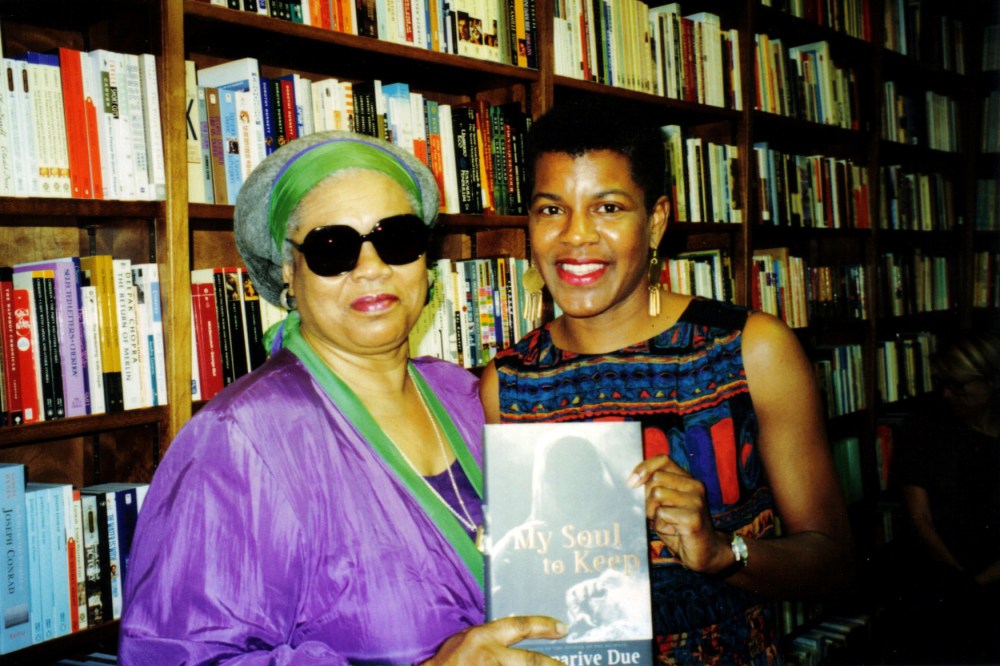
One officer recognized my mother as a leader, said, “I want you,” and threw a teargas canister directly in her face. Although she was aided on the scene by an unknown guardian angel who said he had military training and led her to safety, my mother was never the same. She could no longer tolerate bright light. As a result, my mother usually wore dark glasses – even indoors – until she died in 2012. I rarely saw my own mother’s eyes.
My mother’s dark glasses are among the items my family and I loaned to the Museum of Florida History this week for a November exhibition on the civil rights movement in Florida.
One of tomorrow’s future museum exhibitions is unfolding in Ferguson.
Today’s brave young people are infused with the same spirit to create change, like Howard University grad Mya Aaten-White, who continued to protest even after being treated for a gunshot to the head by an unidentified gunman while she was protesting.
In the 1960s, as now, national indifference, racism, class, rationalization, fear and suppression stand in the way of progress. The trouble in Ferguson has erupted because of a double standard in the criminal justice system and one of our nation’s biggest travesties – mass incarceration and disenfranchisement of its citizens. People of color are more likely to be stopped, more likely to be arrested, more likely to be charged as adults rather than juveniles, and more likely to be killed rather than apprehended. The list goes on. As Michelle Alexander chronicled in her 2010 book The New Jim Crow: Mass Incarceration in the Age of Colorblindness, Jim Crow’s caste system simply has gone underground. Too many of us refuse to notice, even now. One step: activist Shaun King’s petition asking for federal laws banning police choke holds and mandating front-facing cameras on police officers, among other new regulations: https://www.change.org/p/president-barack-obama-please-enact-new-federal-laws-to-protect-citizens-from-police-violence-and-misconduct But no single protest or petition will be The Answer. Some of us will march, some will tweet, some will sing, some will write. Some, like filmmaker Ryan Coogler–whose 2013 film Fruitvale Station is based on the BART police killing of Oscar Grant–will raise awareness through art. But whatever path we choose, we must stay awake. For too long, many of us living the “post-racial” dream have remained silent. We have not paid attention. We were not interested in defending the rights of suspects and people who committed crimes. But just as people of all races and income levels break the law, people of all races and income levels deserve due process and justice. I not only fear for the future of the people of Ferguson. I also fear that too many frustrated communities nationwide are one police shooting away from having teargas in their back yards too – with so many more young people, like my mother, scarred for life. Tananarive Due (@TananariveDue on Twitter) is co-author of Freedom in the Family: a Mother-Daughter Memoir of the Fight for Civil Rights. She is an American Book Award-winning author, a screenwriter and a former reporter for The Miami Herald. She recently served as Cosby Chair in the Humanities at Spelman College. The views and opinions expressed in this article are solely those of the guest writer and do not necessarily reflect the position of MSNBC.
Tananarive Due Recommended


