








In the opening of the Disney Pixar film Wall·E we’re introduced to the title character, an adorable trash-compacting robot, and his existence on an abandoned waste-covered Earth far in the future. Save for a cockroach found in a trash heap, Wall·E is alone.
America could now make Wall·E’s story a reality… sort of.
After hundreds of millions of dollars spent, years of research and results, 283 million miles traveled, some of the most advanced engineering ever developed – not to mention an untold number of man-hours – the U.S. now stands the risk of leaving the Mars Rover Opportunity alone in space “to die a lonely, cold death” much like Wall·E was abandoned by humanity in Pixar’s film.
Truth, it would seem in this instance, is at least as strange as fiction.
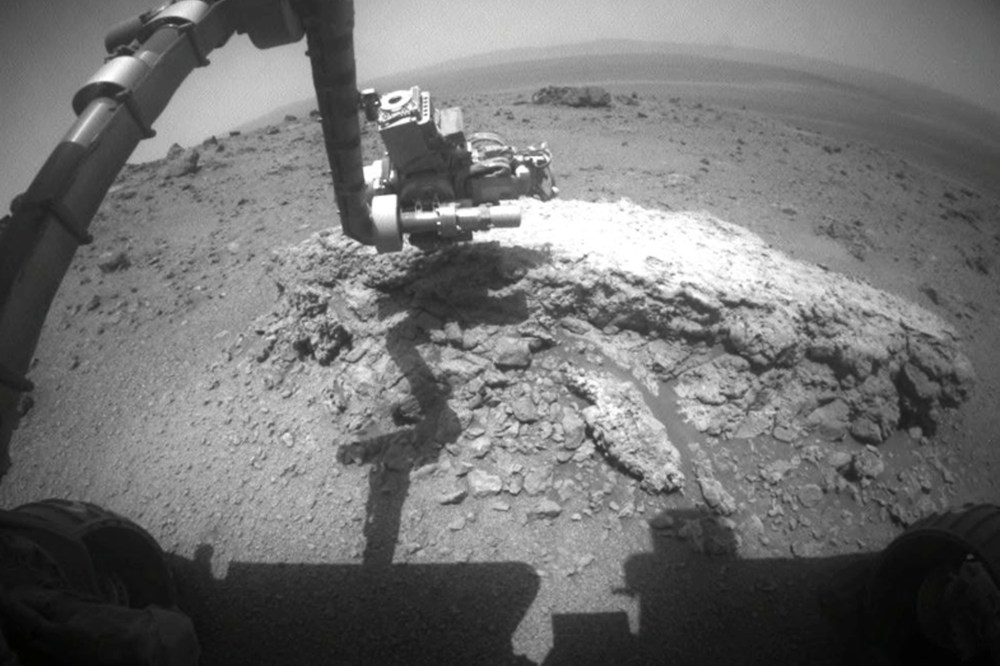
Opportunity’s story is a fascinating one. The six-wheeled craft landed on Mars along with its twin rover Spirit on January 25, 2004, nearly six months after it left Earth. Both were slated to collect data for 90 sols (a sol is one Martian day which equals nearly 24 hours and 40 minutes). That is about 92 and a half days here on Earth. Opportunity is still running 3,723 days later thanks in part to its efficient wing-shaped solar panels. That is over 40 times longer than NASA had hoped when Opportunity’s mission began.
The golf cart-sized vehicle has searched the red planet for signs of water, explored craters, and sent more than 100,000 images back to Earth (including selfies) using cameras on its head that give it the appearance of having eyes. Opportunity also overcame stark odds in June 2005, freeing itself from a sand dune after weeks of being stuck thanks to some ingenious lab tests back here on Earth.
Opportunity and Spirit got their names from a child named Sofi Collins who entered a NASA-sponsored naming contest. Nine years old at the time, Collins, an orphan later adopted, wrote in her winning essay, “It was dark and cold and lonely. At night, I looked up at the sparkly sky and felt better. I dreamed I could fly there. In America, I can make all my dreams come true. Thank you for the ‘Spirit’ and the ‘Opportunity.’”
Spirit became immobile in 2009 and ceased communications the following year remaining silent ever since. Opportunity, however, remains a true overachiever.
The reason Opportunity is at risk of being abandoned is an accounting trick in NASA’s 2015 budget proposal. As the Los Angeles Times reported, the budget does not include any funding for it. Instead, NASA is planning to use a $35 million line item called the Planetary Science Extended Mission Funding to pay for both Opportunity and the space agency’s Lunar Reconnaissance Orbiter program. That $35 million is buried within a $52-billion White House package called the Opportunity, Growth, and Security Initiative which includes funding for everything from job training, climate change research, and pre-schools.
Therein lies the problem.
The Opportunity, Growth, and Security Initiative is likely to be more controversial to spending-obsessed House Republicans than NASA’s standalone budget, and that has Rep. Adam Schiff concerned.
The California Democrat represents the district that is home to NASA’s Jet Propulsion Laboratory responsible for Opportunity’s Martian mission. Schiff told msnbc, “Leaving the rover to die a lonely, cold death when it is fully functional is a terrible idea and speaks volumes about the overall need for greater resources for our planetary science program.” Schiff says he will work during the appropriations process to keep Opportunity and “other healthy spacecraft” funded so they can continue with their respective missions.
Rep. Steven Palazzo, who chairs the House Space Subcommittee, also expressed concern – both with NASA’s overall budget and the Opportunity, Growth, and Security Initiative. The Mississippi Republican told msnbc, “It seems odd that core space exploration initiatives, like the Mars Rover and the Lunar Reconnaissance Orbiter, have been left out of NASA’s budgets completely.” It does seem odd. NASA spokesman Dwayne Brown tells msnbc the reason is there was “insufficient budget available” for the Opportunity Rover and the Lunar Reconnaissance Orbiter, adding “As these are our next highest priorities, they were included in the Opportunity, Growth, and Security Initiative.” He also stated that if NASA’s 2015 funding requests aren’t fully met the space agency will use a review process to “establish funding priorities.” None of that bodes well for Opportunity’s future. Dr. Heidi Hammel, who sits on the board of The Planetary Society, warned this is just the “first step in a long dance among the Administration, Congress, and NASA.” Dr. Hammel added that as long as Opportunity continues to return high-quality science, “the science community will likely advocate to continue support for (its) operation.” But Dr. William McKinnon, a fellow at the McDonnell Center for the Space Sciences at Washington University in St. Louis, is less optimistic. Noting that spending on NASA has been cut repeatedly over the past several years he said, “However you slice it… that means less scientists, less engineers, less rocket parts, etc. It’s hard to keep the great missions we have going, much less start new ones.” Ensuring Opportunity’s funding is particularly important given that NASA is preparing for a manned mission to Mars sometime in the 2030s. Future space flight would create more jobs. It also means NASA would develop more technologies to solve problems in space that get integrated into our daily lives here on Earth. These discoveries – known as “spinoffs” – are how we got things like LED lights, artificial limbs, safety gear for firefighters, memory foam mattresses, the Dustbuster cordless vacuum cleaner, solar power, and water purifiers, to name just a few. So as America works toward sending humans to Mars, it would make sense to keep Opportunity knocking — in order learn as much about our red neighbor as possible. And while NASA now also has a more advanced rover, Curiosity, on the Martian surface (the car-sized cousin to Opportunity arrived in August 2012), two rovers are still far better than one. More data means better preparation for the intrepid humans who will one day visit Mars. Plus, if Wall·E taught us anything, it’s that every robot needs a companion.
Nick Ramsey
Nick Ramsey is a senior producer with MSNBC’s “The Last Word with Lawrence O’Donnell.” Recommended


