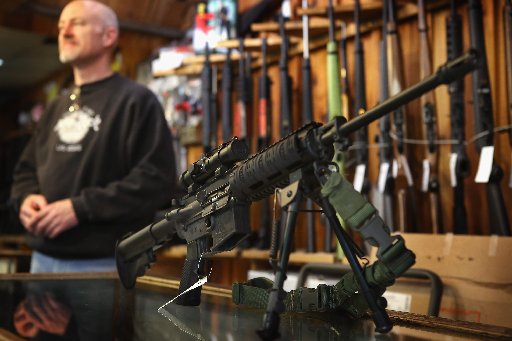
In 1994, the Republicans reclaimed the House of Representatives for the first time in 40 years. The key factor in the major Democratic loss pointed to the federal assault weapons ban that was passed by Congress on September 13, 1994. A part of the Violent Crime Control and Law Enforcement Act, the assault weapons ban banned semiautomatic weapons from having two or more military features, and placed a ten-year ban on the sale of assault weapons and large ammunition magazines. The ’94 election was significant because gun control became a deciding factor in the election and wedged two ideologically distant parties further apart.
In 2004, a report to the U.S. Justice Department that assessed the impact of the Federal Assault Weapons Ban on gun markets and gun violence found that “… the most important feature of military-style weapons may be their ability to accept [large-capacity magazines], and this feature has been addressed by the LCM ban and the LCMM rifle ban. Whether changing other features of military-style firearms will produce measurable benefits is unknown.”
Earlier this week, President Obama and the House Democratic Caucus vowed to reduce gun violence by focusing on the following four areas–closing background check loopholes, banning military-style assault weapons and high-capacity magazines, providing schools with safety resources, and increasing access to mental health services. But the history of gun legislation has shown that one bill does not prevent another massacre from occurring and fuels a recurring pattern.
After a mass shooting, political leaders call for action, then introduce bills that drag out legislative battles, and a law riddled with loopholes finally gets signed. But manufacturers have found ways around even those laws that are deemed legislative milestones: fter the law defined what an assault weapon was, manufacturing companies came up with modified designs and built weapons that became somewhat mainstream. Because the assault weapons ban did not outlaw the sale of semiautomatic rifles and handguns that had been manufactured before 1994, the country quickly discovered that the ban wasn’t all that effective.
For example, Connecticut’s assault weapons ban allowed the Bushmaster semiautomatic rifle Nancy Lanza purchased and kept in her home, easily accessible to her unstable son. He used the gun to shoot 20 children and six educators dead. The state ban was modeled after the 1994 federal assault weapons ban.
Mother Jones researched the gun violence of the past 30 years and found that since 1982, there have been at least 62 mass shootings. Twenty-five of these shootings occurred since 2006, and seven took place in 2012. What’s striking is that most of the killers obtained their guns legally.
Generally, the gun control versus the gun rights debate exists focuses on an individual’s right to bear arms and the government’s obligation to counter violence and crime. The wording of the Second Amendment–specifically “the right of the people to keep and bear arms shall not be infringed”–seems unambiguous but in fact the interpretation of the law has evolved.
In the 18th and 19th century, armed civilians used guns as a means of survival and protection from foreign enemies. As westward expansion occurred, frontiersman used guns to arm themselves against Native Americans and potential threats in the uncharted territories. Then in 1927, Congress outlawed the mail-order sale of guns or concealed firearms after mob violence broke out from Prohibition. However, mob violence escalated so quickly with the usage of Tommy guns in gang wars that Congress passed the National Firearms Act of 1934, which taxed firearms under 18 inches and on machine guns and required gun registration. This act became the first federal gun-control law.
President John F. Kennedy’s assassination in 1963 and Martin Luther King, Jr.’s assassination spurred leaders to pass the Gun Control Act of 1968. This act prohibited the sale of guns to convicted felons, drug users and the mentally ill, and also required firearm dealers to obtain licenses and imposed interstate sale restrictions. The law also raised the age to legally purchase a handgun to 21.
Although the ATF was granted expanded power, the NRA became increasingly agitated, prompting the gun lobby to create a new lobbying branch, the NRA Institute for Legislative Action, which aimed to nullify the 1968 law. In 1986, President Reagan signed the Firearm Owners’ Protection Act which eased the penalties from the 1968 law, banned a federal registry of gun owners, and disallowed the ATF’s power to inspect gun dealers.
But the gun culture changed again in 1981 when John Hinckley, Jr. tried to assassinate President Reagan and nearly killed his press secretary James Brady instead. He and his wife Sarah became activists. “You can begin to see a sea change of attitudes during this time,” said Sarah Brady. “The NRA was fighting against the cop-killing bullets and plastic guns, and we got into an alliance with law enforcement and we just got together and said, ‘What’s the first thing we should do?’ And we all said, ‘Background checks.’”
In 1991, Ronald Reagan said at a ceremony at George Washington University: “I want to tell all of you here today something that I’m not sure you know. You do know that I’m a member of the NRA. My position on right to bear arms is well known. But I want you to know something else. And I’m going to say it in clear unmistakable language. I support the Brady bill and I urge the Congress to enact it.”
The Brady Handgun Violence Prevention Act was passed in 1993. This law created a system for background checks of licensed gun buyers, which was maintained by the FBI.
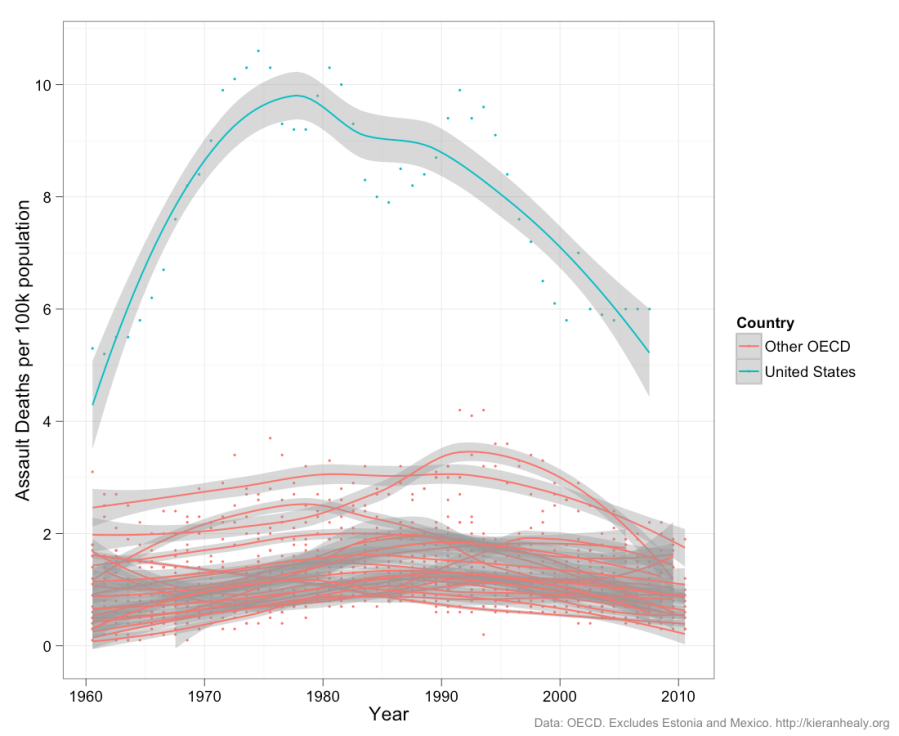
Although this national system prevented convicted criminals and potentially violent people from purchasing handguns, a loophole existed. The 1993 act did not cover private sales from one individual to another. In 1993, 57% of people surveyed by the Pew Research Center said that controlling gun ownership was more important than protecting gun rights; in 2012, the percentage went down to 47%. In 2004, President George W. Bush said, “I did think we ought to extend the assault weapons ban, and was told the fact that the bill was never going to move, because Republicans and Democrats were against the assault weapon ban, people of both parties. I believe law-abiding citizens ought to be able to own a gun. I believe in background checks at gun shows or anywhere to make sure that guns don’t get in the hands of people that shouldn’t have them.” Ten years earlier, his father wrote a letter to the NRA just two weeks after the Oklahoma City bombing, resigning as a life member of the NRA. And while Ronald Reagan was the Governor of California, he stated his view on guns in May of 1967 when Black Panther Party members walked into the California Statehouse carrying rifles to protest a gun-control bill. “There’s no reason why on the street today a citizen should be carrying loaded weapons.” Former Nixon speechwriter, William Safire, wrote in 1999 how Nixon felt about gun control. “His on-the-record reply: ”Guns are an abomination.’ Free from fear of gun owners’ retaliation at the polls, he favored making handguns illegal and requiring licenses for hunting rifles.” Now, with the recent Newtown shootings, the issue of gun control and gun rights has returned to national prominence. Americans purchased a record number of guns in 2012 and gun makers have reported a record high in demand. Firearm sales have surged recently as politicians have urged stricter gun laws and a reinstatement of the assault weapons ban following the shooting in Connecticut. TIME published a list of the worst mass shootings in the last 50 years, excluding Newtown; 15 of the 25 worst mass shootings took place in the United States. Recent research from the Harvard Injury Control Research Center linked guns and homicide and found evidence that shows that more guns means more homicides. Internationally, America is a much more violent country, as Duke University’s Kieran Healy points out in this graph. The most recent NBC News/Wall Street Journal poll indicates that 56% believe that the laws covering the sale of firearms should be stricter, as opposed to 42% who believe laws should be less strict or kept the same. This 56% number is the highest since 2006, but is still less than the 60-70% who supported stricter laws during the 1990s, including when the federal assault weapons ban was enacted in 1994. Additionally, 69% said that being able to purchase assault and military style firearms played “a good or great role in recent mass shootings”; 38% said it played little to no role. Lastly, 59% said that the availability of high capacity ammunition clips played a good or great role and 39% said it played little to no role. The poll presents an even larger divide between Republicans and Democrats. The Republican House seems unlikely to budge on gun control, but perhaps a reminder of the Nixon-Reagan-Bush stances on gun control could prove useful.
Clare Kim Recommended