








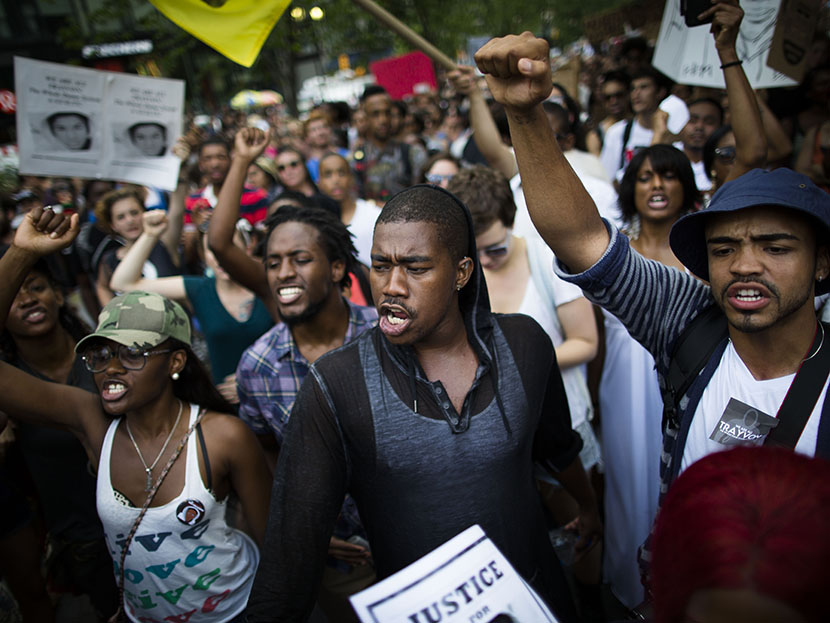
Shortly after the news came down that 29-year-old George Zimmerman had been acquitted of all criminal charges in the death of 17-year-old Trayvon Martin, America’s oldest civil rights organization, the NAACP, called for the Justice Department to file federal civil rights charges against Zimmerman.
With thousands protesting the verdict all across the country, Attorney General Eric Holder may have stoked hopes that Zimmerman could again face criminal charges with his remarks at a luncheon hosted by Delta Sigma Theta, one of America’s oldest traditionally black sororities. Holder called Martin’s death “tragic” and “unnecessary.”
“As parents, as engaged citizens, and as leaders who stand vigilant against violence in communities across the country, the Deltas are deeply, and rightly, concerned about this case,” Holder said to applause. “The Justice Department shares your concern-I share your concern.”
Yet concern and sympathy may be all the attorney general will have to offer. The civil rights division of the Justice Department, which handles hate crimes prosecutions, has been investigating whether or not to file charges against George Zimmerman since spring of 2012. But convicting Zimmerman on federal hate crimes charges would likely be even more difficult than trying to convict him of second-degree murder, because it requires proving beyond a reasonable doubt that when Zimmerman shot and killed Martin during a confrontation in Sanford, Fla., last year, he did so because of race. Zimmerman has maintained that while he initially followed Martin, believing he might have been connected to recent burglaries in the neighborhood, he broke off pursuit and was attacked by Martin while returning to his car. Zimmerman claims he shot Martin in self-defense.
The jury didn’t necessarily need to believe Zimmerman’s story to acquit him. If the jury didn’t believe Zimmerman’s statements to a police dispatcher about Martin, in which he used profanity to refer to the teenager, indicated that he acted out of “ill will, hatred, spite or evil intent” when he shot Martin, then it’s unlikely that federal prosecutors would be able to prove Zimmerman acted out of racism, barring any new, previously undisclosed evidence.
“Based on what I’ve seen, I think it would be difficult to envision proving racial intent beyond a reasonable doubt here,” said Samuel Bagenstos, a former deputy assistant attorney general in the civil rights division who is now a law professor at Michigan Law. “It’s always hard to prove what’s on people’s minds, but particularly when you have an event like this that took place away from anyone who would be able to testify it’s going to be very difficult.”
The civil rights division hasn’t been shy about bringing hate crimes charges under the Obama administration. According to Department of Justice statistics, in the past few years hate crimes prosecutions have increased by 29% over the three years before Obama took office. Several recent convictions have involved group assaults on minorities, such as a black man in West Jackson, Miss., who was run over with a truck in a motel parking lot by a group of men screaming “white power,” or two Arkansas men who screamed racial slurs at a group of Latino men at a gas station before chasing them down and using their car to run the victims’ car off the road, at which point it flipped over and burst into flames (the victims were injured but survived). “The government would have to prove with evidence that race was the motivation,” Alex Whiting, a former civil rights division prosecutor who is now a professor at Harvard Law. “Normally this is proven either through statements made by the attacker-either before, during, or after the attack-or by showing a pattern of such attacks or by other circumstantial evidence showing that race was the motivation.” Indeed, those recent hate crimes cases involved explicit verbal confirmation of racial motivations and suspects who could be witnesses to their accomplices’ motivations, neither of which is present in the Zimmerman case. In fact, the Florida judge who presided over the Zimmerman trial forbade the prosecution from using the word “profiling” to refer exclusively to race. The Department of Justice would also likely have to find something “demonstrably deficient” about the state proceedings, Whiting said. “I would rate it as unlikely that a charge would be brought, but I do know the Justice Department’s civil rights division will look at the facts very carefully before they decide what to do,” said Bagenstos. “They’re not going to bring a case that they don’t think they can prove.”
Adam Serwer Recommended


