








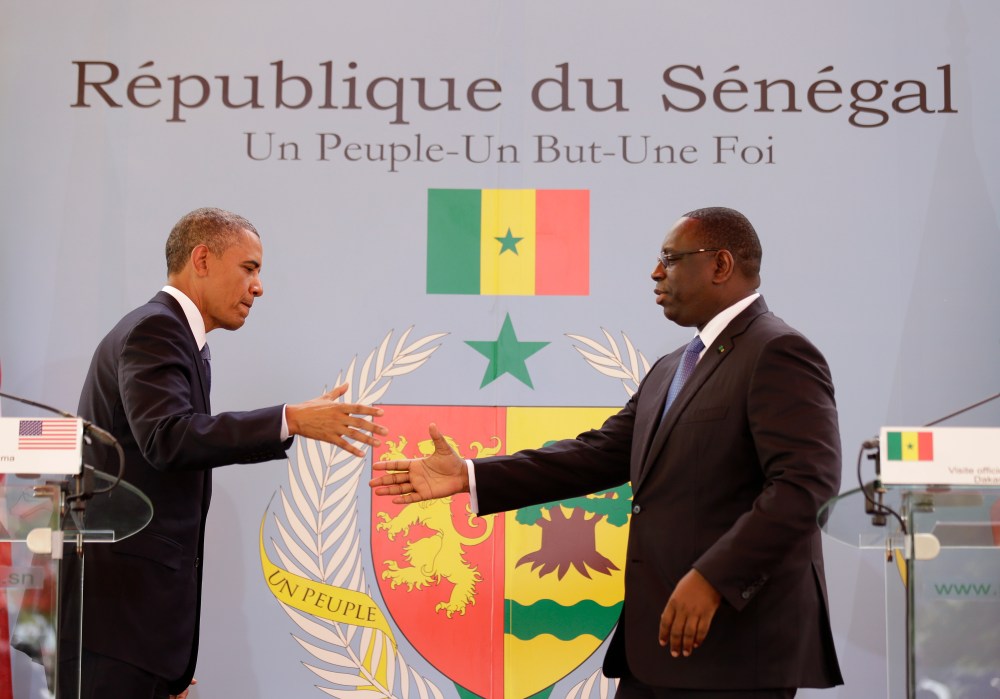
The cost of President Obama’s eight-day trip to Senegal, South Africa and Tanzania has raised the ire of deficit hawks ever since the Washington Post broke news of the trip.
Estimates for the cost of the trip run between $60 to $100 million (President Clinton’s 1998 six-nation Africa tour ran $61 million in 2013 dollars). In lieu of any official cost breakdown, here are some of the most important numbers to know when it comes to US-Africa relations.
3,000: The number of U.S. soldiers expected to serve in Africa this year according to an article by Army Times press service. While this is an increase over past deployment levels, Maj. Gen. David Hogg told the paper that the U.S. has no plan to set-up bases across the continent. “We are here to enable, where wanted, the African forces to figure out and solve their own problems.”
$276,000,000: U.S. Africa Command’s (AFRICOM) headquarters operating budget in FY 2012, a $10 million reduction from 2011. Despite its stated mission of working with African militaries and conducting military operations, AFRICOM is based in Stuttgart, Germany where it employs about 1,500 personnel.
8: The number of U.S. drone bases reported to be operating in Africa by Foreign Policy Magazine. The bases cluster in the northern and eastern reaches of sub-Saharan Africa. Locations ideally placed for dealing with everyone from al-Qaida in Africa to Somali pirates and militants.
$31,653,000,000 and $66,288,000,000: U.S. exports to and imports from sub-Saharan Africa, respectively, in 2012, according to Commerce Department records. The U.S. runs a trade deficit with the rest of the world and Africa is no exception. In 2011, the latest year on record with the Office of the U.S. Trade Representative, African nations spent $4 billion on American machinery and $3.5 billion on cars; but these figures pale in comparison to annual U.S. oil purchases totaling $31 billion from Nigeria and $11.8 billion from Angola.
1,607,000: The number of African-born U.S. residents reported in the latest census. Compared to all other regions of the world Africa exports the highest proportion of males, but African women living in America are the most fertile of all expats living in the U.S. with 97 of every 1,000 women surveyed having given birth in the past 12 months. $56,600,000,000: U.S. Direct investment in Africa at the end of 2011, the latest figures available from the Congressional Research Service. This represents only 1.5% of all U.S. direct investment abroad, but that figure will likely grow. Reuters predicts a 10% rise in total foreign direct investment to Africa in 2013. In their Africa 2013 Attractiveness Survey accounting firm Ernst & Young shows that Africa had the highest number of countries that grew by 7% or more between 2000- 2009. 3.54%: The requested increase in funding by the United States Agency for International Development for 2014 aid to all of Africa. If granted by congress, that would raise total aid granted to more than $3.8 billion. The largest section of the aid goes to health programs. Other line items in the aid budget may be facing significant changes. Migration and refugee support could receive a 15.8% bump in spending, while funding for narcotics control and law enforcement could be slashed by almost 30%. How do you think the U.S. should approach its relationship with Africa in the future? Which of these numbers matter the most to you? Please leave a comment below and keep the cycle spinning.
Max Lockie Recommended


