








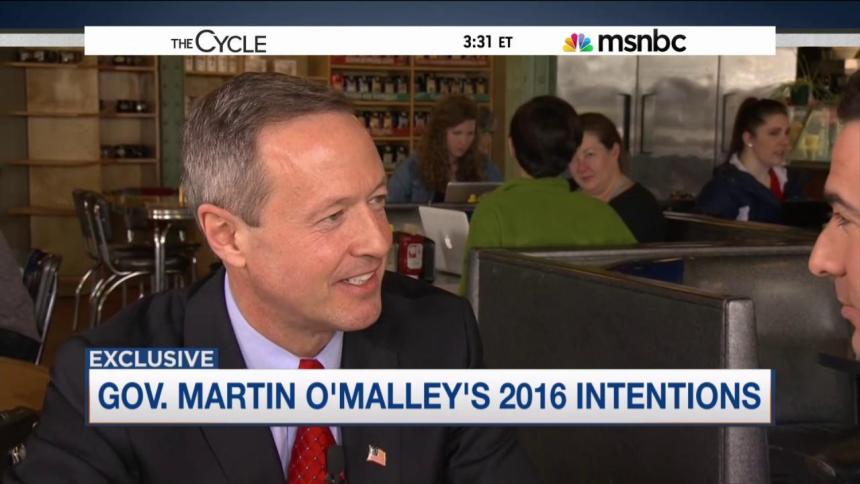
Des Moines, Iowa – Former Maryland Gov. Martin O’Malley says if he runs for president, he will try to pull the Democratic Party back to its populist roots.
“You know what it’s about? It’s really about calling our party back to its true self,” he said in a wide-ranging MSNBC interview airing Friday. “Our politics has been greatly impacted, for the worse, by big money and the concentration of big money.”
O’Malley, in Iowa this week for meetings and a local Democratic Party event, took a break to talk about his potential 2016 challenge to former Secretary of State Hillary Clinton at Smokey Row Coffee, a bustling coffee shop on the West side of Des Moines. Clinton is expected to begin her presidential campaign as early as this weekend.
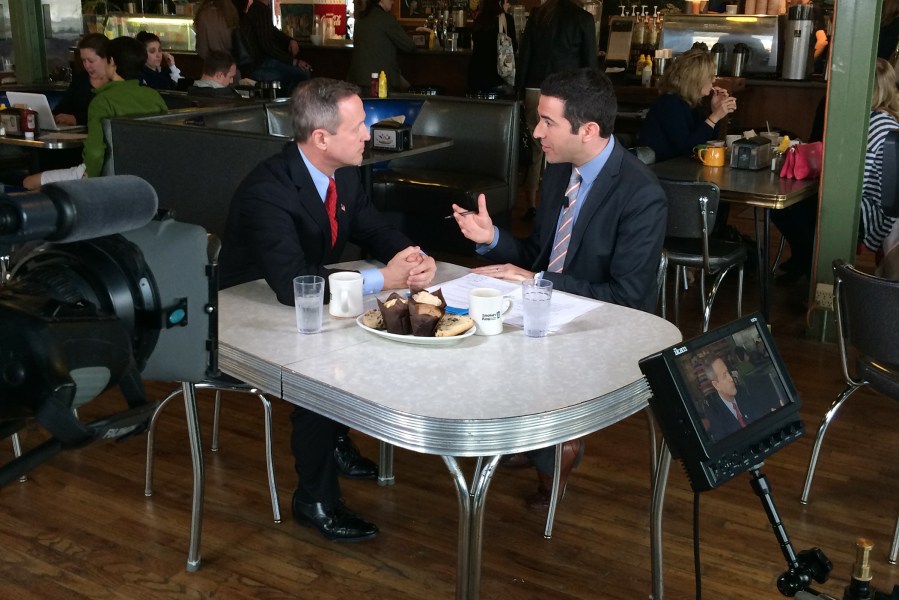
Widely known as number-crunching technocrat, O’Malley sounds pretty blunt when criticizing what he calls Wall Street’s growing dominance of campaigns and government – including some members of the Obama administration.
“For 30 years we’ve followed this trickle-down theory of economics that said, ‘Concentrate wealth at the very top, remove regulation and keep wages low so we can be competitive — whatever the hell that means,” O’Malley says.
“What it led to was the first time since the Second World War where wages have actually declined, rather than going up — where almost all of the new income earned in this recovery has gone to the top 1%,” he says, invoking the famous phrase from the Occupy Wall Street protests.
“It doesn’t have to be this way,” he continues, arguing, “these things are not effects that blew in on a gulf stream or on a polar vortex — these are the products of the policy choices we made over these 30 years.”
O’Malley says the system is rigged “in many ways” – a concern pressed by the “Elizabeth Warren wing” of the Democratic Party – and contends middle class priorities should be “at the center of our economic theory.”
Asked whether President Obama has appointed the wrong people to the Securities and Exchange Commission and Justice Department, O’Malley responds, “Yes, I would say that.” He laments that no bank executives went to jail for “wrongdoing” in the financial crisis.
“I think that the S.E.C. has been pretty feckless,” he says, “when it comes to reigning in reckless behavior on Wall Street.”
O’Malley has clearly honed his campaign lines on this theme.
While his op-eds are peppered with references to the S.E.C.’s civil liability standards and the Depression-era Glass-Steagall bank regulation, he has more relatable examples at the ready in Iowa.
RELATED: The man who thinks he can beat Hillary
“There are more repercussions for a person being a chronic speeding violator in our country,” he argues, “than there is for a big bank being a chronic violator of S.E.C. rules!” O’Malley posts similar lines and videos on his social media accounts. He also tries to channel the anger against Wall Street into an argument for a stronger federal government.
“We can’t expect Wall Street to police itself — that’s why we have a federal government,” he declares.
O’Malley freely admits most Iowans he meets haven’t heard of him, but he believes they are receptive to his economic focus — and they aren’t all ready for Hillary.
Many Iowans want to literally “meet every candidate” before they decide, he says, and they don’t accept “the inevitability or the punditry or whatever the polls happen to say.”
O’Malley should know. He got started in politics working on Gary Hart’s 1984 presidential campaign in Iowa, and he believes history shows there’s really no such thing as inevitable candidates.
“There is an ‘inevitable’ front-runner who remains ‘inevitable’ right up until he or she’s no longer inevitable,” he says. “And the person that emerges as the alternative is the person that usually no one in America had heard of before — until that person got into a van and went county to county to county.”
O’Malley is careful not to criticize Hillary Clinton by name, but her presence clearly looms over his possible candidacy.
Her perceived dominance in the Democratic Party constrains the momentum of any potential challenger. From O’Malley to Vice President Joe Biden, the would-be alternatives are treated by politicos and reporters as little more than the negative space in Clinton’s painting, and yet it’s the very prospect of anointing a nominee that seems to animate O’Malley’s rationale for running.
On the stump and in our interview, he talks about the need for a real race, an “alternative” choice and a “contest of ideas” — paeans to the democratic process that can be read as Clinton code words.
Asked about the dynasties that could compete in the presidential race, O’Malley says the presidency shouldn’t be a “hereditary right.”
He has hit that theme before, telling George Stephanopoulos last month that the White House shouldn’t simply “pass back and forth between two families.” The line speaks to Bush and Clinton fatigue, but isn’t exactly a substantive disqualification for higher office. (Former Sen. Lincoln Chaffee, by contrast, said this week that Clinton should not be president because of her vote for the Iraq War.)
O’Malley looks like a politician out of central casting – piercing green eyes, close cropped hair, crisp suit – he was even part of the basis for the ambitious mayor in “The Wire,” which dramatized the drug trade and extreme poverty O’Malley confronted as the mayor of Baltimore. Yet his conventional appearance belies some pretty liberal politics – voters may find activist tendencies under that Brooks Brothers suit.
“I’ve actually done the things on a state-wide basis,” he argues, that national Democrats “only talk about doing.” And he ticks off a battery of liberal reforms like a proud father.
%E2%80%9CWe%20made%20it%20easier%20for%20people%20to%20vote%20not%20harder.%20We%20passed%20marriage%20equality.%20We%20made%20it%20easier%20for%20new%20American%20immigrants%20to%20get%20driver%E2%80%99s%20licenses%20so%20they%20can%20travel%20to%20and%20from%20work%2C%20and%20take%20care%20of%20their%20families.%22′
“We made it easier for people to vote not harder,” he says. “We passed marriage equality. We made it easier for new American immigrants to get driver’s licenses so they can travel to and from work, and take care of their families. We raised the minimum wage. We passed a living wage. We made bigger investments in improving the education of our children and made our schools No. 1. We made bigger investments in infrastructure, water, wastewater, cyber and the rest — and created a better rate of job creation than our neighbors north or south of us.”
He continues, “So look, these are the things that actually make our economy grow and make our middle class stronger. And it is why the U.S. Chamber of Commerce named our state No. 1 in innovation and entrepreneurship three years in a row. It is why we maintain the highest median income of any state in the nation over these last eight years. So these are the differentiators. People want leaders who have the ability to get things done.”
If that weren’t wonky enough, O’Malley is also eager to explain his numerical approach to governing, the idea that “the things that get measured get done.” He established statistical measuring programs – Citi-State and Comp-Stat – to focus law enforcement and government services. Some dubbed it “Moneyball” for government. Reflecting on that approach, O’Malley says any organization can use metrics, accountability and technology to improve results, including the federal government. He rattles off tools that would make most people’s eyes glaze over – “performance management” and “graphical information technologies” – insisting these dry concepts helped stop drug dealers from murdering children. “We achieved the biggest reductions in crime of any major city in America,” he says. The statistics themselves have been in some dispute in Maryland, but even conservative estimates showed robberies and aggravated assaults down over 30%, while successful homicide investigations rose from 54% to 80%. Unlike many traditional urban crackdowns, however, O’Malley took on violent crime while advancing criminal justice reforms, including repealing the death penalty and harsh marijuana laws. RELATED: O’Malley: Presidency ‘not some crown’ reserved for Clintons, Bushes The federal death penalty is back in the news after a jury convicted Dzhokar Tsarnaev in the Boston Marathon bombing case this week, and O’Malley says he remains opposed to capital punishment even in cases of domestic terrorism. “I’m opposed to the death penalty; I don’t believe that it works,” he says. “In the case of this individual, I probably think killing’s too good for him — he should rot in prison for the harm that he’s done to so many people and children.” O’Malley also argues the U.S. is also in the wrong camp on this issue internationally. “The countries on this globe that are responsible for the greatest numbers of public executions are places like Yemen, North Korea, Iraq, Iran, communist China,” he says. “I don’t believe our country belongs on that list.” That’s an unusual position for an aspiring national Democrat. Ever since Michael Dukakis was pilloried for being “soft on crime” and opposing the death penalty, the party’s presidential nominees have supported it. (Clinton and Obama firmly backed it, while Kerry revised his opposition in 2004 to support capital punishment for terrorists.) O’Malley’s critiques of the criminal justice system also provide common ground with at least one Republican presidential candidate, Sen. Rand Paul. At his presidential campaign launch this week, Paul said the U.S. should repeal “any law that disproportionately incarcerates people of color.” O’Malley says he agrees with Paul’s statement — and as a chief executive he tried to change the “different standards of justice” for crimes occurring “in poor neighborhoods, neighborhoods of color” or “wealthier neighborhoods.” O’Malley has also faced criticism, however, for using the kind of aggressive policing that led to the arrest of one out of every six Baltimore residents in a single year. The NAACP and American Civil Liberties Union filed a suit alleging police harassment on his watch, but he counters that Baltimore faced an emergency, and he still built a multiracial mandate for policing. “In our city, when I was elected mayor, [we] had sadly allowed ourselves to become the most violent and addicted city in America,” O’Malley says. “I was elected on a campaign that promised that we would recover all of our neighborhoods from the 24/7 drug dealer occupation and appallingly high homicide rates. And so that’s what we set out to do. And in re-election — I was re-elected with 88% of the vote. “All along the course of that — we had to keep a precious consensus together to save lives,” he continues. “And there is no issue more difficult to bring people together around over racial divides than the issue of law enforcement. But we managed to do it. We made our police force more diverse. We reduced, during my time in office, police-involved shootings. We also reduced violent crime, and the city is moving in a much better direction.” It’s the kind of thoughtful, evidence-based answer that could appeal to Democratic voters concerned about racial divides and policing in America today – if there is room and time for that debate. O’Malley’s greatest political vulnerability, however, may be the belief that voters will analyze their choices the way he does – methodically, rigorously, even dispassionately. Yet without a larger disruption in the Democratic primary, it’s not clear whether that debate will begin this year.
Ari Melber
Ari Melber, an Emmy Award-winning journalist, writer and attorney, is the host of “The Beat with Ari Melber” airing nightly at 6 p.m. ET on MSNBC. He also serves as MSNBC’s chief legal correspondent and an NBC News legal analyst. Before joining MSNBC, Melber practiced First Amendment law and served as a legislative aide in the U.S. Senate. He received a J.D. from Cornell Law School and is a member of the New York Bar. Recommended


