








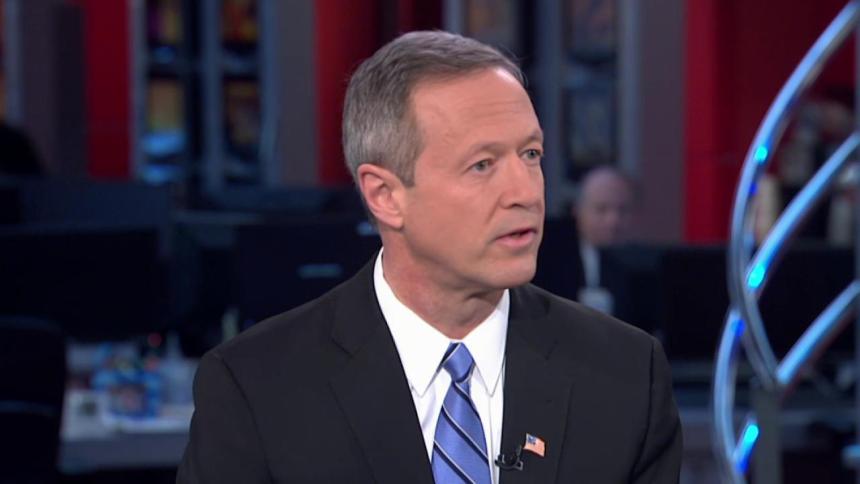
Hillary Clinton will be opposed by a real, actual, credible Democrat for her party’s presidential nomination.
That’s the takeaway from Martin O’Malley’s Sunday appearance on ABC’s “This Week,” during which the former Maryland governor previewed the themes he hopes will distinguish him from Clinton – and fired what amounts to the opening shot of their campaign.
“Let’s be honest here,” he said. “The presidency of the United States is not some crown to be passed between two families.”
The significance of that swipe is simple. For well over a year, O’Malley has been quietly making the rounds to lay the groundwork for a ’16 campaign. But he’s been haunted by the imposing and unprecedented shadow cast by Clinton, whose poll numbers are stronger than any non-incumbent candidate for either party’s nomination has posted in the modern era. With the political world already treating Clinton as the presumed nominee, O’Malley has faced skepticism about his intentions. Won’t he ultimately stand down rather than wage a hopeless campaign? Or if he does go ahead and run, surely he’ll keep the gloves on, the better to position himself for a more attainable prize like, say, the vice presidency. Right?
But it’s now safe to say that’s not what’s going on here. O’Malley is, for all intents and purposes, already running, with a formal announcement probably a few months away. And he’s already made peace with the hard feelings this will engender in Clinton World and is under no illusions that running for the top job will in any way make him more attractive to Clinton as a No. 2. Minutes after O’Malley’s appearance on “This Week,” former Michigan governor Jennifer Granholm, a top adviser to the Ready for Hillary PAC, said on the same program, “Martin O’Malley, he’s a very nice guy, and I was thinking he might make a nice member of a President Clinton administration, so he better watch it.”
Related: With an eye on 2016, Martin O’Malley takes a jab at Clinton
Sunday’s national television appearance came as O’Malley has begun ratcheting up his public schedule. After traveling extensively to aid Democratic candidates in last year’s elections, he faded from view during the winter months, claiming that people wanted a break from politics – but also fueling speculation that he might not be so serious about a White House bid. And for the past few years, he’s been highly selective in accepting television interview requests in an effort to preserve his freshness. More recently, though, O’Malley has been back in Iowa and New Hampshire.
As a former two-term governor of a major state – and someone who cultivated extensive national fundraising contacts while chairing the Democratic Governors Association in 2012 – he brings serious credentials to the race. Besides O’Malley, Vermont Senator Bernie Sanders is also flirting with a campaign for the Democratic nomination, although he remains a registered independent. And former Virginia Senator Jim Webb has also made some noise about running, but he’s mainly been invisible, both publicly and privately. And while Sen. Elizabeth Warren and Vice President Joe Biden are often suggested as possible Clinton challengers, neither has made a serious move toward running or shown any inclination to do so. Simply put, O’Malley brings to the table stature, infrastructure and fund-raising capabilities that the other would-be Clinton foes don’t have.
What he lacks, however, is just about any discernible polling support. It’s bad enough for him that Clinton routinely polls over 60% in Democratic trial heats, an unheard of level in a supposedly open nomination race. What’s worse, though, is that O’Malley barely registers at all – he averages 1.2%. So how on Earth does he expect to compete with Clinton?
The answer is a platform that leans on the same economic populism that Warren champions, a strategy that will seek to turn the race against Clinton into a future/past battle, and a hunch that Clinton’s numbers are a lot softer than they seem – especially in the lead-off state of Iowa.
In a Warren-esque move, O’Malley is already calling for the reinstatement of Glass-Steagall, the Depression-era law that separated commercial and investment banking – and that, in a major deregulatory victory for Wall Street, President Bill Clinton repealed in 1999. Many anti-Wall Street activists point to that repeal as a contributing factor to the economic meltdown of 2008. In his speeches, he highlights the growing concentration of wealth among the super-rich and points to the progressive agenda he muscled through the Maryland legislature – gay marriage, an end to the death penalty, a minimum wage hike, and a state version of the Dream Act.
Related: O’Malley weighs in on Clinton email controversy O’Malley’s bet is that the market for a Clinton alternative is far bigger than assumed – that she’s riding high on two decades of goodwill from Democrats, but that when those Democrats focus on the choice in front of them they won’t be excited by much she has to say. At 52 years old, he’ll try to position himself as the forward-looking candidate, playing up the notion – as he did on “This Week” – that Clinton feels the nomination is owed to her. There are all sorts of reasons to believe O’Malley has no chance of pulling this off, or of even making Clinton sweat much. He’s worked the Democratic grassroots intensely these past few years, but there remains little clamoring from that base for his candidacy, as opposed to the loud efforts to draft Warren into the race. He also delivered a poorly received speech at the 2012 Democratic convention, squandering an opportunity to impress activists and key party figures, and looked on helplessly last November as voters in blue state Maryland opted to elect a Republican to succeed him as governor. Still, he sees a path, and it starts with Iowa, where Clinton finished in third place in the 2008 caucuses. The state’s activist-oriented caucus electorate is receptive to his populist message and eager to put Clinton through her paces, O’Malley believes, and if he can make a game of it in Iowa, Democrats across the country (not to mention the press) will start to look at his candidacy differently. The example of his old boss probably has something to do with this. In 1984, a young O’Malley worked for Gary Hart, who waged what was initially seen as a no-shot campaign against the overwhelming Democratic favorite, former Vice President Walter Mondale. Hart, who also stressed generational themes, came out of nowhere to finish second in Iowa, parlayed that momentum into a shocking victory in New Hampshire, and very nearly stole the nomination from Mondale. It’s a story, you can imagine, that O’Malley will probably be reminding himself about a lot in the months ahead.
Steve Kornacki
Steve Kornacki, author of "The Red and the Blue: 1990s and the Birth of Political Tribalism," is a national political correspondent for NBC News and MSNBC. Recommended


