








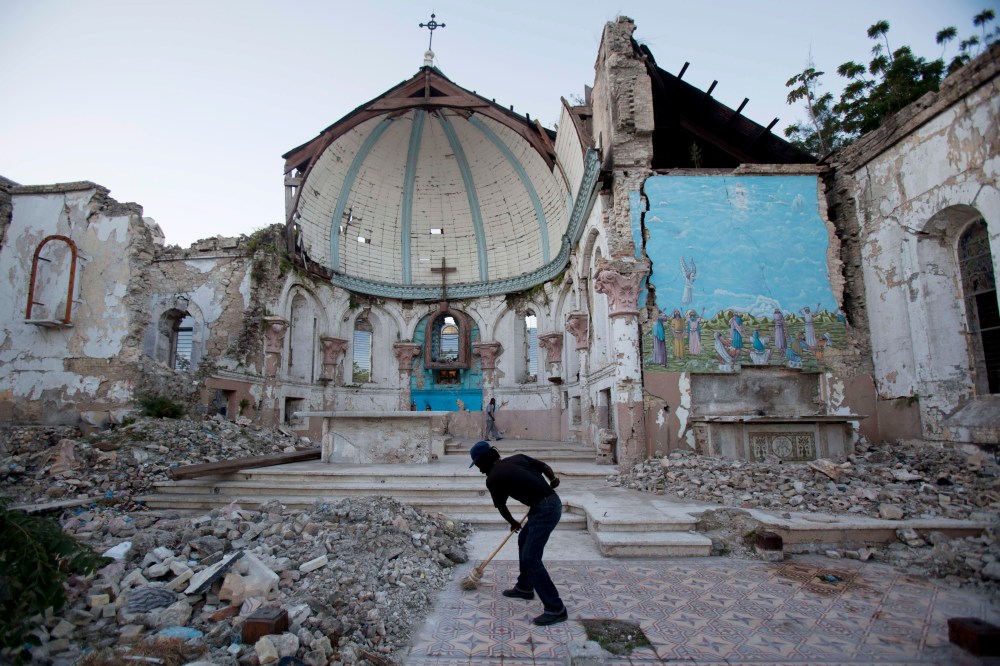
Carlos Rodriguez is a world traveler. On Sundays I would drink beer and play guitar with him, a Colombian national, poolside at his home in the Democratic Republic of the Congo. One evening while sharing the table with a mix of local elite and well-traveled expats, he told a story about the time he spent working in Haiti. Carlos works for one of those invisible corporations that silently sustain life on the planet. A past tour of duty landed him in Port-au-Prince overseeing the operations at a major flour processing plant, an indispensable industrial staple. On January 12, 2010, Carlos was working. It was a Tuesday, and he left the plant in his pick-up truck to meet and run an errand. On his way to run the errand an earthquake struck the island, the likes of which hadn’t been seen in at least 200 years.
Shaken but unharmed, Carlos returned to his place of business to find it in ruins. Co-workers were injured and some were already dead, crushed under rubble and fallen heavy machinery. The most horrifying part of the ordeal–the part that makes Carlos shift the tone of his voice–is when he tells me about colleagues, friends, who were still alive, but concealed, trapped under mounds of debris. These poor souls were not only alive and conscious, but calling out for help, begging to be rescued. Perhaps had their business been on the other side of the island, in the Dominican Republic, or back in Carlos’ home of Columbia, there would have been hope; but in Haiti, the poorest country in the Western hemisphere, there was simply no chance these men were getting out alive.
The 3-year anniversary of this catastrophe offers the world an opportunity to assess the recovery and reconstruction efforts, to see if the world rose to the occasion or not. A December 2012 examination by The New York Times presented some troubling findings. Of the $7.5 billion in aid disbursed up to that point,
“More than half of the money had gone to relief aid. Of the rest, only a portion went to earthquake reconstruction strictly defined. Instead, much of the so-called recovery aid was devoted to costly current programs, like highway building and H.I.V. prevention, and to new projects far outside the disaster zone, like an industrial park in the north and a teaching hospital in the central plateau.
Meanwhile, just a sliver of the total disbursement—$215 million—had been allocated to the most obvious and pressing need: safe, permanent housing.”
Misallocation of funds in charity and non-profit organizations is a serious and persistent concern: potential donors should ask tough budgetary questions of these businesses and use websites like Charity Navigator to assess the percentage of a given donation that will reach its advertised purpose. Of course no one is more keenly aware of the Haitian financial situation than the concerned officials themselves. The director-general of the government of Haiti’s Ministry of Finance, Pierre Erold Etienne, was quoted in a report to the UN Special Envoy as saying:
“The real problem is that we do not have, or I should say we have only very little, overall information on aid…We have very little information in this sector, very little. If we really want to help this country, we have to be able to manage this financial information, to centralize it somewhere for the benefit of everyone, both for the benefit of the state and also of donors themselves, so that everyone can know what interventions are being made in each sector… and this will also facilitate the coordination of donors’ own interventions. … [So] if we had information on disbursements to NGOs, disbursements to public institutions and to what sector and region, this would facilitate the programming of our local resources–or the treasury’s resources. What good is it to open a clinic in an area where there are already three run by NGOs? There is duplication simply because we do not have advance information.” In addition for mutual financial transparency between donors, NGOs, the UN, and national governments, there should also be attention paid to the amount of money dedicated to the recovery effort. Official UN figures tally $13.34 billion in pledged aid to the still shattered country. Compare that to the $60 billion that the U.S. government will likely lay out for Hurricane Sandy recovery. For Haiti to recover from this real life horror story it will take more than modern bookkeeping. A new round of conversations needs to take place on what it will take to get Haitians out of Cholera-infested tent cities and into adequate permanent housing. Haiti has been one against the world since it shook off the French imperial yoke by way of a slave rebellion over 200 years ago; it’s well past time for the Creole country to be given an opportunity to be healthy and free.
Max Lockie Recommended


