








It’s a familiar dilemma to many Americans: you’re too sick to leave the house but too afraid to take time off from work. Now, supporters of paid sick leave are giving it another go.
Senator Tom Harkin (D-IA) and Rep. Rosa DeLauro (D-CT) re-introduced the Healthy Families Act on Wednesday, legislation that would set a national minimum sick-day standard.
The bill would allow employees to earn up to 7 days or 56 hours per year to take care of their own health or the health of a family member. People would get one hour of paid sick time for every 30 hours worked.
“When illness or emergencies strike, millions of hardworking people must make an impossible choice between the job they need and their or their families’ health and well-being,” Harkin, chair of the Senate Health, Education, Labor, and Pensions (HELP) Committee, said in a statement.
Under this bill, businesses that already give their employees paid sick time could keep the same policies intact, as long as they meet the guidelines. It also allows room for businesses to ask their workers for documentation to prove a need to take more than three days off in a row.
The Healthy Families Act has been introduced several times before to no avail. Although research suggests that majorities in both parties support requirements for paid sick days, the legislation never garnered enough support in Congress to advance.
“It isn’t really businesses, it’s lobbyists for multi-billion dollar corporations who are most against this,” Ellen Bravo, Executive Director of “Family Values at Work,” told The Cycle hosts Thursday, underscoring that she sees it as not just an issue of economics, but of public health. “We’re talking about workers at Wal-Mart and Olive Garden. It’s a little hard to argue that the people who prepare your Kentucky Fried Chicken or your tacos at Taco Bell shouldn’t be allowed to stay home if they’re sick and not pass on the flu with your food.”
Only 19% of low-wage workers have access to paid sick days, and adults without sick leave are 1.5 times more likely to go to work sick, according to the National Partnership for Women & Families. A report by the Public Welfare Foundation found that 23% of American adults either lost a job or said they were threatened with losing their job if they took time off for being sick or to help a sick relative.
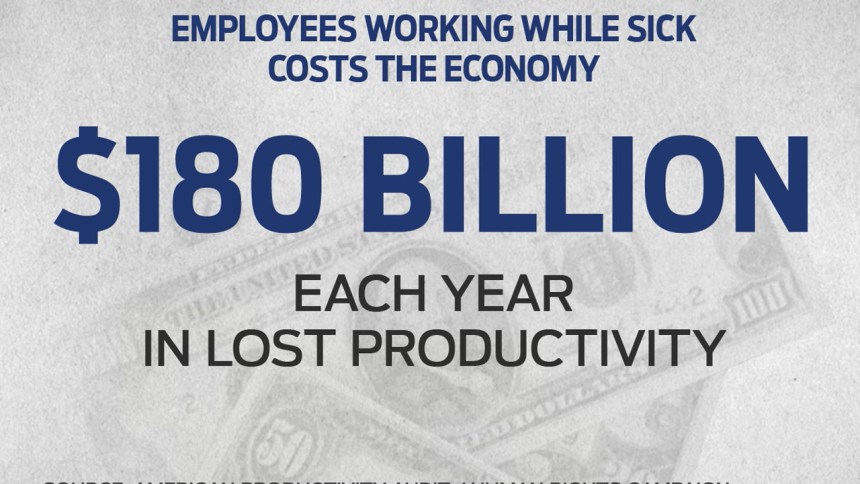
Some critics of the bill say the requirements could hinder free enterprise. The Heritage Foundation claims that employers would end up actually lowering wages to offset replacement costs, and that the bill encourages ” irresponsible employees to game the system.” A few progressive organizations challenge that assumption. According to the American Productivity Audit/Human Rights Campaign, some estimates show that coming to work sick can cost the economy $180 billion each year in lost productivity. A few Democrats like New York City Council Speaker and mayoral candidate Christine Quinn oppose mandating that employers pay for sick time now, saying today’s economic climate is not the right time to press a law that has the potential to cost small businesses. Bravo refutes that assumption, telling The Cycle hosts that bills like this will actually help the economy because people will have more money to spend if they are paid for their sick days instead of not taking in any income during that time. “We can’t have recovery and growth unless people have money in their pockets to cover the basics, keeping the lights on, keeping food on the table,” she said. “Business owners who are partners in all of our state coalitions tell us what they most need is for people to come and spend money in their shop.” She later added, “I want to urge your viewers in Philly or New York to call Mayor Nutter and Chris Quinn and tell them your cities need paid sick days.” Cycle host Touré quickly noted one problem, referring to Quinn: “She’s not our mayor yet.”
Kailani Koenig Recommended


