








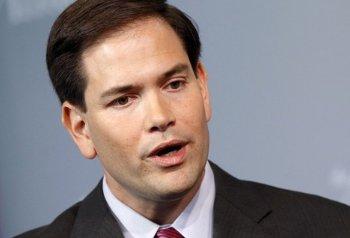
Mitt Romney quietly told supporters the other day that he’d like to see a “Republican DREAM Act” to help his party with Latino voters. Sen. Marco Rubio (R-Fla.), who’s talking more and more about immigration policy, believes he has just such a proposal.
Hoping to boost his party’s image with Hispanic voters, Sen. Marco Rubio (R-Fla.) launched a one-man push Thursday to promote a modified version of legislation to benefit undocumented children whose parents brought them to this nation.
Repeatedly denying any interest in being the vice presidential nominee, Rubio used a pair of appearances Thursday to push legislation based around the “DREAM Act,” a bill that Democrats have promoted to offer a path to citizenship for underage illegal immigrants who go on to college or into the military.
Rubio’s working draft of similar legislation would grant legal immigration status to such children who were brought to the United States illegally by their parents. It would require that they graduated from college or served honorably in the military.
So, what’s the problem? It depends on your perspective. For the left, this is a DREAM Act without the dream — Rubio’s version offers no pathway to citizenship. The conservative senator has admitted as much, saying, “You can legalize someone’s status without placing them on a path toward citizenship.” Rubio has said he doesn’t want to help these immigrants become citizens for fear that they might — que horror — sponsor family members for legal immigration later.
For the right, there’s a very different kind of concern. It’s generally called the “Kobach test,” named after Mitt Romney’s right-wing immigration adviser, Kris Kobach, who’s helped shape anti-immigrant laws.
For Kobach, proposals are necessarily “unacceptable” if undocumented immigrants receive any kind of legal status, even if it falls short of citizenship.
Does Rubio’s watered down, GOP-friendly version of the DREAM Act pass the “test”? Rubio says it does, but his friends on the right disagree.
Greg Sargent talked yesterday to Crytsal Williams, the executive director of the American Immigration Lawyers Association, who
Rubio said today that his plan gives non-immigrant visas to children who have grown up with illegal status in the United States. There are various forms of non-immigrant visas; some are for workers; others for students; still others for tourists. They all confer temporary legal status provided the recipient follows certain guidelines. By all indications, Williams tells me, Rubio’s plan would confer indefinite legal status on formerly illegal immigrants. A non-immigrant visa confers legal status, and Rubio is suggesting their new status would be open-ended. “I don’t see how Mr. Rubio’s proposal can possibly pass the Kobach test,” Williams says. “His proposal allows the DREAMers to remain in the U.S. legally.” The DREAMERS are the one million to two million people who were “brought here by their parents and have the ability to contribute to the country and are out of status right now.” Part of this is important because it will doom the “Republican DREAM Act” before Rubio is even able to formally introduce it. The right-wing base isn’t fond of compromise, especially where illegal immigration is concerned, and they will find it easy to dismiss Rubio’s bill as not nearly good enough. And part of this is also worth considering as we realize how little wiggle room Republicans have left themselves on immigration policy in general. Update: Kobach told Greg Sargent this morning that Rubio’s version simply won’t do. Kobach, a leading Romney advisor on immigration policy, still expects those who would benefit from a DREAM Act to leave the country first.
The place for in-depth analysis, commentary and informed perspectives. Recommended


