








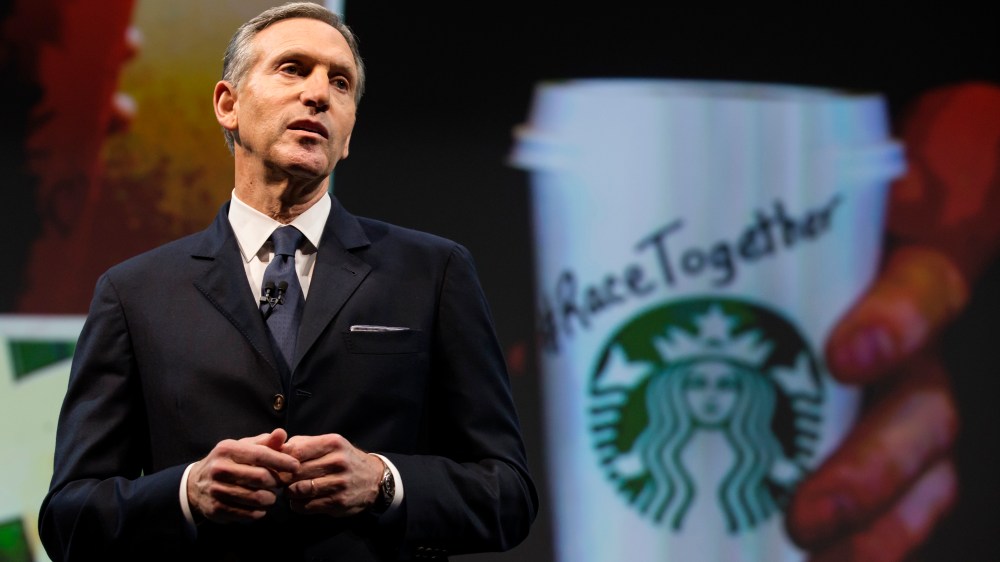
Former Starbucks CEO Howard Schultz published a blog post to Medium overnight, making his usual pitch in support of his possible independent presidential campaign. Despite recent evidence that the public is unimpressed by what they’ve seen from him, Schultz continues to believe that people are clamoring for what he brings to the table.
To be very clear, I firmly believe there is an unprecedented appetite for a centrist independent presidential candidate, and that there is a credible path for an independent to win more than the necessary 270 electoral votes — a key criteria in my consideration of whether to run.
I’m hard pressed to imagine how or why anyone would seriously believe this, though I have seen some political observers endorse the underlying idea: a growing number of Americans identify as “independents,” which necessarily suggests there’s a sizable part of the electorate looking for someone like Schultz.
Indeed, by some measures, there are quite a few more independent voters than partisans affiliated with the Democratic or Republican parties. Why shouldn’t an independent presidential candidate excel? If a growing number of voters don’t want to align themselves with either of the major parties, why would we assume that an independent candidate would fail?
The answer is, because those polls only tell a small part of a larger story.
As we discussed a few years ago, part of the problem is that the “independent” label, in practical terms, has little real meaning. It’s widely assumed that self-identified independents see themselves as moderate/centrist voters. As the argument goes, the left sides with Democrats, the right sides with Republicans, which leaves independents in the middle.
It’s a tidy little summary, but it’s not true. The Monkey Cage’s John Sides published a piece several years ago that doesn’t appear to be online anymore, but it continues to ring true.
[H]ere is the problem: Most independents are closet partisans. This has been well-known in political science since at least 1992, with the publication of The Myth of the Independent Voter.
When asked a follow-up question, the vast majority of independents state that they lean toward a political party. They are the “independent leaners.” … The number of pure independents is actually quite small – perhaps 10% or so of the population. And this number has been decreasing, not increasing, since the mid-1970s. […]
Recommended


The significance of independent leaners is this: they act like partisans…. There is very little difference between independent leaners and weak partisans. Approximately 75% of independent leaners are loyal partisans.
Gallup’s findings, often seen as proof of strong independent support, show that most of the Americans who describe themselves as independent actually lean towards one party or the other.
So why do so many Americans bother with the label? Perhaps the most important thing to understand about independents is that there are so many different kinds of independents. Some are on the far-left or the far-right, and see the major parties as too moderate. Some are closet partisans who get a personal sense of satisfaction from the independent label, using it as a synonym for being “open-minded” or a “free-thinker.”
New York magazine’s Ed Kilgore flagged an analysis from a few years ago that found just 5% of the overall electorate meets “the standard, commonly-used definition of an Independent: voters who do not identify with a party and at the same time place themselves ideologically between Democrats and Republicans.”
How would a candidate win by appealing to just 5% of the electorate? Therein lies the point: he or she wouldn’t.
Steve Benen is a producer for "The Rachel Maddow Show," the editor of MaddowBlog and an MS NOW political contributor. He's also the bestselling author of "Ministry of Truth: Democracy, Reality, and the Republicans' War on the Recent Past."
