








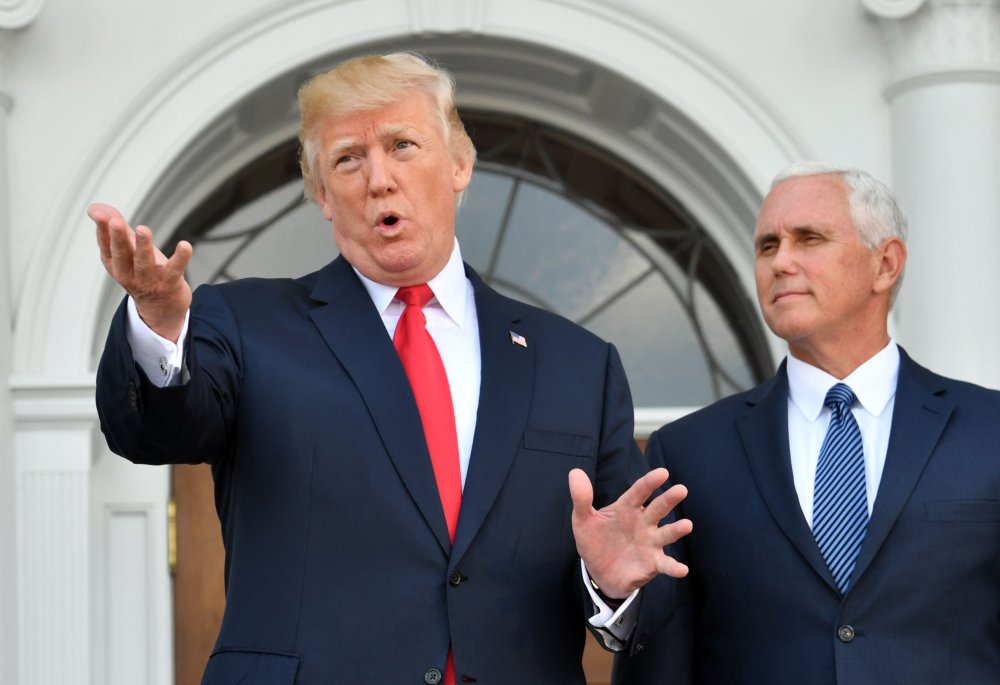
The New York Times ran an interesting piece today on Vice President Mike Pence and the specific role he often plays in Donald Trump’s White House: that of presidential “decoder.”
More than halfway into Mr. Trump’s term, he and Mr. Pence have developed what aides describe as a rhythm, in which the president lays out the broad contours of policy and then hands off to the vice president to make the granular sales pitch. […]
In a White House with a revolving door of top officials and a president who is often focused on his own message, it is often left to Mr. Pence — who has ties to the traditional conservative movement — to try to clarify the administration’s approach on key issues.
At face value, this probably makes a fair amount of sense. Every administration works a little differently, but in this White House, it stands to reason that Trump, who neither knows nor cares about governing, would play the role of “big picture” president. In this model, he wants to lay out a vision in broad strokes, while asking Pence to fill in the gaps.
Despite his limitations, the vice president is a former member of the congressional leadership and a former governor of a fairly large state. It’d be an exaggeration to say Pence excels in governing, but compared to Trump, he’s practically a wonk.
My concern is not with the model, but rather, the application of the model — because even if the president delegates some power to Pence to “make the granular sales pitch” and/or “clarify the administration’s approach,” we’ve all learned that the vice president often has no idea when or whether Trump will step on his efforts.
During the lengthy government shutdown, for example, Pence tried to broker a deal with congressional Democratic leaders. It was Trump who rejected the terms his own vice president had offered. Soon after, Pence spoke with Juan Orlando Hernandez, the president of Honduras, and the vice president praised Hernandez’s cooperative efforts to limit migrant caravans. Soon after, as regular readers may recall, Trump publicly rejected Pence’s line and said the opposite. When Trump was weighing whether to use an emergency declaration to divert federal funds to a border project, in defiance of Congress’ wishes, Pence worked with some GOP senators on possible revisions to the National Emergencies Act — the law Trump had decided to abuse. After Pence signaled to Capitol Hill that the White House was open to legislative changes, the president quickly closed the door. I don’t blame Trump for dispatching Pence to make the case for the administration, but since the vice president has little role in shaping policies, and Trump routinely contradicts Pence, why would anyone listen to him?
Steve Benen is a producer for "The Rachel Maddow Show," the editor of MaddowBlog and an MS NOW political contributor. He's also the bestselling author of "Ministry of Truth: Democracy, Reality, and the Republicans' War on the Recent Past." Recommended


