








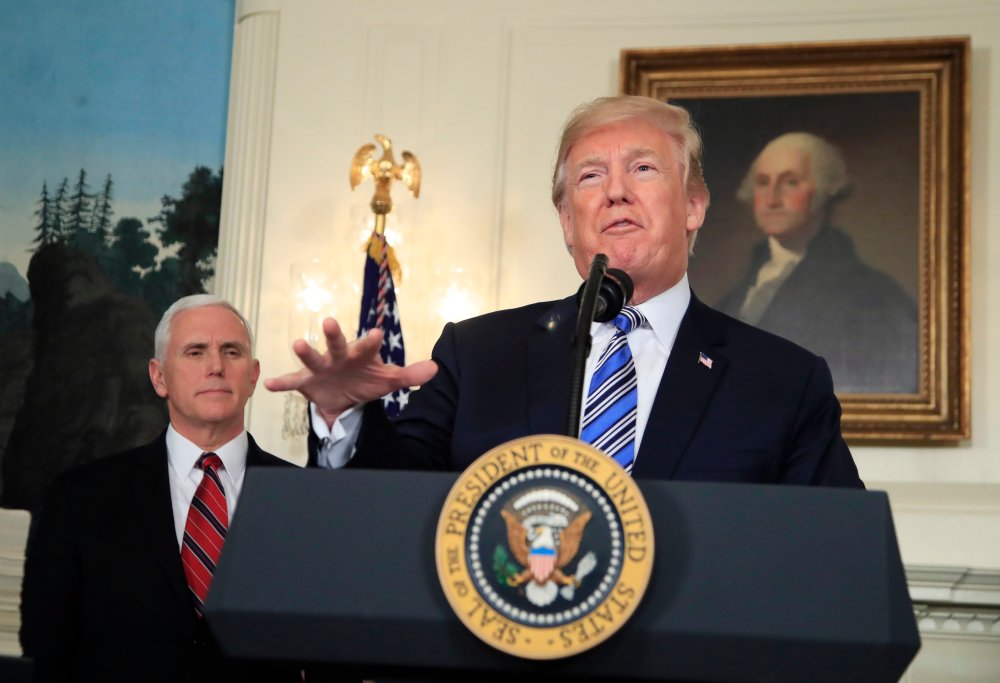
Ahead of today’s Senate vote on a resolution rejecting Donald Trump’s emergency declaration, Vice President Mike Pence took on an unpleasant task: lobbying Senate Republicans to put aside their principles, ignore the separation of powers, and follow the president’s lead in the name of partisan loyalty.
Oddly enough, those lobbying efforts appeared to be having some effect. As we discussed the other day, Sen. Mike Lee (R-Utah) has been working on revising the National Emergencies Act — the law Trump abused to redirect funds to the border — in order to restrict the scope of presidential powers going forward. If the vice president could get the White House’s support for Lee’s proposal, Pence was told, it might help persuade GOP senators to reject the bill on the emergency declaration.
As TPM reported yesterday:
[On Tuesday] Vice President Mike Pence indicated to Republican senators in a closed-door meeting that Trump was open to Lee’s legislation as a way to avoid an embarrassing public rebuke that would expose rifts within the GOP.
And right on cue, as the New York Times reported, Trump decided he wasn’t open to Lee’s measure after all.
A last-ditch gambit to spare Senate Republicans a hostile showdown with President Trump over the Constitution’s separation of powers was torpedoed on Wednesday by the president himself, increasing the likelihood that the Senate will vote on Thursday to overturn the president’s emergency declaration and force the first veto of his term.
Soon after, the Utah Republican announced that he, too, intends to support the resolution intended to block Trump’s emergency declaration.
There’s still some last-minute wrangling this morning, and I’ll have a separate item later today on the fate of the measure in the Senate, but for now I have a related question: if Pence can’t speak for the White House, why do people keep trying to negotiate with him?
A couple of months ago, for example, the vice president had a conversation with Juan Orlando Hernandez, the president of Honduras, and the Republican praised Hernandez’s cooperative efforts to limit migrant caravans. Soon after, Trump publicly rejected Pence’s line and said the opposite. It came on the heels of Pence’s efforts to broker a deal with Democratic lawmakers to avoid a government shutdown, only to have Trump reject the terms his own vice president had offered. To reiterate a point from our previous coverage, I’m not talking about private deliberations, in which there’s back and forth between a president and top members his team. This is about public disagreements, in which the vice president, under the impression that he’s articulating the administration’s position, says one thing, only to have the president say something altogether different soon after. The next time Pence tells an official, “Let’s work something out,” why would anyone believe he has any meaningful authority to represent the administration?
Steve Benen is a producer for "The Rachel Maddow Show," the editor of MaddowBlog and an MS NOW political contributor. He's also the bestselling author of "Ministry of Truth: Democracy, Reality, and the Republicans' War on the Recent Past." Recommended


