








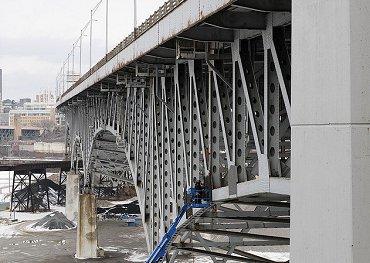
In his State of the Union address this week, President Obama spoke enthusiastically about addressing “an aging infrastructure badly in need of repair.” As he put it, “Ask any CEO where they’d rather locate and hire — a country with deteriorating roads and bridges, or one with high-speed rail and Internet, high-tech schools, self-healing power grids.”
Presumably, the president thought the answer was obvious, and proposed a “Fix-It-First” program, talked up for years by transportation policy wonks. As Matt Yglesias explained, “[P]oliticians and real-estate developers like to open brand new roads with fun ribbon-cutting ceremonies and new subdivisions. Finding money to actually maintain roads we already have is less appealing. Consequently, we get too many miles of road (and too much sprawl), but the roads suck. The fix-it-first concept is to flip this and make sure we’re maximizing the value of our existing roads before we build new ones.”
Plenty of Republicans, including a guy named Mitt Romney, used to think this was a smart approach to infrastructure spending, but then again, Republicans used to like cap-and-trade, the Dream Act, and an individual health care mandate, too.
But even putting that aside, the next question is whether Obama’s infrastructure plans have any chance at all on Capitol Hill. On the surface, there’s little reason for optimism — as I’ve written more times that you’ve cared to read, we’ve basically been able to borrow money for free to make real investments in this area, creating jobs and boosting growth, but the GOP has refused.
Neil Irwin isn’t convinced all hope is lost. With the private sector supporting new infrastructure spending, and even small government conservatives wanting “quality roads in their districts,” Irwin thinks there’s a chance.
First, Republicans have seen electoral damage by their image as an obstruction-at-all-cost party, losing the White House and seats in both houses of Congress in the 2012 elections. Cantor himself delivered a speech last week aimed at presenting a more pragmatic face to the party. Second, the president has been re-elected, so there is no longer the odd dynamic where bipartisan dealmaking could make Obama look more statesmanlike and help his re-election chances. […]
In that sense, this is a great test of whether divided democracy can work, and whether Republicans can come to the table to govern. One can easily imagine a deal: Democrats get their new infrastructure spending, and Republicans insist on a structure that requires private sector lenders to be co-investors in any projects, deploying money based on its potential return rather than where the political winds are tilting.
I wish I was as optimistic.
The problem isn’t with Irwin’s thesis. On the contrary, he’s entirely correct — this is a perfect time to prioritize infrastructure investments. It would improve commerce; it would help the economy; it would benefit red and blue states alike; and since these investments are going to have to be made eventually anyway, we might as well do it while investors are effectively throwing free money at us. But the argument that progress is possible is predicated on the notion that congressional Republicans are far gone, but they’re not that far gone. They’ve moved sharply to the right, but they’re still able to recognize the basics of public and economic necessities. I’m not convinced that’s true. In fact, I’m largely convinced of the opposite — if an idea isn’t a tax cut, a spending cut, or an effort to curtail women’s reproductive rights, Republicans just aren’t interested. There’s nothing in “Atlas Shrugged” about repairing bridges, improving runways and rail, or expanding high-speed Internet access, ergo, it’s not something conservative lawmakers are interested in. Indeed, I assume it’s only a matter of time before someone in the GOP leadership insists taxpayer-financed roadways create an unhealthy dependency on the public sector, and in the name of American “freedom,” Republicans will no longer tolerate the White House’s socialistic ambitions.
The place for in-depth analysis, commentary and informed perspectives. Recommended


